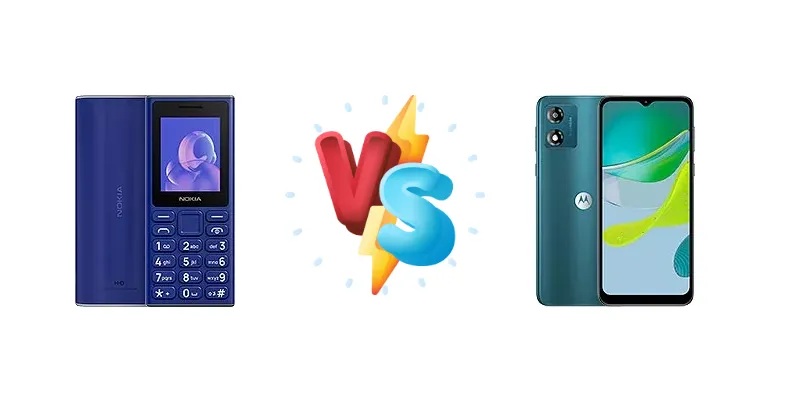
The mobile landscape is bifurcated. While flagships chase bleeding-edge specs, a significant market remains for devices prioritizing core functionality and affordability. This comparison pits the Nokia 105 (2024), a modern iteration of a classic feature phone, against the Motorola Moto E13, an entry-level smartphone offering app access and expanded capabilities. We’ll dissect the key differences to help you determine which device best suits your needs.
🏆 Quick Verdict
For users prioritizing call quality, exceptional battery life, and ultimate simplicity, the Nokia 105 (2024) is the clear winner. However, the Motorola Moto E13 provides smartphone functionality – app access, internet browsing, and a basic camera – at a very low price point, making it ideal for first-time smartphone users or those with minimal digital needs.
| Network |
|---|
| 2G bands | GSM 900 / 1800 | GSM 850 / 900 / 1800 / 1900 |
| 3G bands | - | HSDPA 850 / 900 / 2100 |
| 4G bands | - | 1, 3, 5, 7, 8, 28, 38, 40, 41 |
| EDGE | Yes | - |
| GPRS | Yes | - |
| Speed | - | HSPA, LTE |
| Technology | GSM | GSM / HSPA / LTE |
| | - | 1, 3, 5, 7, 8, 20, 28, 38, 40, 41 |
| Launch |
|---|
| Announced | 2024, July 03 | 2023, January 24 |
| Status | Available. Released 2024, July | Available. Released 2023, February 13 |
| Body |
|---|
| Build | - | Glass front, plastic frame, plastic back |
| Dimensions | 115.5 x 49.5 x 14 mm (4.55 x 1.95 x 0.55 in) | 164.2 x 75 x 8.5 mm (6.46 x 2.95 x 0.33 in) |
| SIM | Dual SIM (Mini-SIM, dual stand-by) | Nano-SIM + Nano-SIM |
| Weight | 77.5 g (2.75 oz) | 179.5 g (6.35 oz) |
| | - | Water-resistant design |
| Display |
|---|
| Resolution | 120 x 160 pixels, 4:3 ratio (~100 ppi density) | 720 x 1600 pixels, 20:9 ratio (~270 ppi density) |
| Size | 2.0 inches, 12.4 cm2 (~21.7% screen-to-body ratio) | 6.5 inches, 102.0 cm2 (~82.8% screen-to-body ratio) |
| Type | TFT LCD, 65K colors | IPS LCD |
| Platform |
|---|
| CPU | - | Octa-core (2x1.6 GHz Cortex-A75 & 6x1.6 GHz Cortex-A55) |
| Chipset | - | Unisoc T606 (12 nm) |
| GPU | - | Mali-G57 MP1 |
| OS | RTOS OS | Android 13 (Go edition) |
| Memory |
|---|
| Card slot | microSDHC | microSDXC (dedicated slot) |
| Internal | 4 MB 4 MB RAM | 32GB 2GB RAM, 64GB 2GB RAM, 64GB 4GB RAM, 128GB 8GB RAM |
| | - | eMMC 5.1 |
| Main Camera |
|---|
| Features | - | LED flash, HDR, panorama |
| Single | - | 13 MP, f/2.2, (wide), 1.12µm, PDAF |
| Video | - | 1080p@30fps |
| Selfie camera |
|---|
| Single | - | 5 MP, f/2.4, (wide), 1/5.0", 1.12µm |
| Video | - | 1080p@30fps |
| Sound |
|---|
| 3.5mm jack | - | Yes |
| 35mm jack | Yes | Yes |
| Loudspeaker | Yes | Yes |
| Comms |
|---|
| Bluetooth | No | 5.0, A2DP, LE |
| NFC | No | No |
| Positioning | No | GPS, GLONASS, GALILEO |
| Radio | Wireless FM radio | FM radio, recording |
| USB | microUSB | USB Type-C 2.0, OTG |
| WLAN | No | Wi-Fi 802.11 a/b/g/n/ac, dual-band |
| Features |
|---|
| Sensors | - | Accelerometer, proximity |
| Battery |
|---|
| Charging | - | 10W wired |
| Type | 1000 mAh, removable | Li-Po 5000 mAh |
| Misc |
|---|
| Colors | Black, Blue, Purple | Cosmic Black, Creamy White, Aurora Green |
| Price | - | $ 119.99 / € 104.99 |
Nokia 105 (2024)
- Exceptional battery life (days/weeks)
- Extreme durability and reliability
- Simple and easy to use
- No smartphone features (no apps)
- Limited functionality
- Basic display
Motorola Moto E13
- Smartphone functionality (apps, internet)
- Larger display for better viewing
- Affordable price point
- Shorter battery life (daily charging)
- Lower performance compared to modern smartphones
- Basic camera quality
Display Comparison
The Nokia 105 (2024) utilizes a display sized for basic readability, typical of feature phones, and likely employs a monochrome or low-resolution color panel. In contrast, the Motorola Moto E13 features a larger display, though specifics like panel type (likely LCD) and resolution are not provided. The Moto E13’s larger screen is beneficial for viewing content and interacting with apps, while the Nokia 105 prioritizes power efficiency and simplicity. The absence of detailed display specs for the Nokia 105 suggests a focus on minimizing power consumption rather than visual fidelity.
Camera Comparison
The Nokia 105 (2024) likely features a very basic camera, if any, primarily intended for simple snapshots. The Motorola Moto E13, while not boasting a high-end camera system, includes a camera module capable of capturing photos and videos. Without specific sensor details, it’s reasonable to assume the Moto E13’s camera is geared towards casual use rather than high-quality photography. The presence of a camera on the Moto E13, even a basic one, provides a functionality entirely absent on the Nokia 105.
Performance
The Motorola Moto E13’s Unisoc T606 chipset, a 12nm process node SoC, represents a significant performance leap over what the Nokia 105 (2024) can offer. The T606’s octa-core configuration – with 2x 1.6 GHz Cortex-A75 and 6x 1.6 GHz Cortex-A55 cores – allows for basic multitasking and app usage. The Nokia 105, lacking a modern application processor, is limited to its embedded firmware for core functions. This difference translates to the Moto E13 being capable of running apps, while the Nokia 105 is not. The 12nm node of the Unisoc T606, while not leading-edge, provides a reasonable balance between performance and power efficiency for its target market.
Battery Life
The Nokia 105 (2024) is renowned for its exceptional battery life, often lasting days or even weeks on a single charge due to its minimal power requirements. The Motorola Moto E13, powered by the Unisoc T606 and running a smartphone OS, will have significantly shorter battery life, requiring daily charging with typical usage. The Moto E13’s 10W wired charging offers a convenient way to replenish the battery, but it won’t match the Nokia 105’s longevity. The trade-off is clear: the Nokia 105 prioritizes endurance, while the Moto E13 offers more features at the cost of battery life.
Buying Guide
Buy the Nokia 105 (2024) if you need a reliable, long-lasting device solely for calls and texts, with a focus on durability and extended battery life. It’s perfect as a secondary phone or for users who actively avoid smartphone complexity. Buy the Motorola Moto E13 if you prefer having access to apps like WhatsApp, basic web browsing, and a camera, even if it means sacrificing battery life and raw performance. It’s a gateway smartphone for those transitioning from feature phones.
Frequently Asked Questions
❓ Is the Motorola Moto E13 suitable for running demanding apps like mobile games?
The Unisoc T606 chipset in the Moto E13 is designed for basic smartphone tasks. While it can handle some lighter games, it will struggle with graphically intensive titles. Expect low frame rates and potential lag in demanding games.
❓ Can I use WhatsApp on the Nokia 105 (2024)?
No, the Nokia 105 (2024) does not support running applications like WhatsApp. It is a feature phone with limited functionality, primarily focused on calls and texts.
❓ How durable is the Nokia 105 (2024) compared to the Motorola Moto E13?
Nokia 105 phones are known for their robust build quality and durability. They are typically more resistant to drops and impacts than the Motorola Moto E13, which has a plastic construction. The Nokia 105 is designed to withstand harsher conditions.
❓ What type of SIM card does the Motorola Moto E13 use?
The Motorola Moto E13 uses a Nano-SIM card. It also supports dual SIM functionality, allowing you to use two different SIM cards simultaneously.