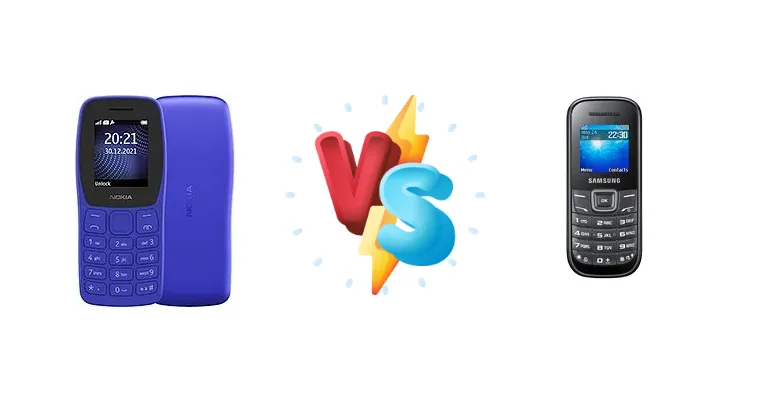
In a market saturated with smartphones, the ultra-basic feature phone persists. We pit the Nokia 105 (2022) against the Samsung E1200 Pusha, two of the most affordable options available, to determine which best serves the needs of users prioritizing simplicity, reliability, and extended battery life. This isn't about speed or features; it's about core communication.
🏆 Quick Verdict
For the average user needing a reliable, no-frills phone for calls and texts, the Nokia 105 (2022) is the slightly better choice. Its Mediatek MT6261D chipset, while still basic, offers a more modern architecture than the Samsung E1200 Pusha’s 156 MHz CPU, potentially leading to marginally smoother operation of basic functions.
| Network |
|---|
| 2G bands | GSM 900 / 1800 | GSM 900 / 1800 |
| EDGE | No | No |
| GPRS | No | No |
| Technology | GSM | GSM |
| Launch |
|---|
| Announced | 2022, April 26 | 2012. Released 2012 |
| Status | Available. Released 2022, April 26 | Discontinued |
| Body |
|---|
| Dimensions | 115.2 x 49.9 x 14.3 mm (4.54 x 1.96 x 0.56 in) | 108 x 45 x 13.5 mm (4.25 x 1.77 x 0.53 in) |
| SIM | Single SIM (Mini-SIM) or Dual SIM (Mini-SIM, dual stand-by) | Mini-SIM |
| Weight | 70 g (2.47 oz) | 65.1 g (2.29 oz) |
| | Flashlight | - |
| Display |
|---|
| Resolution | 120 x 160 pixels, 4:3 ratio (~113 ppi density) | 128 x 128 pixels, 1:1 ratio (~119 ppi density) |
| Size | 1.77 inches, 9.7 cm2 (~16.9% screen-to-body ratio) | 1.52 inches, 7.5 cm2 (~15.3% screen-to-body ratio) |
| Type | TFT LCD, 65K colors | TFT, 65K colors |
| Platform |
|---|
| CPU | - | 156 MHz |
| Chipset | Mediatek MT6261D | - |
| Memory |
|---|
| Call records | Yes | Yes |
| Card slot | No | No |
| Internal | 4MB, 4MB RAM | - |
| Phonebook | Yes | Yes |
| Sound |
|---|
| 3.5mm jack | Yes | No |
| 35mm jack | Yes | No |
| Loudspeaker | Yes | Yes |
| Comms |
|---|
| Bluetooth | No | No |
| NFC | No | - |
| Positioning | No | No |
| Radio | Wireless FM radio | No |
| USB | microUSB 1.1 | Proprietary |
| WLAN | No | No |
| Features |
|---|
| Games | Yes | No |
| Java | No | No |
| Messaging | SMS | SMS |
| Battery |
|---|
| Stand-by | - | Up to 720 h |
| Talk time | - | Up to 7 h |
| Type | Li-Ion 800 mAh, removable | Removable Li-Ion 800 mAh battery |
| Misc |
|---|
| Colors | Blue, Charcoal | Black, White, Blue |
| Models | TA-1464, TA-1435, TA-1203, TA-1174, TA-1037, TA-1010 | - |
| Price | About 20 EUR | About 20 EUR |
| SAR | 1.20 W/kg (head) 0.79 W/kg (body) | - |
| SAR EU | 1.50 W/kg (head) 1.38 W/kg (body) | 0.81 W/kg (head) |
Nokia 105 (2022)
- More modern chipset (MT6261D) for potentially smoother operation.
- Likely better software support and updates (though limited).
- Generally more widely available.
- May be slightly more expensive than the Samsung E1200 Pusha.
- Still a very basic phone with limited functionality.
Samsung E1200 Pusha
- Extremely simple and easy to use.
- Potentially the most affordable option.
- Very long battery life due to minimal power consumption.
- Outdated 156 MHz CPU may feel sluggish.
- Limited software support and features.
Display Comparison
Neither device boasts a sophisticated display. Both likely utilize basic monochrome or low-resolution color LCDs, typical of this market segment. Detailed specifications regarding brightness or color accuracy are unavailable, but the focus is on legibility rather than visual fidelity. The screen size is likely similar, prioritizing compactness over viewing area. Bezels are substantial on both, dictated by the need for durability and cost reduction.
Camera Comparison
Neither device is equipped with a camera worth discussing in detail. The primary function of these phones is communication, not photography. Any camera included would be extremely low resolution and of limited practical use. Comparing camera capabilities is irrelevant in this context.
Performance
The core difference lies in the processing power. The Nokia 105 (2022) utilizes the Mediatek MT6261D, a chipset designed for basic feature phone functionality. While not powerful, it represents a more modern architecture than the Samsung E1200 Pusha’s 156 MHz CPU. This CPU is likely based on older ARM core designs. The MT6261D’s architecture allows for potentially faster execution of basic tasks like contact management and SMS messaging. RAM capacity is minimal on both, sufficient only for the limited functions offered. Thermal management is not a concern given the low power consumption of both processors.
Battery Life
Both phones excel in battery life due to their low-power components and limited functionality. Exact mAh ratings are not provided, but both are expected to offer days, if not weeks, of standby time and hours of talk time. Charging is likely via a proprietary connector, and charging speeds are slow, prioritizing longevity over convenience. The lower processing demands of the Samsung E1200 Pusha *might* translate to slightly longer battery life, but the difference would be marginal.
Buying Guide
Buy the Nokia 105 (2022) if you need a phone primarily for making calls and sending texts, and appreciate a slightly more modern chipset for potentially better responsiveness. Buy the Samsung E1200 Pusha if you prioritize extreme simplicity and a potentially lower price point, accepting a very basic processing experience. Both are excellent choices for emergency backup phones or users avoiding smartphone complexity.
Frequently Asked Questions
❓ Will the Nokia 105 (2022) support modern Bluetooth headsets?
The Nokia 105 (2022) likely supports Bluetooth, but the version is likely older (Bluetooth 3.0 or earlier). Compatibility with newer headsets is not guaranteed, but basic audio functionality should work. Expect limited features like advanced audio codecs.
❓ Can I use a microSD card to expand storage on the Samsung E1200 Pusha?
While some basic phones offer microSD card support, the Samsung E1200 Pusha’s specifications do not confirm this feature. Given its ultra-basic nature, it’s unlikely to have expandable storage. Internal storage is limited to contacts and a small number of SMS messages.
❓ Is either phone suitable as a dedicated emergency phone?
Yes, both phones are excellent choices for emergency backup. Their long battery life and simple operation make them reliable in situations where smartphone complexity is a hindrance. The Nokia 105’s slightly more modern chipset might offer a small advantage in responsiveness during an emergency.