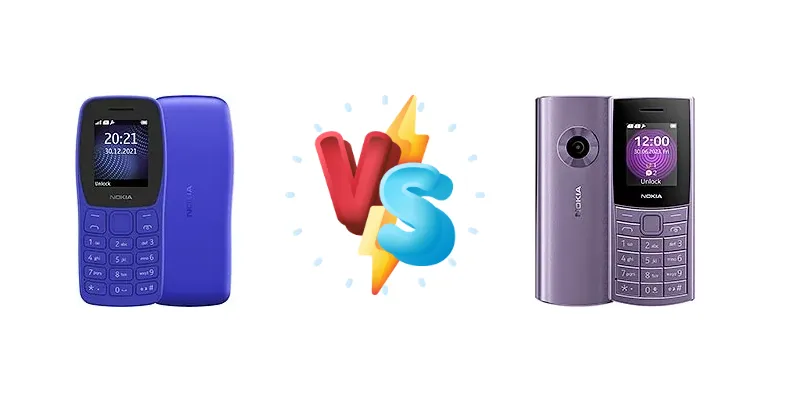
In a market saturated with smartphones, Nokia continues to cater to a specific niche: users prioritizing simplicity, durability, and affordability. The Nokia 105 (2022) and the newer Nokia 110 4G (2023) represent the latest iterations of this philosophy. While both are ultra-budget feature phones, the addition of 4G connectivity in the 110 represents a significant, if understated, upgrade. This comparison dissects the differences to help you determine which best suits your needs.
🏆 Quick Verdict
For the average user needing a reliable, basic phone for calls and texts, the Nokia 110 4G (2023) is the better choice. The inclusion of 4G connectivity future-proofs the device against network sunsets and offers a noticeably faster browsing experience, even if limited, compared to the 2G-only Nokia 105 (2022).
| Network |
|---|
| 2G bands | GSM 900 / 1800 | GSM 900 / 1800 |
| 3G bands | - | HSDPA 850 / 900 / 1700(AWS) / 1900 / 2100 |
| 4G bands | - | LTE |
| EDGE | No | - |
| GPRS | No | - |
| Speed | - | HSPA, LTE |
| Technology | GSM | GSM / HSPA / LTE |
| Launch |
|---|
| Announced | 2022, April 26 | 2023, May 18 |
| Status | Available. Released 2022, April 26 | Available. Released 2023, June |
| Body |
|---|
| Dimensions | 115.2 x 49.9 x 14.3 mm (4.54 x 1.96 x 0.56 in) | 121.5 x 50 x 14.4 mm (4.78 x 1.97 x 0.57 in) |
| SIM | Single SIM (Mini-SIM) or Dual SIM (Mini-SIM, dual stand-by) | · Nano-SIM· Nano-SIM + Nano-SIM |
| Weight | 70 g (2.47 oz) | 94.5 g (3.35 oz) |
| | Flashlight | Flashlight
Splash resistant |
| Display |
|---|
| Resolution | 120 x 160 pixels, 4:3 ratio (~113 ppi density) | 120 x 160 pixels, 4:3 ratio (~111 ppi density) |
| Size | 1.77 inches, 9.7 cm2 (~16.9% screen-to-body ratio) | 1.8 inches, 10.0 cm2 (~16.5% screen-to-body ratio) |
| Type | TFT LCD, 65K colors | TFT LCD, 65K colors |
| Platform |
|---|
| Chipset | Mediatek MT6261D | - |
| Memory |
|---|
| Call records | Yes | Yes |
| Card slot | No | microSDHC |
| Internal | 4MB, 4MB RAM | Unspecified |
| Phonebook | Yes | Yes |
| Sound |
|---|
| 3.5mm jack | Yes | Yes |
| 35mm jack | Yes | Yes |
| Loudspeaker | Yes | Yes |
| Comms |
|---|
| Bluetooth | No | 5.0, A2DP |
| NFC | No | No |
| Positioning | No | No |
| Radio | Wireless FM radio | Wireless FM radio |
| USB | microUSB 1.1 | microUSB 2.0 |
| WLAN | No | No |
| Features |
|---|
| Games | Yes | Yes |
| Java | No | No |
| Messaging | SMS | SMS |
| | - | MP3 player |
| Battery |
|---|
| Type | Li-Ion 800 mAh, removable | Li-Ion 1450 mAh |
| Misc |
|---|
| Colors | Blue, Charcoal | Midnight Blue, Arctic Purple |
| Models | TA-1464, TA-1435, TA-1203, TA-1174, TA-1037, TA-1010 | - |
| Price | About 20 EUR | About 40 EUR |
| SAR | 1.20 W/kg (head) 0.79 W/kg (body) | - |
| SAR EU | 1.50 W/kg (head) 1.38 W/kg (body) | - |
Nokia 105 (2022)
- Extremely affordable
- Exceptional battery life
- Durable build quality
- Limited to 2G connectivity
- Basic feature set
Nokia 110 4G (2023)
- 4G connectivity for future-proofing
- Slightly improved browsing experience
- Similar battery life to Nokia 105
- Slightly higher price than Nokia 105
- Chipset details unavailable
Display Comparison
Both devices feature small, low-resolution displays typical of feature phones. Specifics regarding panel technology (TFT, LCD) and brightness are not available for the Nokia 110 4G, but given the price point, it's unlikely to differ significantly from the Nokia 105. Bezels are substantial on both, prioritizing durability over screen real estate. Color accuracy is not a primary concern in this segment, and both displays are likely optimized for readability under direct sunlight rather than color fidelity.
Camera Comparison
Neither device is intended for photography. Both likely include a basic camera, but image quality will be extremely limited. Focusing on sensor size or lens apertures is irrelevant in this context; these cameras are primarily for occasional, low-resolution snapshots. The absence of detailed camera specifications for the Nokia 110 4G reinforces its focus on core communication features rather than multimedia.
Performance
The Nokia 105 (2022) is powered by the Mediatek MT6261D chipset, a well-established solution for basic feature phones. The Nokia 110 4G (2023) lacks publicly available chipset information. However, the inclusion of 4G connectivity necessitates a more powerful processor than the MT6261D, which is 2G-only. This likely translates to a slightly snappier user interface when accessing 4G-enabled services, though performance will remain limited by the available RAM and processing power. The 4G modem itself represents the biggest performance difference, enabling faster data speeds where available.
Battery Life
Both phones excel in battery life, a key advantage of feature phones over smartphones. While specific mAh ratings aren't always prominently advertised, the Nokia 105 (2022) is known for its exceptional standby time – potentially weeks on a single charge. The Nokia 110 4G (2023), despite supporting 4G, likely maintains comparable battery performance due to the efficiency of its chipset and the limited usage scenarios. Charging times will be slow, utilizing micro-USB, and are not a primary consideration for this user segment.
Buying Guide
Buy the Nokia 105 (2022) if you absolutely need the lowest possible price and live in an area with robust 2G coverage, primarily requiring a phone for voice calls and SMS. Buy the Nokia 110 4G (2023) if you want a phone that will remain functional as 2G networks are phased out, and you occasionally need basic internet access for services like WhatsApp or checking simple information.
Frequently Asked Questions
❓ Will the Nokia 110 4G work with my existing SIM card?
Yes, the Nokia 110 4G supports standard SIM cards and is compatible with 4G, 3G, and 2G networks. However, ensure your carrier still supports 2G if you plan to use it as a backup phone in areas without 4G coverage.
❓ Can I use WhatsApp on the Nokia 110 4G?
Yes, the Nokia 110 4G supports WhatsApp, but the experience will be limited. The small screen and basic browser will make navigating the app less convenient than on a smartphone. However, it allows for basic messaging functionality.
❓ Is the Nokia 105 (2022) still a good buy if 4G is becoming more widespread?
The Nokia 105 (2022) remains a viable option if you primarily need a phone for voice calls and SMS and live in an area with reliable 2G coverage. However, as 2G networks are phased out, its long-term usability will be limited.