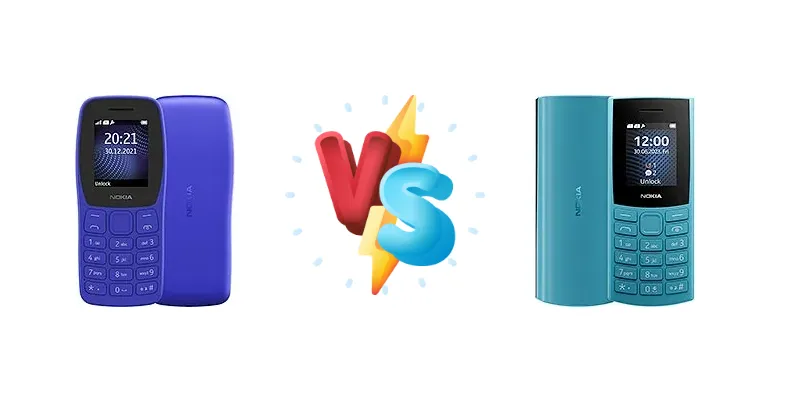
The Nokia 105 (2022) and Nokia 106 4G (2023) represent HMD Global’s continued commitment to the ultra-budget feature phone market. While both devices cater to users prioritizing call and text functionality, the 106 4G introduces the crucial element of modern cellular connectivity, a significant upgrade in areas with 4G network coverage. This comparison dissects the differences, focusing on how the addition of 4G impacts usability and value.
🏆 Quick Verdict
For the average user needing reliable voice communication and extended battery life, the Nokia 106 4G (2023) is the superior choice. The inclusion of 4G connectivity future-proofs the device against network sunsets and provides faster access to VoLTE calls, even if other specifications remain largely unchanged.
| Network |
|---|
| 2G bands | GSM 900 / 1800 | GSM 900 / 1800 |
| 3G bands | - | HSDPA 850 / 900 / 2100 |
| 4G bands | - | 1, 3, 5, 8 |
| EDGE | No | - |
| GPRS | No | - |
| Speed | - | HSPA, LTE |
| Technology | GSM | GSM / HSPA / LTE |
| Launch |
|---|
| Announced | 2022, April 26 | 2023, May 18 |
| Status | Available. Released 2022, April 26 | Available. Released 2023, May 18 |
| Body |
|---|
| Dimensions | 115.2 x 49.9 x 14.3 mm (4.54 x 1.96 x 0.56 in) | 121.5 x 50 x 14.4 mm (4.78 x 1.97 x 0.57 in) |
| SIM | Single SIM (Mini-SIM) or Dual SIM (Mini-SIM, dual stand-by) | · Nano-SIM· Nano-SIM + Nano-SIM |
| Weight | 70 g (2.47 oz) | 93 g (3.28 oz) |
| | Flashlight | - |
| Display |
|---|
| Resolution | 120 x 160 pixels, 4:3 ratio (~113 ppi density) | 120 x 160 pixels, 4:3 ratio (~111 ppi density) |
| Size | 1.77 inches, 9.7 cm2 (~16.9% screen-to-body ratio) | 1.8 inches, 10.0 cm2 (~16.5% screen-to-body ratio) |
| Type | TFT LCD, 65K colors | IPS LCD |
| Platform |
|---|
| Chipset | Mediatek MT6261D | - |
| Memory |
|---|
| Call records | Yes | Yes |
| Card slot | No | microSDHC |
| Internal | 4MB, 4MB RAM | Unspecified storage |
| Phonebook | Yes | Yes |
| Sound |
|---|
| 3.5mm jack | Yes | - |
| 35mm jack | Yes | Yes |
| Loudspeaker | Yes | Yes |
| Comms |
|---|
| Bluetooth | No | 5.0, A2DP |
| NFC | No | No |
| Positioning | No | No |
| Radio | Wireless FM radio | Wireless FM radio |
| USB | microUSB 1.1 | microUSB 2.0 |
| WLAN | No | No |
| Features |
|---|
| Games | Yes | Yes |
| Java | No | No |
| Messaging | SMS | SMS |
| Battery |
|---|
| Type | Li-Ion 800 mAh, removable | Li-Ion 1450 mAh, removable |
| Misc |
|---|
| Colors | Blue, Charcoal | Charcoal, Ocean Blue |
| Models | TA-1464, TA-1435, TA-1203, TA-1174, TA-1037, TA-1010 | - |
| Price | About 20 EUR | About 30 EUR |
| SAR | 1.20 W/kg (head) 0.79 W/kg (body) | - |
| SAR EU | 1.50 W/kg (head) 1.38 W/kg (body) | - |
Nokia 105 (2022)
- Lowest possible price point
- Excellent battery life
- Simple and durable design
- Limited to 2G/3G connectivity
- Basic feature set
- Poor camera quality
Nokia 106 4G (2023)
- 4G connectivity for clearer calls and data access
- Potential for VoLTE support
- Future-proofed against network shutdowns
- Slightly higher price than the 105 (2022)
- Detailed specs are unavailable
- Camera quality remains basic
Display Comparison
Both the Nokia 105 (2022) and Nokia 106 4G (2023) feature relatively small displays, likely utilizing similar LCD technology given their price points. Detailed specifications regarding resolution, brightness, or color gamut are unavailable for the 106 4G, but it’s reasonable to assume they are comparable to the 105’s. The primary difference isn’t display quality, but rather the potential for utilizing data services on the 106 4G, which could display basic web content or utilize apps like WhatsApp (depending on compatibility).
Camera Comparison
Neither device is intended for photography. Both likely feature a basic VGA camera, primarily for capturing simple images for contact photos or limited sharing. Image quality will be extremely limited, and the cameras should not be considered a significant feature. Detailed analysis is irrelevant given the intended use case.
Performance
The Nokia 105 (2022) is powered by the Mediatek MT6261D chipset, a processor designed for basic feature phone functionality. The Nokia 106 4G (2023) lacks publicly available chipset information. However, the inclusion of 4G connectivity necessitates a more powerful processor capable of handling the increased data throughput and modulation schemes. This suggests a newer Mediatek or Unisoc chipset, even if the performance gains aren’t dramatically noticeable in everyday use. The 4G modem itself represents the biggest performance upgrade, enabling faster call setup and potentially VoLTE support.
Battery Life
Both phones prioritize exceptional battery life. The Nokia 105 (2022) boasts a 1000mAh battery, providing days of standby time and hours of talk time. The Nokia 106 4G (2023) likely features a similar capacity battery. While 4G connectivity inherently consumes more power than 2G/3G, the efficiency improvements in modern chipsets and network protocols may offset this difference, resulting in comparable real-world battery performance. The 106 4G’s ability to quickly connect to a network and complete calls could also reduce overall power consumption compared to the 105 struggling for a signal.
Buying Guide
Buy the Nokia 105 (2022) if you require the absolute lowest possible price point and live in an area with reliable 2G/3G coverage. It’s a functional device for basic communication. Buy the Nokia 106 4G (2023) if you want the benefits of 4G connectivity for clearer calls, potential data access, and future-proofing against network changes, even if it means a slightly higher initial investment.
Frequently Asked Questions
❓ Will the Nokia 106 4G (2023) work with my existing carrier if they are phasing out 3G?
Yes, that's the primary benefit. The 4G connectivity of the 106 4G ensures compatibility with modern networks as carriers decommission older 3G infrastructure. This means continued voice service and potentially data access where available.
❓ Can I use WhatsApp or other data-reliant apps on the Nokia 106 4G (2023)?
While the Nokia 106 4G (2023) supports 4G data, compatibility with apps like WhatsApp depends on the specific version of the software and the app's minimum requirements. It's likely to support basic versions of these apps, but don't expect a full smartphone experience.
❓ Is the Nokia 105 (2022) still a good option if 4G isn't available in my area?
Absolutely. If you live in an area with strong 2G/3G coverage, the Nokia 105 (2022) provides a reliable and affordable solution for basic voice communication. The lack of 4G isn't a disadvantage in areas where it's unavailable.