
Nio Phone 2 vs ZTE nubia RedMagic 9 Pro+: A Deep Dive into Gaming and Charging
| Phones Images | |||||
|---|---|---|---|---|---|
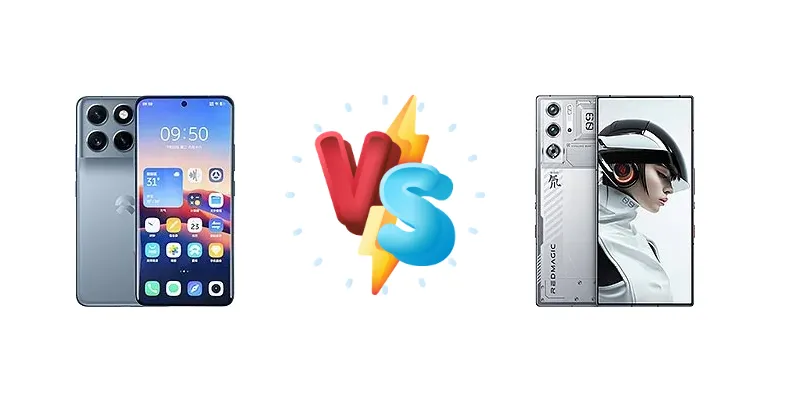
|
🏆 Quick Verdict
For the average user prioritizing a well-rounded experience, the Nio Phone 2 offers a compelling package. However, the ZTE nubia RedMagic 9 Pro+ is the clear winner for dedicated mobile gamers, thanks to its industry-leading 165W charging and focus on thermal management, despite a potentially less refined software experience.
| PHONES | ||
|---|---|---|
| Phone Names | Nio Phone 2 | ZTE nubia RedMagic 9 Pro+ |
| Network | ||
|---|---|---|
| 2G bands | GSM 850 / 900 / 1800 / 1900 | GSM 850 / 900 / 1800 / 1900 |
| 3G bands | HSDPA 800 / 850 / 900 / 1700(AWS) / 1900 / 2100 | HSDPA 850 / 900 / 1700(AWS) / 1900 / 2100 |
| 4G bands | 1, 2, 3, 4, 5, 7, 8, 12, 17, 18, 19, 20, 26, 28, 34, 38, 39, 40, 41, 42 | LTE |
| 5G bands | 1, 3, 5, 7, 8, 20, 28, 38, 40, 41, 77, 78, 79 SA/NSA | SA/NSA |
| Speed | HSPA, LTE, 5G | HSPA, LTE, 5G |
| Technology | GSM / CDMA / HSPA / CDMA2000 / LTE / 5G | GSM / CDMA / HSPA / EVDO / LTE / 5G |
| Launch | ||
|---|---|---|
| Announced | 2024, July 27 | 2023, November 23 |
| Status | Available. Released 2024, July 27 | Available. Released 2023, November 23 |
| Body | ||
|---|---|---|
| Build | - | Glass front (Gorilla Glass 5), aluminum frame, glass back |
| Dimensions | 163.9 x 77.5 x 8.5 / 8.6 / 8.7 mm | 164 x 76.4 x 8.9 mm (6.46 x 3.01 x 0.35 in) |
| SIM | Nano-SIM + Nano-SIM | Nano-SIM + Nano-SIM |
| Weight | 209 / 214 / 226 g (7.37 oz) | 229 g (8.08 oz) |
| Display | ||
|---|---|---|
| Protection | Corning Gorilla Glass Victus 2 | Corning Gorilla Glass 5 |
| Resolution | 1440 x 3168 pixels (~510 ppi density) | 1116 x 2480 pixels, 20:9 ratio (~400 ppi density) |
| Size | 6.82 inches, 113.0 cm2 (~89.0% screen-to-body ratio) | 6.8 inches, 111.6 cm2 (~89.1% screen-to-body ratio) |
| Type | LTPO AMOLED, 1B colors, 120Hz, HDR10+, 2600 nits (peak) | AMOLED, 1B colors, 120Hz, 1600 nits (peak) |
| Platform | ||
|---|---|---|
| CPU | Octa-core (1x3.3 GHz Cortex-X4 & 3x3.2 GHz Cortex-A720 & 2x3.0 GHz Cortex-A720 & 2x2.3 GHz Cortex-A520) | Octa-core (1x3.3 GHz Cortex-X4 & 3x3.2 GHz Cortex-A720 & 2x3.0 GHz Cortex-A720 & 2x2.3 GHz Cortex-A520) |
| Chipset | Qualcomm SM8650-AB Snapdragon 8 Gen 3 (4 nm) | Qualcomm SM8650-AB Snapdragon 8 Gen 3 (4 nm) |
| GPU | Adreno 750 | Adreno 750 |
| OS | SkyUI 2.0 | Android 14, Redmagic OS 9 |
| Memory | ||
|---|---|---|
| Card slot | No | No |
| Internal | 512GB 12GB RAM, 1TB 12GB RAM, 1TB 16GB RAM | 256GB 16GB RAM, 512GB 16GB RAM, 1TB 24GB RAM |
| Main Camera | ||
|---|---|---|
| Features | Laser AF, Ring-LED flash, HDR, panorama | LED flash, HDR, panorama |
| Triple | 48 MP, f/1.8, 25mm (wide), 1/1.43", 1.12µm, multi-directional PDAF, OIS 50 MP, f/2.6, 65mm (periscope telephoto), 1/1.56", 1.0µm, PDAF, OIS, 2.6x optical zoom 48 MP, f/2.3, 14mm, 114˚ (ultrawide), 1/1.95", 0.8µm, PDAF | 50 MP, (wide), 1/1.57", 1.0µm, PDAF, OIS 50 MP, f/2.2, (ultrawide), 1/2.76", 0.64µm 2 MP (macro) |
| Video | 4K@30/60fps, 1080p@30/60/120/240fps, gyro-EIS, OIS, HDR10+ | 8K@30fps, 4K@30/60fps, 1080p@30/60/120/240fps |
| Selfie camera | ||
|---|---|---|
| Features | - | HDR |
| Single | 12 MP, f/2.5, (wide) | 16 MP, f/2.0, (wide), 1.12µm, under display |
| Video | 4K@30/60fps, 1080p@30fps, gyro-EIS | 1080p@30/60fps |
| Sound | ||
|---|---|---|
| 35mm jack | No | Yes |
| Loudspeaker | Yes | Yes, with stereo speakers |
| Comms | ||
|---|---|---|
| Bluetooth | 5.3, A2DP, LE, aptX HD, aptX Lossless | 5.3, A2DP, LE, aptX HD, aptX Adaptive, aptX Lossless |
| Infrared port | Yes | Yes |
| NFC | Yes | Yes (market/region dependent) |
| Positioning | GPS (L1+L5), BDS (B1I+B1c+B2a), GALILEO (E1+E5a), QZSS (L1+L5), GLONASS | GPS (L1+L5), GLONASS, BDS, GALILEO |
| Radio | No | No |
| USB | USB Type-C 3.2, DisplayPort 1.2, OTG | USB Type-C 3.2 Gen 2, OTG, accessory connector, DisplayPort |
| WLAN | Wi-Fi 802.11 a/b/g/n/ac/6/7, dual-band | Wi-Fi 802.11 a/b/g/n/ac/6e/7, tri-band, Wi-Fi Direct |
| Features | ||
|---|---|---|
| Sensors | Fingerprint (under display, optical), accelerometer, proximity, gyro, compass, barometer | Fingerprint (under display, optical), accelerometer, gyro, proximity, compass |
| Battery | ||
|---|---|---|
| Charging | 80W wired, PD3.0, QC4 50W wireless 10W reverse wireless | 165W wired, PD3.0, 100% in 16 min |
| Type | Li-Po 5020 mAh | Li-Ion 5500 mAh |
| Misc | ||
|---|---|---|
| Colors | Space Blue, Moonlight Silver, Pine Green, Golden Sand, Nebula Red, EPedition | Sleet (Black), Snowfall (Silver), Cyclone (Transparent Black) |
| Models | N2301 | - |
| Price | About 820 EUR | About 710 EUR |
Nio Phone 2
- Versatile charging options (wired, wireless, reverse wireless)
- Potentially more refined software experience
- Likely superior camera system (based on brand positioning)
- Significantly slower wired charging compared to RedMagic
- May prioritize thermal balance over sustained peak performance
ZTE nubia RedMagic 9 Pro+
- Industry-leading 165W wired charging
- Aggressive cooling system for sustained gaming performance
- Designed specifically for mobile gaming
- Potentially less refined software experience
- Camera system may be less advanced than Nio Phone 2
Display Comparison
Both devices utilize the Qualcomm SM8650-AB Snapdragon 8 Gen 3 (4nm), meaning display performance will be largely dictated by panel quality and optimization. While specific display specs are missing, the RedMagic series historically prioritizes high refresh rates for gaming, suggesting a potential advantage in smoothness. The Nio Phone 2, given its broader appeal, may focus more on color accuracy and viewing angles. The absence of LTPO information makes it difficult to assess power efficiency differences in dynamic refresh rate scenarios.
Camera Comparison
Without detailed camera specifications, a direct comparison is challenging. However, given the RedMagic’s gaming focus, its camera system is likely optimized for quick snapshots and social media sharing rather than professional-grade photography. The Nio Phone 2, positioned as a premium flagship, likely features a more sophisticated camera system with larger sensors and advanced image processing algorithms, potentially offering superior image quality in various lighting conditions. The absence of sensor size data prevents a definitive assessment.
Performance
Both the Nio Phone 2 and RedMagic 9 Pro+ are equipped with the same Snapdragon 8 Gen 3 chipset, featuring an Octa-core CPU configuration (1x3.3 GHz Cortex-X4, 3x3.2 GHz Cortex-A720, 2x3.0 GHz Cortex-A720, 2x2.3 GHz Cortex-A520). This ensures comparable raw processing power. However, the RedMagic 9 Pro+ likely employs a more aggressive cooling solution – a hallmark of the RedMagic line – to sustain peak performance for longer gaming sessions, mitigating potential thermal throttling. The Nio Phone 2, while capable, may prioritize thermal balance over sustained peak output.
Battery Life
The most significant difference lies in charging speed. The RedMagic 9 Pro+ boasts a staggering 165W wired charging capability, promising a full charge in just 16 minutes. This is a substantial advantage for users who prioritize minimizing downtime. The Nio Phone 2’s 80W wired charging, while still fast, pales in comparison. The inclusion of 50W wireless and 10W reverse wireless charging on the Nio Phone 2 adds versatility, but the RedMagic’s sheer charging speed is a game-changer for gamers needing quick top-ups between matches.
Buying Guide
Buy the Nio Phone 2 if you need a premium smartphone with fast charging and a balanced feature set, prioritizing a polished user interface and broader appeal. Buy the ZTE nubia RedMagic 9 Pro+ if you prioritize uncompromising gaming performance, require the absolute fastest charging speeds available, and are willing to accept a more gamer-centric design and software experience.