
Nio Phone 2 vs. iPhone 15 Pro Max: A Head-to-Head Battle of Chipsets and Charging
| Phones Images | |||||
|---|---|---|---|---|---|
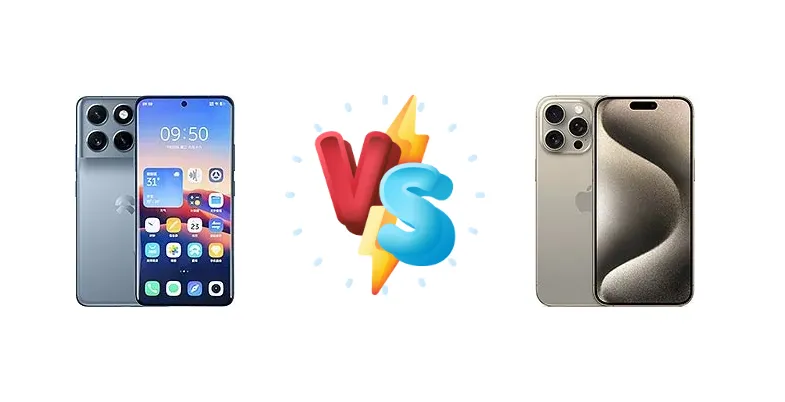
|
🏆 Quick Verdict
For the average user prioritizing a seamless ecosystem and long-term software support, the iPhone 15 Pro Max remains the superior choice. However, the Nio Phone 2’s significantly faster 80W wired charging and powerful Snapdragon 8 Gen 3 make it a compelling option for power users and gamers who value speed and customization.
| PHONES | ||
|---|---|---|
| Phone Names | Nio Phone 2 | Apple iPhone 15 Pro Max |
| Network | ||
|---|---|---|
| 2G bands | GSM 850 / 900 / 1800 / 1900 | GSM 850 / 900 / 1800 / 1900 |
| 3G bands | HSDPA 800 / 850 / 900 / 1700(AWS) / 1900 / 2100 | HSDPA 850 / 900 / 1700(AWS) / 1900 / 2100 |
| 4G bands | 1, 2, 3, 4, 5, 7, 8, 12, 17, 18, 19, 20, 26, 28, 34, 38, 39, 40, 41, 42 | 1, 2, 3, 4, 5, 7, 8, 12, 13, 17, 18, 19, 20, 25, 26, 28, 30, 32, 34, 38, 39, 40, 41, 42, 46, 48, 53, 66 - A3106 |
| 5G bands | 1, 3, 5, 7, 8, 20, 28, 38, 40, 41, 77, 78, 79 SA/NSA | 1, 2, 3, 5, 7, 8, 12, 20, 25, 26, 28, 30, 38, 40, 41, 48, 53, 66, 70, 77, 78, 79 SA/NSA/Sub6 - A3106 |
| Speed | HSPA, LTE, 5G | HSPA, LTE, 5G, EV-DO Rev.A 3.1 Mbps |
| Technology | GSM / CDMA / HSPA / CDMA2000 / LTE / 5G | GSM / CDMA / HSPA / EVDO / LTE / 5G |
| Launch | ||
|---|---|---|
| Announced | 2024, July 27 | 2023, September 12 |
| Status | Available. Released 2024, July 27 | Available. Released 2023, September 22 |
| Body | ||
|---|---|---|
| Build | - | Glass front, glass back, titanium frame (grade 5) |
| Dimensions | 163.9 x 77.5 x 8.5 / 8.6 / 8.7 mm | 159.9 x 76.7 x 8.3 mm (6.30 x 3.02 x 0.33 in) |
| SIM | Nano-SIM + Nano-SIM | · Nano-SIM + eSIM + eSIM (max 2 at a time; International)· eSIM + eSIM (8 or more, max 2 at a time; USA)· Nano-SIM + Nano-SIM (China) |
| Weight | 209 / 214 / 226 g (7.37 oz) | 221 g (7.80 oz) |
| Display | ||
|---|---|---|
| Protection | Corning Gorilla Glass Victus 2 | Ceramic Shield glass |
| Resolution | 1440 x 3168 pixels (~510 ppi density) | 1290 x 2796 pixels, 19.5:9 ratio (~460 ppi density) |
| Size | 6.82 inches, 113.0 cm2 (~89.0% screen-to-body ratio) | 6.7 inches, 110.2 cm2 (~89.8% screen-to-body ratio) |
| Type | LTPO AMOLED, 1B colors, 120Hz, HDR10+, 2600 nits (peak) | LTPO Super Retina XDR OLED, 120Hz, HDR10, Dolby Vision, 1000 nits (typ), 2000 nits (HBM) |
| Platform | ||
|---|---|---|
| CPU | Octa-core (1x3.3 GHz Cortex-X4 & 3x3.2 GHz Cortex-A720 & 2x3.0 GHz Cortex-A720 & 2x2.3 GHz Cortex-A520) | Hexa-core (2x3.78 GHz + 4x2.11 GHz) |
| Chipset | Qualcomm SM8650-AB Snapdragon 8 Gen 3 (4 nm) | Apple A17 Pro (3 nm) |
| GPU | Adreno 750 | Apple GPU (6-core graphics) |
| OS | SkyUI 2.0 | iOS 17, upgradable to iOS 26.1 |
| Memory | ||
|---|---|---|
| Card slot | No | No |
| Internal | 512GB 12GB RAM, 1TB 12GB RAM, 1TB 16GB RAM | 256GB 8GB RAM, 512GB 8GB RAM, 1TB 8GB RAM |
| Main Camera | ||
|---|---|---|
| Features | Laser AF, Ring-LED flash, HDR, panorama | Dual-LED dual-tone flash, HDR (photo/panorama) |
| Triple | 48 MP, f/1.8, 25mm (wide), 1/1.43", 1.12µm, multi-directional PDAF, OIS 50 MP, f/2.6, 65mm (periscope telephoto), 1/1.56", 1.0µm, PDAF, OIS, 2.6x optical zoom 48 MP, f/2.3, 14mm, 114˚ (ultrawide), 1/1.95", 0.8µm, PDAF | 48 MP, f/1.8, 24mm (wide), 1/1.28", 1.22µm, dual pixel PDAF, sensor-shift OIS 12 MP, f/2.8, 120mm (periscope telephoto), 1/3.06", 1.12µm, dual pixel PDAF, 3D sensor‑shift OIS, 5x optical zoom 12 MP, f/2.2, 13mm, 120˚ (ultrawide), 1/2.55", 1.4µm, dual pixel PDAF TOF 3D LiDAR scanner (depth) |
| Video | 4K@30/60fps, 1080p@30/60/120/240fps, gyro-EIS, OIS, HDR10+ | 4K@24/25/30/60fps, 1080p@25/30/60/120/240fps, 10-bit HDR, Dolby Vision HDR (up to 60fps), ProRes, 3D (spatial) video, stereo sound rec. |
| Selfie camera | ||
|---|---|---|
| Features | - | HDR, Dolby Vision HDR |
| Single | 12 MP, f/2.5, (wide) | 12 MP, f/1.9, 23mm (wide), 1/3.6", 1.0µm, PDAF, OIS SL 3D, (depth/biometrics sensor) |
| Video | 4K@30/60fps, 1080p@30fps, gyro-EIS | 4K@24/25/30/60fps, 1080p@25/30/60/120fps, gyro-EIS |
| Sound | ||
|---|---|---|
| 35mm jack | No | No |
| Loudspeaker | Yes | Yes, with stereo speakers |
| Comms | ||
|---|---|---|
| Bluetooth | 5.3, A2DP, LE, aptX HD, aptX Lossless | 5.3, A2DP, LE |
| Infrared port | Yes | - |
| NFC | Yes | Yes |
| Positioning | GPS (L1+L5), BDS (B1I+B1c+B2a), GALILEO (E1+E5a), QZSS (L1+L5), GLONASS | GPS (L1+L5), GLONASS, GALILEO, BDS, QZSS, NavIC |
| Radio | No | No |
| USB | USB Type-C 3.2, DisplayPort 1.2, OTG | USB Type-C 3.2 Gen 2, DisplayPort |
| WLAN | Wi-Fi 802.11 a/b/g/n/ac/6/7, dual-band | Wi-Fi 802.11 a/b/g/n/ac/6e, tri-band, hotspot |
| Features | ||
|---|---|---|
| Sensors | Fingerprint (under display, optical), accelerometer, proximity, gyro, compass, barometer | Face ID, accelerometer, gyro, proximity, compass, barometer |
| Battery | ||
|---|---|---|
| Charging | 80W wired, PD3.0, QC4 50W wireless 10W reverse wireless | Wired, PD2.0, 50% in 30 min 15W wireless (MagSafe) 15W wireless (Qi2) - requires iOS 17.2 update 4.5W reverse wired |
| Type | Li-Po 5020 mAh | Li-Ion 4441 mAh |
| Misc | ||
|---|---|---|
| Colors | Space Blue, Moonlight Silver, Pine Green, Golden Sand, Nebula Red, EPedition | Black Titanium, White Titanium, Blue Titanium, Natural Titanium |
| Models | N2301 | A2849, A3105, A3106, A3108, iPhone16,2 |
| Price | About 820 EUR | € 758.79 / $ 579.87 / £ 628.29 |
| SAR | - | 1.07 W/kg (head) 1.11 W/kg (body) |
| SAR EU | - | 0.98 W/kg (head) 0.98 W/kg (body) |
Nio Phone 2
- 80W Wired Charging: Significantly faster than iPhone.
- Snapdragon 8 Gen 3: Powerful processor for gaming and demanding tasks.
- 50W Wireless Charging: Much faster wireless charging than iPhone.
- Ecosystem Lock-in: Android ecosystem may not appeal to all users.
- Software Updates: Typically shorter support window compared to Apple.
Apple iPhone 15 Pro Max
- A17 Pro Chipset: Excellent performance and efficiency.
- iOS Ecosystem: Seamless integration and long-term software support.
- Camera Quality: Industry-leading photo and video capabilities.
- Slower Charging: Wired and wireless charging are significantly slower.
- Less Customization: iOS offers less customization compared to Android.
Display Comparison
The iPhone 15 Pro Max boasts a peak brightness of 1787 nits, a figure the Nio Phone 2’s display specifications don’t directly address. While the Nio Phone 2’s display quality is likely excellent, the iPhone’s higher peak brightness translates to superior visibility in direct sunlight. Both devices likely employ LTPO technology for adaptive refresh rates, conserving battery life, but Apple’s ProMotion technology is known for its smoothness. Bezels are expected to be minimal on both, but Apple typically leads in achieving the slimmest profile. Color accuracy is likely high on both, though Apple’s calibration is often considered a benchmark.
Camera Comparison
The context data lacks detailed camera specifications for the Nio Phone 2, making a direct comparison challenging. However, given its flagship positioning, it’s reasonable to expect a high-resolution main sensor with optical image stabilization (OIS). The iPhone 15 Pro Max is renowned for its exceptional photo and video capabilities, leveraging advanced computational photography. Apple’s image processing prioritizes natural-looking images, while many Android manufacturers tend towards more saturated colors. The iPhone’s video recording capabilities are industry-leading, with ProRes support and cinematic mode. Without knowing the Nio Phone 2’s sensor size and lens apertures, it’s difficult to assess its low-light performance or dynamic range. We can assume the iPhone will have a more refined and consistent camera experience.
Performance
The core of this comparison lies in the chipsets. The iPhone 15 Pro Max’s A17 Pro, fabricated on a 3nm process, is a hexa-core CPU designed for efficiency and peak performance. The Nio Phone 2 counters with the Snapdragon 8 Gen 3 (4nm), an octa-core processor. While core count isn’t everything, the A17 Pro’s architectural advantages and tighter software integration generally yield superior single-core performance, crucial for responsive app launches and UI fluidity. The Snapdragon 8 Gen 3 excels in multi-core tasks and GPU performance, potentially offering a slight edge in sustained gaming workloads. The Nio Phone 2 benefits from potentially faster LPDDR5x RAM, but Apple’s memory controller optimization is a significant factor. Thermal management will be key; the 4nm node of the Snapdragon should offer good efficiency, but Apple’s cooling solutions are typically refined.
Battery Life
The iPhone 15 Pro Max achieves an impressive 16:01h of active use, and an endurance rating of 118 hours, demonstrating excellent battery life. The Nio Phone 2’s battery capacity is not specified, but its 80W wired charging is a significant advantage. This allows for a full charge in a fraction of the time compared to the iPhone’s wired charging (50% in 30 minutes, using PD2.0). The Nio Phone 2 also offers 50W wireless charging, far exceeding the iPhone’s 15W MagSafe/Qi2 charging. Furthermore, the Nio Phone 2 includes 10W reverse wireless charging, a feature absent on the iPhone (which offers only 4.5W wired reverse charging). While the iPhone may have a larger battery, the Nio Phone 2’s charging speed offers a different kind of convenience.
Buying Guide
Buy the Nio Phone 2 if you need incredibly fast charging, prioritize Android’s open ecosystem, and demand top-tier gaming performance. You’ll benefit from the Snapdragon 8 Gen 3’s raw power and the flexibility of Android. Buy the Apple iPhone 15 Pro Max if you prefer a polished, integrated experience, value long-term software updates, and prioritize camera consistency and video recording capabilities. The A17 Pro offers excellent performance, but the real advantage lies in Apple’s software and ecosystem.