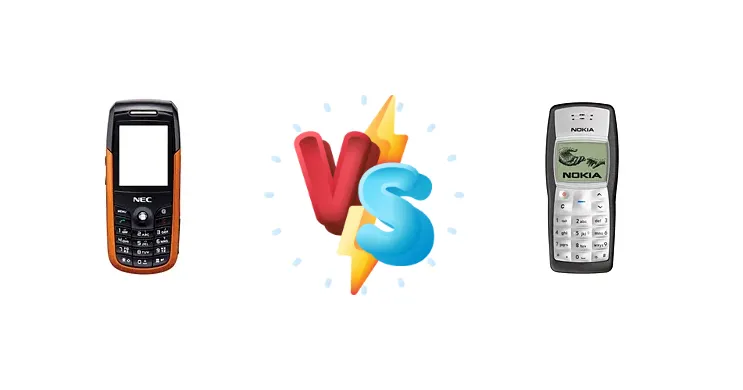
In a world dominated by smartphones, the humble feature phone continues to hold appeal for those seeking simplicity, durability, and extended battery life. We pit two icons of this segment – the NEC e1108 and the Nokia 1100 – against each other, analyzing their strengths and weaknesses to determine which reigns supreme for users prioritizing essential communication.
🏆 Quick Verdict
For the average user needing a reliable, long-lasting basic phone, the Nokia 1100 likely holds a slight edge. Its legendary durability and widespread availability, coupled with a potentially more robust distribution network for replacement parts, make it a safer long-term investment, despite the NEC e1108 potentially offering a slightly more refined user experience.
| Network |
|---|
| 2G bands | GSM 900 / 1800 / 1900 | GSM 900 / 1800 |
| EDGE | No | No |
| GPRS | Class 10 | No |
| Technology | GSM | GSM |
| | - | GSM 850 / 1900 - Nokia 1100B for US |
| Launch |
|---|
| Announced | 2006 | 2003, Q3 |
| Status | Discontinued | Discontinued |
| Body |
|---|
| Dimensions | 103 x 44 x 18.5 mm (4.06 x 1.73 x 0.73 in) | 106 x 46 x 20 mm, 79 cc (4.17 x 1.81 x 0.79 in) |
| SIM | Mini-SIM | Mini-SIM |
| Weight | 84 g (2.96 oz) | 86 g (3.03 oz) |
| | - | Flashlight |
| Display |
|---|
| Resolution | 128 x 160 pixels (~114 ppi density) | 96 x 65 pixels, 4 lines, 3:2 ratio |
| Size | 1.8 inches, 10.2 cm2 (~22.5% screen-to-body ratio) | - |
| Type | TFT, 65K colors | Monochrome graphic |
| | - | 2-way scroll key
Full display screensaver
Dynamic font size
Softkeys |
| Memory |
|---|
| Call records | 20 dialed, 20 received, 20 missed calls | 10 dialed, 10 received, 10 missed calls |
| Card slot | microSD (dedicated slot) | No |
| Internal | 28MB | - |
| Phonebook | Yes | 50 |
| | - | Dynamic phonebook memory
Editable message templates |
| Main Camera |
|---|
| Single | 1.3 MP | - |
| Video | Yes | - |
| Sound |
|---|
| 3.5mm jack | No | No |
| 35mm jack | No | No |
| Alert types | Vibration; Downloadable polyphonic, MP3 ringtones | Vibration; Downloadable monophonic ringtones, composer |
| Loudspeaker | Yes | No |
| Comms |
|---|
| Bluetooth | No | No |
| Positioning | No | No |
| Radio | No | No |
| USB | Proprietary | - |
| WLAN | No | No |
| Features |
|---|
| Browser | WAP 2.0/xHTML | - |
| Games | Yes | 2 - Snake II and Space Impact+ |
| Java | Yes, MIDP 2.0 | No |
| Languages | - | Most major European and Asian |
| Messaging | SMS, MMS | SMS |
| | MP3 player
Predictive text input
Organizer | Predictive text input
SMS to many
Calculator
Stopwatch
Xpress-on front and back covers
Picture messaging
|
| Battery |
|---|
| Stand-by | Up to 100 h | Up to 400 h |
| Talk time | Up to 2 h 20 min | Up to 4 h 30 min |
| Type | Removable Li-Ion battery | Removable Li-Ion 850 mAh battery (BL-5C) |
| Misc |
|---|
| Colors | Fluorescent Green, Metallic Orange | Xpress-on covers |
| SAR | - | 0.97 W/kg (head) 0.64 W/kg (body) |
| SAR EU | - | 0.73 W/kg (head) |
NEC e1108
- Potentially more ergonomic design
- Slightly more modern aesthetic (subjective)
- May offer unique regional features
- Limited parts availability
- Potentially lower durability compared to Nokia 1100
- Less widespread brand recognition
Nokia 1100
- Legendary durability and reliability
- Widespread parts availability
- Exceptional battery life
- Basic display technology
- Limited features
- Less aesthetically refined design
Display Comparison
Given the lack of specific display data, we can infer both devices utilize monochrome displays typical of their era. The Nokia 1100’s display, while basic, was known for its readability in direct sunlight, a crucial feature for outdoor use. The NEC e1108 likely employed a similar technology, but its display size and pixel density may differ, potentially impacting readability for some users. The absence of backlighting on either device means usability is limited in low-light conditions.
Camera Comparison
Neither the NEC e1108 nor the Nokia 1100 feature a camera. This is a defining characteristic of their market segment, prioritizing simplicity and affordability over imaging capabilities. Users requiring a camera must look to more modern feature phones or smartphones.
Performance
Both phones operate on extremely low-power chipsets designed solely for voice calls and basic SMS messaging. Performance differences are negligible; neither device is capable of running applications beyond its core functionality. The Nokia 1100’s chipset was optimized for minimal power consumption, contributing to its exceptional battery life. The NEC e1108 likely employed a similar strategy, but potential variations in component efficiency could lead to minor differences in standby time.
Battery Life
The Nokia 1100 is renowned for its exceptional battery life, often exceeding a week on a single charge with moderate use. This is achieved through a combination of a large battery capacity (for the time) and a highly efficient chipset. The NEC e1108 likely offers comparable battery performance, but potential differences in battery capacity and chipset efficiency could result in slightly shorter standby and talk times. Both phones utilize standard NiMH batteries, making replacements relatively accessible.
Buying Guide
Buy the NEC e1108 if you prioritize a potentially more ergonomic design and a slightly more modern aesthetic, assuming availability isn't a concern. Buy the Nokia 1100 if you need absolute reliability, widespread parts availability, and a proven track record of surviving harsh conditions – it’s the workhorse of the feature phone world. The Nokia 1100 is ideal for users in emerging markets or those needing a secondary, ultra-reliable device.
Frequently Asked Questions
❓ Is the Nokia 1100 truly as durable as its reputation suggests?
Yes, the Nokia 1100 is renowned for its exceptional durability. Its robust construction and simple design contribute to its ability to withstand drops, dust, and harsh environmental conditions. Numerous anecdotal reports and tests confirm its resilience, making it a popular choice in demanding environments.
❓ What type of SIM card do the NEC e1108 and Nokia 1100 use?
Both the NEC e1108 and Nokia 1100 utilize standard-sized SIM cards. This is typical for feature phones of their era. Micro or Nano SIM adapters may be required for use with newer SIM cards.
❓ Can I use a modern charger with either of these phones?
While both phones use a proprietary charger, they can often be charged with a standard USB charger using an adapter. However, using the original charger is recommended to ensure optimal charging speed and prevent potential damage to the battery.