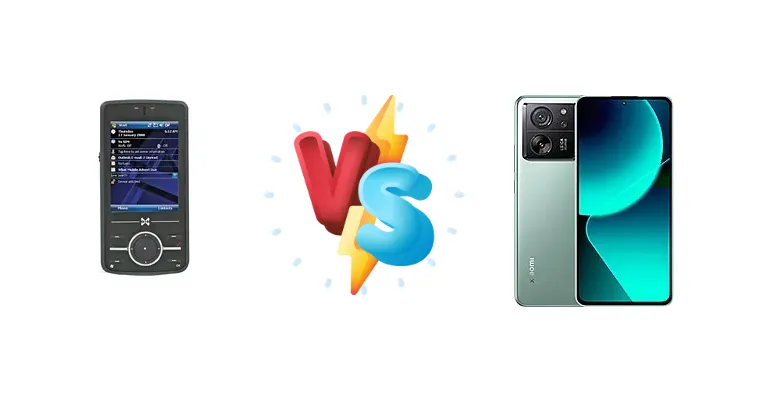
The MWg Atom V represents a resurgence of interest in retro handheld gaming, leveraging older architecture for a unique experience. Conversely, the Xiaomi 13T is a contemporary mid-range smartphone focused on delivering a balanced feature set at a competitive price. This comparison dissects these vastly different devices, highlighting their strengths and weaknesses for distinct user profiles.
🏆 Quick Verdict
For the average user seeking a versatile, modern smartphone, the Xiaomi 13T is the clear winner. Its Dimensity 8200 Ultra chipset, excellent battery life (12:23h active use), and 67W charging provide a far more practical and powerful experience than the MWg Atom V's aging hardware.
| Network |
|---|
| 2G bands | GSM 850 / 900 / 1800 / 1900 | GSM 850 / 900 / 1800 / 1900 |
| 3G bands | HSDPA 2100 | HSDPA 800 / 850 / 900 / 1700(AWS) / 1900 / 2100 |
| 4G bands | - | 1, 2, 3, 4, 5, 7, 8, 12, 13, 17, 18, 19, 20, 26, 28, 32, 38, 40, 41, 66 |
| 5G bands | - | 1, 3, 5, 7, 8, 20, 28, 38, 40, 41, 66, 77, 78 SA/NSA |
| Speed | HSPA 7.2/0.384 Mbps | HSPA, LTE, 5G |
| Technology | GSM / HSPA | GSM / HSPA / LTE / 5G |
| Launch |
|---|
| Announced | 2008, March | 2023, September 26 |
| Status | Discontinued | Available. Released 2023, September 26 |
| Body |
|---|
| Build | - | Glass front (Gorilla Glass 5), glass back or silicone polymer back, plastic frame |
| Dimensions | 116 x 59 x 15 mm (4.57 x 2.32 x 0.59 in) | 162.2 x 75.7 x 8.5 mm (6.39 x 2.98 x 0.33 in) |
| SIM | Mini-SIM | · Nano-SIM + eSIM· Nano-SIM + Nano-SIM |
| Weight | 133 g (4.69 oz) | 193 g or 197 g (6.81 oz) |
| Display |
|---|
| Protection | - | Corning Gorilla Glass 5 |
| Resolution | 240 x 320 pixels, 4:3 ratio (~143 ppi density) | 1220 x 2712 pixels, 20:9 ratio (~446 ppi density) |
| Size | 2.8 inches, 24.3 cm2 (~35.5% screen-to-body ratio) | 6.67 inches, 107.4 cm2 (~87.5% screen-to-body ratio) |
| Type | TFT resistive touchscreen, 256K colors (65K effective) | AMOLED, 68B colors, 144Hz, Dolby Vision, HDR10+, 1200 nits (HBM), 2600 nits (peak) |
| | Handwriting recognition | - |
| Platform |
|---|
| CPU | Intel XScale PXA 270 520 MHz | Octa-core (1x3.1 GHz Cortex-A78 & 3x3.0 GHz Cortex-A78 & 4x2.0 GHz Cortex-A55) |
| Chipset | - | Mediatek Dimensity 8200 Ultra (4 nm) |
| GPU | - | Mali-G610 MC6 |
| OS | Microsoft Windows Mobile 6 Professional | Android 13, up to 4 major Android upgrades, HyperOS |
| Memory |
|---|
| Card slot | microSDHC (dedicated slot) | No |
| Internal | 64MB RAM, 256MB ROM | 256GB 8GB RAM, 256GB 12GB RAM |
| Main Camera |
|---|
| Features | LED flash | Leica lens, color spectrum sensor, LED flash, HDR, panorama |
| Single | 2 MP | - |
| Triple | - | 50 MP, f/1.9, 24mm (wide), 1/1.28", 1.22µm, PDAF, OIS
50 MP, f/1.9, 50mm (telephoto), 1/2.88", 0.61µm, PDAF, 2x optical zoom
12 MP, f/2.2, 15mm (ultrawide), 1/3.06", 1.12µm |
| Video | Yes | 4K@30fps (HDR10+), 1080p@30/60/120fps, gyro-EIS |
| Selfie camera |
|---|
| Features | - | HDR |
| Single | - | 20 MP, f/2.2, (wide), 0.8µm |
| Video | - | 1080p@30fps, HDR10+ |
| | No | - |
| Sound |
|---|
| 3.5mm jack | No | - |
| 35mm jack | No | No |
| Loudspeaker | Yes, with stereo speakers | Yes, with stereo speakers |
| Comms |
|---|
| Bluetooth | 2.0, A2DP | 5.4, A2DP, LE |
| Infrared port | Yes | Yes |
| NFC | - | Yes (market/region dependent) |
| Positioning | GPS, SiRF Star III chipset | GPS (L1+L5), GLONASS (G1), GALILEO (E1+E5a), QZSS (L1+L5), NavIC (L5), BDS |
| Radio | Stereo FM radio, RDS | No |
| USB | miniUSB | USB Type-C 2.0, OTG |
| WLAN | Wi-Fi 802.11b/g | Wi-Fi 802.11 a/b/g/n/ac/6, dual-band |
| Features |
|---|
| Browser | WAP 2.0/xHTML, HTML (PocketIE) | - |
| Sensors | - | Fingerprint (under display, optical), accelerometer, gyro, proximity, compass |
| | Pocket Office
Voice memo
MP3/AAC/MP4 player
Predictive text input | - |
| Battery |
|---|
| Charging | - | 67W wired, PD3.0, QC4, 100% in 42 min |
| Stand-by | Up to 150 h | - |
| Talk time | Up to 3 h 30 min | - |
| Type | Removable Li-Po 1300 mAh battery | Li-Po 5000 mAh |
| Misc |
|---|
| Colors | Black | Alpine Blue, Meadow Green, Black |
| Models | - | 2306EPN60G |
| Price | - | $ 255.96 / £ 326.27 / € 204.18 |
| SAR EU | - | 0.99 W/kg (head) 0.99 W/kg (body) |
MWg Atom V
- Unique retro gaming experience
- Highly portable and pocketable
- Niche appeal for retro enthusiasts
- Outdated processor and limited performance
- Poor modern app compatibility
- Likely limited battery life
- No camera or basic camera functionality
Xiaomi 13T
- Powerful Dimensity 8200 Ultra processor
- Excellent battery life and fast charging
- Bright and vibrant display
- Versatile camera system
- Larger form factor than the Atom V
- May not appeal to retro gaming purists
- Software bloatware (typical of Xiaomi)
Display Comparison
The Xiaomi 13T boasts a significantly more advanced display, reaching a measured peak brightness of 1264 nits. This is crucial for outdoor visibility, a feature entirely absent from any specification for the MWg Atom V. While the Atom V's screen size is likely smaller to fit its handheld form factor, the 13T’s modern panel technology likely offers superior color accuracy and viewing angles. The Atom V’s display is likely a low-resolution LCD, optimized for retro gaming aesthetics rather than visual fidelity.
Camera Comparison
The Xiaomi 13T features a modern camera system, though specific details beyond 'Photo / Video' are missing. However, given Xiaomi’s track record, it likely includes features like optical image stabilization (OIS) and advanced image processing algorithms. The MWg Atom V, being a retro-focused device, almost certainly lacks a dedicated camera or features a very basic one. The 13T’s camera is geared towards capturing high-quality photos and videos for social media and personal use, a capability the Atom V simply doesn’t offer.
Performance
The performance gap is substantial. The Xiaomi 13T’s Mediatek Dimensity 8200 Ultra (4nm) is an octa-core processor designed for demanding tasks, including modern mobile games. Its Cortex-A78 cores, clocked up to 3.1 GHz, provide a significant performance uplift compared to the MWg Atom V’s Intel XScale PXA 270 (520 MHz). The PXA 270, while capable in its time, is architecturally outdated and primarily suited for emulating older consoles. The 4nm process node of the Dimensity 8200 Ultra also translates to better thermal efficiency, reducing throttling during sustained workloads. The Xiaomi 13T’s LPDDR5X RAM further enhances performance, while the Atom V likely utilizes slower, older RAM standards.
Battery Life
Battery life is another area where the Xiaomi 13T excels. Its active use score of 12:23 hours and endurance rating of 101 hours demonstrate impressive longevity. The 67W wired charging with PD3.0 and QC4 support allows for a full charge in just 42 minutes. The MWg Atom V’s battery capacity is unknown, but given its compact size and older processor, it’s likely significantly smaller and will require more frequent charging. The Atom V’s charging technology is also likely far slower and less efficient.
Buying Guide
Buy the MWg Atom V if you prioritize retro gaming emulation and a unique, pocketable form factor, accepting significant limitations in modern app compatibility and performance. Buy the Xiaomi 13T if you need a capable all-around smartphone with a vibrant display, strong performance for everyday tasks and gaming, and long-lasting battery life. The 13T is for users who want a device that seamlessly integrates into the modern mobile ecosystem.
Frequently Asked Questions
❓ Can the MWg Atom V run modern Android apps like streaming services or social media?
The MWg Atom V’s Intel XScale PXA 270 processor and limited RAM are unlikely to provide a satisfactory experience with modern Android apps. It’s primarily designed for emulating older gaming consoles and may struggle with the demands of contemporary software.
❓ How does the Dimensity 8200 Ultra in the Xiaomi 13T handle graphically intensive games like Genshin Impact or Call of Duty Mobile?
The Dimensity 8200 Ultra is well-equipped to handle demanding games. Expect smooth frame rates at high settings in titles like Genshin Impact and Call of Duty Mobile. The 4nm process node and efficient thermal design help minimize throttling during extended gaming sessions.
❓ Is the Xiaomi 13T's camera good in low-light conditions?
While specific low-light performance data isn't provided, Xiaomi phones generally perform well in low light. Expect features like night mode to improve image clarity and reduce noise in challenging lighting scenarios. The sensor size and aperture will be key factors, but Xiaomi typically prioritizes camera quality.
❓ What type of storage does the MWg Atom V use, and is it expandable?
Information on the MWg Atom V's storage is limited. Given its age and design, it likely uses older storage technology like microSD cards. Expandability is probable, but the maximum supported capacity will be significantly lower than modern smartphones.