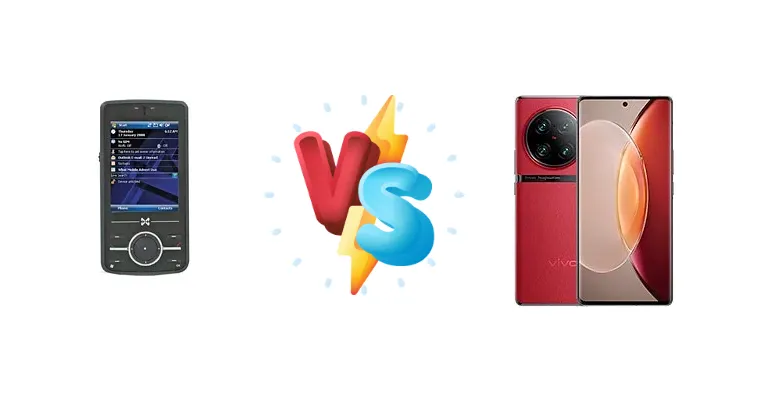
This comparison pits a modern Android flagship, the vivo X90 Pro+, against the MWg Atom V, a device deliberately designed to evoke the early smartphone era. It’s a clash of generations – cutting-edge silicon and features versus a focus on simplicity and a classic form factor. We’ll dissect the core differences to determine which device suits your needs.
🏆 Quick Verdict
For the vast majority of users, the vivo X90 Pro+ is the superior choice. Its Snapdragon 8 Gen 2 chipset delivers dramatically faster performance, the 80W charging is a game-changer, and the camera system is in a different league. The MWg Atom V appeals to a niche audience seeking a retro experience.
| Network |
|---|
| 2G bands | GSM 850 / 900 / 1800 / 1900 | GSM 850 / 900 / 1800 / 1900 - SIM 1 & SIM 2 |
| 3G bands | HSDPA 2100 | HSDPA 800 / 850 / 900 / 1700(AWS) / 1900 / 2100 |
| 4G bands | - | 1, 2, 3, 4, 5, 7, 8, 12, 17, 18, 19, 20, 25, 26, 28, 34, 38, 39, 40, 41, 42, 66 |
| 5G bands | - | 1, 2, 3, 5, 7, 8, 12, 20, 28, 38, 40, 41, 66, 77, 78, 79 SA/NSA |
| Speed | HSPA 7.2/0.384 Mbps | HSPA, LTE-A, 5G |
| Technology | GSM / HSPA | GSM / CDMA / HSPA / EVDO / LTE / 5G |
| | - | CDMA2000 1xEV-DO |
| Launch |
|---|
| Announced | 2008, March | 2022, November 22 |
| Status | Discontinued | Available. Released 2022, December 06 |
| Body |
|---|
| Build | - | Glass front, aluminum frame, eco leather back |
| Dimensions | 116 x 59 x 15 mm (4.57 x 2.32 x 0.59 in) | 164.4 x 75.3 x 9.7 mm (6.47 x 2.96 x 0.38 in) |
| SIM | Mini-SIM | Dual SIM (Nano-SIM, dual stand-by) |
| Weight | 133 g (4.69 oz) | 221 g (7.80 oz) |
| | - | IP68 dust/water resistant (up to 1.5m for 30 min) |
| Display |
|---|
| Resolution | 240 x 320 pixels, 4:3 ratio (~143 ppi density) | 1440 x 3200 pixels, 20:9 ratio (~517 ppi density) |
| Size | 2.8 inches, 24.3 cm2 (~35.5% screen-to-body ratio) | 6.78 inches, 111.4 cm2 (~90.0% screen-to-body ratio) |
| Type | TFT resistive touchscreen, 256K colors (65K effective) | LTPO4 AMOLED, 1B colors, 120Hz, Dolby Vision, HDR10+, 1800 nits (peak) |
| | Handwriting recognition | - |
| Platform |
|---|
| CPU | Intel XScale PXA 270 520 MHz | Octa-core (1x3.2 GHz Cortex-X3 & 2x2.8 GHz Cortex-A715 & 2x2.8 GHz Cortex-A710 & 3x2.0 GHz Cortex-A510) |
| Chipset | - | Qualcomm SM8550-AB Snapdragon 8 Gen 2 (4 nm) |
| GPU | - | Adreno 740 |
| OS | Microsoft Windows Mobile 6 Professional | Android 13, Funtouch (Global), Origin OS 3 (China) |
| Memory |
|---|
| Card slot | microSDHC (dedicated slot) | No |
| Internal | 64MB RAM, 256MB ROM | 256GB 12GB RAM, 512GB 12GB RAM |
| | - | UFS 4.0 |
| Main Camera |
|---|
| Features | LED flash | Zeiss optics, Zeiss T* lens coating, Pixel Shift, dual-LED dual-tone flash, HDR, panorama |
| Quad | - | 50.3 MP, f/1.8, 23mm (wide), 1.0"-type, 1.6µm, Dual Pixel PDAF, Laser AF, OIS
64 MP, f/3.5, 90mm (periscope telephoto), 1/2.0", 0.7µm, PDAF, OIS, 3.5x optical zoom
50 MP, f/1.6, 50mm (telephoto), 1/2.4", 0.7µm, AF, 2x optical zoom, OIS
48 MP, f/2.2, 14mm, 114˚ (ultrawide), 1/2.0", 0.8µm, AF |
| Single | 2 MP | 32 MP, f/2.5, 24mm (wide), 1/2.8", 0.8µm |
| Video | Yes | 8K@30fps, 4K@30/60fps, 1080p@30/60fps, gyro-EIS, 14-bit RAW video |
| Selfie camera |
|---|
| Features | - | HDR |
| Single | - | 32 MP, f/2.5, 24mm (wide), 1/2.8", 0.8µm |
| Video | - | 1080p@30/60fps |
| | No | - |
| Sound |
|---|
| 3.5mm jack | No | No |
| 35mm jack | No | - |
| Loudspeaker | Yes, with stereo speakers | Yes, with stereo speakers |
| | - | 32-bit/192kHz audio |
| Comms |
|---|
| Bluetooth | 2.0, A2DP | 5.3, A2DP, LE, aptX HD |
| Infrared port | Yes | Yes |
| NFC | - | Yes |
| Positioning | GPS, SiRF Star III chipset | GPS (L1+L5), GLONASS, BDS, GALILEO, QZSS |
| Radio | Stereo FM radio, RDS | No |
| USB | miniUSB | USB Type-C 3.2, OTG |
| WLAN | Wi-Fi 802.11b/g | Wi-Fi 802.11 a/b/g/n/ac/6, dual-band, Wi-Fi Direct |
| Features |
|---|
| Browser | WAP 2.0/xHTML, HTML (PocketIE) | - |
| Sensors | - | Fingerprint (under display, ultrasonic), accelerometer, gyro, proximity, compass, color spectrum |
| | Pocket Office
Voice memo
MP3/AAC/MP4 player
Predictive text input | - |
| Battery |
|---|
| Charging | - | 80W wired, 100% in 33 min (advertised)
50W wireless
Reverse wired |
| Stand-by | Up to 150 h | - |
| Talk time | Up to 3 h 30 min | - |
| Type | Removable Li-Po 1300 mAh battery | Li-Po 4700 mAh, non-removable |
| Misc |
|---|
| Colors | Black | Black, Red |
| Models | - | V2227A |
| Price | - | About 1030 EUR |
MWg Atom V
- Unique retro design
- Compact and lightweight
- Simple and easy to use
- Extremely limited performance
- Outdated technology
- Poor camera quality
vivo X90 Pro+
- Exceptional performance with Snapdragon 8 Gen 2
- Fast 80W wired and 50W wireless charging
- Advanced camera system (expected)
- Larger size and weight
- More complex software
- Higher price
Display Comparison
The MWg Atom V’s display specifications are not provided, but given its design intent, it likely features a small, low-resolution LCD panel. In contrast, the vivo X90 Pro+ boasts a modern display, though specifics are missing. The Snapdragon 8 Gen 2’s ISP supports high-resolution panels and advanced display features, suggesting a vibrant and sharp visual experience on the vivo. The difference in display technology represents a significant gap in image quality and responsiveness.
Camera Comparison
The vivo X90 Pro+ is expected to feature a sophisticated camera system, though specific details are missing. However, the Snapdragon 8 Gen 2’s ISP (Image Signal Processor) is capable of handling high-resolution sensors and advanced image processing algorithms. The MWg Atom V likely has a very basic camera sensor, suitable only for rudimentary photos. The Snapdragon’s capabilities enable features like advanced HDR, low-light performance, and high-resolution video recording, which are simply unavailable on the Atom V.
Performance
The performance disparity is immense. The MWg Atom V’s Intel XScale PXA 270, a 520 MHz processor from the early 2000s, is vastly outmatched by the vivo X90 Pro+'s Qualcomm Snapdragon 8 Gen 2. The Snapdragon 8 Gen 2, built on a 4nm process, features an octa-core CPU with a Cortex-X3 prime core clocked at 3.2 GHz, alongside Cortex-A715 and A710 performance cores, and efficiency-focused Cortex-A510 cores. This architecture delivers significantly higher processing power and improved energy efficiency. The Snapdragon’s Adreno GPU also provides a far superior graphics experience, enabling smooth gaming and demanding applications. The Atom V will struggle with even basic modern apps.
Battery Life
Battery capacity for the MWg Atom V is unknown, but given its size and target use case, it’s likely small. The vivo X90 Pro+ offers 80W wired charging, capable of reaching 100% charge in a claimed 33 minutes, and 50W wireless charging. This rapid charging capability is a significant convenience factor. While the Atom V may offer longer standby time due to its limited functionality, the vivo X90 Pro+ provides a much more practical charging experience for daily use.
Buying Guide
Buy the MWg Atom V if you prioritize a compact, minimalist experience and are willing to sacrifice performance and modern features for a nostalgic feel. It’s ideal for those who want a phone for basic communication and appreciate a unique design. Buy the vivo X90 Pro+ if you demand top-tier performance for gaming and demanding apps, a versatile and high-quality camera system, and the convenience of fast wired and wireless charging. It’s the choice for power users and photography enthusiasts.
Frequently Asked Questions
❓ Is the MWg Atom V compatible with modern 4G/5G networks?
No. The MWg Atom V utilizes older 2G/3G cellular technology. It will not connect to modern 4G or 5G networks, limiting its functionality in many areas.
❓ Can I run popular apps like WhatsApp or Facebook on the MWg Atom V?
Highly unlikely. These apps require a modern operating system and processing power that the Intel XScale PXA 270 simply cannot provide. The Atom V runs a very basic operating system designed for limited functionality.
❓ Does the vivo X90 Pro+ support global 5G bands?
The vivo X90 Pro+ is expected to support a wide range of 5G bands, making it compatible with 5G networks in most regions. However, specific band support may vary depending on the model and region.
❓ What type of storage does the vivo X90 Pro+ use?
The vivo X90 Pro+ is expected to utilize UFS 4.0 storage, which is significantly faster than the storage used in older devices like the MWg Atom V. This results in quicker app loading times and improved overall system responsiveness.