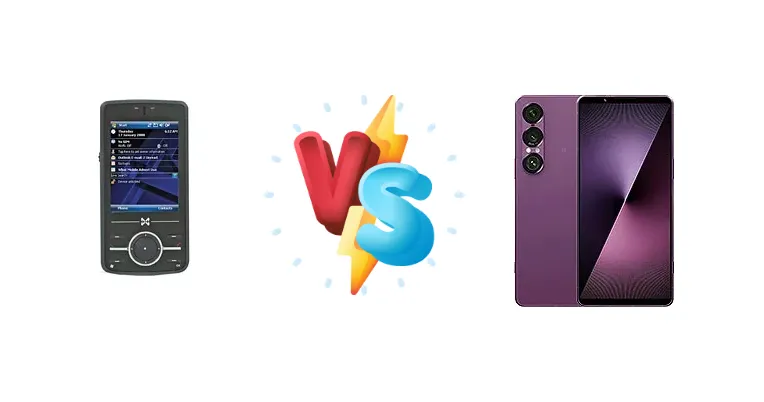
This comparison isn't about specs on paper; it's about two vastly different eras of mobile computing. The MWg Atom V, representing the early 2000s Pocket PC landscape, faces off against the cutting-edge Sony Xperia 1 VII. We'll dissect how a 520MHz processor stacks up against a 4.32GHz octa-core behemoth, and whether modern battery technology can truly eclipse the simplicity of older devices.
🏆 Quick Verdict
For the vast majority of users, the Sony Xperia 1 VII is the clear winner. Its Snapdragon 8 Elite chipset delivers unparalleled performance, a stunning 1475 nit display, and exceptional battery endurance. The MWg Atom V serves primarily as a nostalgic curiosity, best suited for retro enthusiasts.
| Network |
|---|
| 2G bands | GSM 850 / 900 / 1800 / 1900 | GSM 850 / 900 / 1800 / 1900 |
| 3G bands | HSDPA 2100 | HSDPA 800 / 850 / 900 / 1700(AWS) / 1900 / 2100 |
| 4G bands | - | 1, 2, 3, 4, 5, 7, 8, 12, 13, 17, 19, 20, 25, 26, 28, 32, 34, 38, 39, 40, 41, 66 - Europe |
| 5G bands | - | 1, 3, 5, 7, 8, 20, 28, 38, 40, 41, 75, 77, 78 SA/NSA/Sub6 - Europe |
| Speed | HSPA 7.2/0.384 Mbps | HSPA, LTE, 5G |
| Technology | GSM / HSPA | GSM / HSPA / LTE / 5G |
| Launch |
|---|
| Announced | 2008, March | 2025, May 13 |
| Status | Discontinued | Available. Released 2025, June 04 |
| Body |
|---|
| Build | - | Glass front (Gorilla Glass Victus 2), glass back (Gorilla Glass Victus), aluminum frame |
| Dimensions | 116 x 59 x 15 mm (4.57 x 2.32 x 0.59 in) | 162 x 74 x 8.2 mm (6.38 x 2.91 x 0.32 in) |
| SIM | Mini-SIM | · Nano-SIM + eSIM· Nano-SIM + Nano-SIM |
| Weight | 133 g (4.69 oz) | 197 g (6.95 oz) |
| Display |
|---|
| Protection | - | Corning Gorilla Glass Victus 2, Mohs level 5 |
| Resolution | 240 x 320 pixels, 4:3 ratio (~143 ppi density) | 1080 x 2340 pixels, 19.5:9 ratio (~396 ppi density) |
| Size | 2.8 inches, 24.3 cm2 (~35.5% screen-to-body ratio) | 6.5 inches, 103.7 cm2 (~86.5% screen-to-body ratio) |
| Type | TFT resistive touchscreen, 256K colors (65K effective) | LTPO OLED, 1B colors, 120Hz, HDR BT.2020 |
| | Handwriting recognition | - |
| Platform |
|---|
| CPU | Intel XScale PXA 270 520 MHz | Octa-core (2x4.32 GHz Oryon V2 Phoenix L + 6x3.53 GHz Oryon V2 Phoenix M) |
| Chipset | - | Qualcomm SM8750-AB Snapdragon 8 Elite (3 nm) |
| GPU | - | Adreno 830 |
| OS | Microsoft Windows Mobile 6 Professional | Android 15, up to 4 major Android upgrades |
| Memory |
|---|
| Card slot | microSDHC (dedicated slot) | microSDXC (uses shared SIM slot) |
| Internal | 64MB RAM, 256MB ROM | 256GB 12GB RAM, 512GB 12GB RAM |
| Main Camera |
|---|
| Features | LED flash | Zeiss optics, Zeiss T* lens coating, color spectrum sensor, LED flash, panorama, HDR, eye tracking |
| Single | 2 MP | - |
| Triple | - | 48 MP, f/1.9, 24mm (wide), 1/1.35", 1.12µm, dual pixel PDAF, OIS
12 MP, f/2.3, 85mm (telephoto), f/3.5, 170mm (telephoto), 1/3.5", 1.0µm, dual pixel PDAF, 3.5x-7.1x continuous optical zoom, OIS, 4cm macro @ 120mm, no AF
48 MP, f/2.0, 16mm (ultrawide), 1/1.56", 1.0µm, PDAF |
| Video | Yes | 4K@24/30/60/120fps HDR, 1080p@30/60/120fps; 5-axis gyro-EIS, OIS |
| Selfie camera |
|---|
| Features | - | HDR |
| Single | - | 12 MP, f/2.0, 24mm (wide), 1/2.9", 1.22µm |
| Video | - | 4K@30/60fps, 1080p@30/60fps, 5-axis gyro-EIS |
| | No | - |
| Sound |
|---|
| 3.5mm jack | No | - |
| 35mm jack | No | Yes |
| Loudspeaker | Yes, with stereo speakers | Yes, with stereo speakers |
| Comms |
|---|
| Bluetooth | 2.0, A2DP | 6.0, A2DP, LE Audio, aptX HD, aptX Adaptive, aptX Lossless |
| Infrared port | Yes | - |
| NFC | - | Yes |
| Positioning | GPS, SiRF Star III chipset | GPS, GLONASS, BDS, GALILEO, QZSS |
| Radio | Stereo FM radio, RDS | No |
| USB | miniUSB | USB Type-C 3.2, OTG, video output |
| WLAN | Wi-Fi 802.11b/g | Wi-Fi 802.11 a/b/g/n/ac/6e/7, tri-band, Wi-Fi Direct, DLNA |
| Features |
|---|
| Browser | WAP 2.0/xHTML, HTML (PocketIE) | - |
| Sensors | - | Fingerprint (side-mounted), accelerometer, gyro, proximity, barometer, compass |
| | Pocket Office
Voice memo
MP3/AAC/MP4 player
Predictive text input | - |
| Battery |
|---|
| Charging | - | 30W wired, PD3.0, PPS, 50% in 30 min
15W wireless
Reverse wireless |
| Stand-by | Up to 150 h | - |
| Talk time | Up to 3 h 30 min | - |
| Type | Removable Li-Po 1300 mAh battery | 5000 mAh |
| Misc |
|---|
| Colors | Black | Moss Green, Orchid Purple, Slate Black |
| Models | - | XQ-FS54, XQFS54EUKCG.GC, XQFS54EUKCV.GC, XQFS54EUKCB.GC, PDX256 |
| Price | - | € 1,338.99 / $ 1,394.99 / £ 1,149.94 |
| EU LABEL |
|---|
| Battery | - | 43:30h endurance, 1400 cycles |
| Energy | - | Class B |
| Free fall | - | Class B (181 falls) |
| Repairability | - | Class D |
MWg Atom V
- Extremely compact and lightweight
- Nostalgic appeal for retro tech enthusiasts
- Simple and distraction-free user experience
- Severely outdated processing power
- Limited software compatibility
- Poor display quality compared to modern standards
Sony Xperia 1 VII
- Exceptional performance with Snapdragon 8 Elite
- Stunning display with high brightness and likely LTPO
- Long battery life and fast charging capabilities
- Higher price point
- Larger size and weight compared to the Atom V
- Potential for software bloat (typical of Android)
Display Comparison
The contrast is stark. The Sony Xperia 1 VII boasts a display capable of reaching 1475 nits, ensuring excellent visibility even in direct sunlight. While the MWg Atom V's display specifications are unavailable, it's safe to assume it pales in comparison, likely utilizing an older LCD technology with significantly lower brightness and color accuracy. The Xperia 1 VII’s modern panel likely incorporates LTPO technology for variable refresh rates, further enhancing efficiency and smoothness, a feature entirely absent in the Atom V.
Camera Comparison
Camera capabilities are non-comparable. The Sony Xperia 1 VII, while details are limited in the provided data, is expected to feature a sophisticated multi-camera system with advanced image processing. The MWg Atom V likely features a low-resolution camera, primarily for basic image capture. The Xperia 1 VII’s image processing pipeline benefits from years of Sony’s expertise in sensor technology and computational photography, delivering superior image quality and features like optical image stabilization (OIS).
Performance
The Qualcomm Snapdragon 8 Elite, built on a 3nm process, represents a monumental leap in processing power. Its octa-core configuration, with peak clock speeds of 4.32 GHz, dwarfs the Intel XScale PXA 270's 520 MHz. This translates to instantaneous app loading, seamless multitasking, and the ability to handle demanding games and applications with ease. The Atom V, while capable for its time, will struggle with even basic modern tasks. The 3nm node of the Snapdragon 8 Elite also provides superior thermal efficiency, minimizing throttling during sustained workloads.
Battery Life
The Sony Xperia 1 VII’s battery endurance of 43:30 hours and active use score of 15:32 hours demonstrate a significant advantage in longevity. The 30W wired charging with PD3.0 and PPS allows for a 50% charge in just 30 minutes, alongside 15W wireless and reverse wireless charging. The MWg Atom V’s battery life, while potentially adequate for its limited functionality, will be significantly shorter and lack the fast-charging capabilities of the Xperia 1 VII. The Xperia 1 VII’s 1400 charge cycles also suggest a longer lifespan.
Buying Guide
Buy the MWg Atom V if you're a collector seeking a piece of mobile history, enjoy retro gaming emulation, or require an extremely simple, distraction-free device. Buy the Sony Xperia 1 VII if you demand the latest in smartphone technology, prioritize a vibrant display, long battery life, fast charging, and a versatile camera experience. The Xperia 1 VII is for the power user; the Atom V is for the preservationist.
Frequently Asked Questions
❓ Can the Sony Xperia 1 VII handle demanding mobile games like Genshin Impact at maximum settings?
Yes, the Snapdragon 8 Elite chipset is designed for flagship gaming. Its powerful CPU and GPU, combined with ample RAM (likely LPDDR5x), will allow Genshin Impact and other graphically intensive games to run at maximum settings with consistently high frame rates. The advanced thermal management system will also help prevent throttling during extended gaming sessions.
❓ Is the MWg Atom V capable of running any modern applications, even emulators?
Running modern applications directly on the MWg Atom V is highly unlikely due to its outdated operating system and processor. While it may be possible to run some emulators for older consoles, performance will be limited, and compatibility will be a significant issue. The hardware simply lacks the resources to handle the demands of modern software.
❓ How does the 30W charging on the Xperia 1 VII compare to older fast charging standards?
The Xperia 1 VII’s 30W charging with PD3.0 and PPS is significantly faster and more efficient than older fast charging standards like Quick Charge 2.0. PD3.0 allows for dynamic voltage and current adjustment, optimizing charging speed and reducing heat. PPS further refines this process, providing even more precise power delivery for compatible devices.