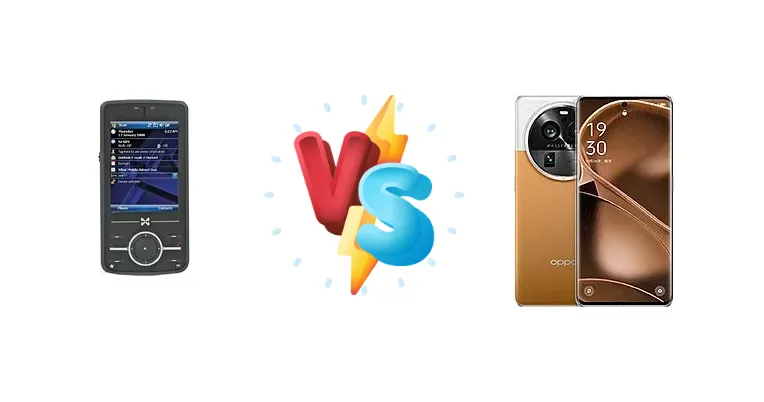
Comparing the MWg Atom V and the Oppo Find X6 Pro isn't about finding a direct competitor; it's about witnessing two decades of smartphone evolution. The Atom V, powered by a 520MHz Intel XScale processor, represents the dawn of mobile computing, while the Find X6 Pro, with its Snapdragon 8 Gen 2, embodies the pinnacle of modern smartphone performance. This comparison highlights the sheer scale of technological advancement.
🏆 Quick Verdict
For the vast majority of users, the Oppo Find X6 Pro is the clear winner. Its Snapdragon 8 Gen 2 chipset delivers exponentially faster performance, a stunning display, and modern connectivity features. The MWg Atom V is a fascinating historical artifact, but impractical for daily use in 2024.
| Network |
|---|
| 2G bands | GSM 850 / 900 / 1800 / 1900 | GSM 850 / 900 / 1800 / 1900 |
| 3G bands | HSDPA 2100 | HSDPA 800 / 850 / 900 / 1700(AWS) / 1900 / 2100 |
| 4G bands | - | 1, 2, 3, 4, 5, 7, 8, 12, 17, 18, 19, 20, 26, 28, 34, 38, 39, 40, 41, 66 |
| 5G bands | - | 1, 3, 5, 7, 8, 20, 28, 38, 40, 41, 66, 77, 78, 79 SA/NSA |
| Speed | HSPA 7.2/0.384 Mbps | HSPA, LTE, 5G |
| Technology | GSM / HSPA | GSM / CDMA / HSPA / CDMA2000 / LTE / 5G |
| | - | CDMA2000 1x |
| Launch |
|---|
| Announced | 2008, March | 2023, March 21 |
| Status | Discontinued | Available. Released 2023, March 24 |
| Body |
|---|
| Build | - | Glass front (Gorilla Glass Victus 2), glass back (Gorilla Glass 5) or eco leather back, aluminum frame |
| Dimensions | 116 x 59 x 15 mm (4.57 x 2.32 x 0.59 in) | 164.8 x 76.2 x 9.1 mm or 9.5 mm |
| SIM | Mini-SIM | Nano-SIM + Nano-SIM |
| Weight | 133 g (4.69 oz) | 216 g or 218 g (7.62 oz) |
| | - | IP68 dust/water resistant (up to 1.5m for 30 min) |
| Display |
|---|
| Protection | - | Corning Gorilla Glass Victus 2 |
| Resolution | 240 x 320 pixels, 4:3 ratio (~143 ppi density) | 1440 x 3168 pixels (~510 ppi density) |
| Size | 2.8 inches, 24.3 cm2 (~35.5% screen-to-body ratio) | 6.82 inches, 113.0 cm2 (~90.0% screen-to-body ratio) |
| Type | TFT resistive touchscreen, 256K colors (65K effective) | LTPO3 AMOLED, 1B colors, 120Hz, Dolby Vision, HDR10+, 800 nits (typ), 1500 nits (HBM), 2500 nits (peak) |
| | Handwriting recognition | - |
| Platform |
|---|
| CPU | Intel XScale PXA 270 520 MHz | Octa-core (1x3.2 GHz Cortex-X3 & 2x2.8 GHz Cortex-A715 & 2x2.8 GHz Cortex-A710 & 3x2.0 GHz Cortex-A510) |
| Chipset | - | Qualcomm SM8550-AB Snapdragon 8 Gen 2 (4 nm) |
| GPU | - | Adreno 740 |
| OS | Microsoft Windows Mobile 6 Professional | Android 13, up to 4 major Android upgrades, ColorOS 14 |
| Memory |
|---|
| Card slot | microSDHC (dedicated slot) | No |
| Internal | 64MB RAM, 256MB ROM | 256GB 12GB RAM, 256GB 16GB RAM, 512GB 16GB RAM |
| | - | UFS 4.0 |
| Main Camera |
|---|
| Features | LED flash | Laser AF, color spectrum sensor, Hasselblad Color Calibration, LED flash, HDR, panorama |
| Single | 2 MP | - |
| Triple | - | 50 MP, f/1.8, 23mm (wide), 1.0"-type, 1.6µm, dual pixel PDAF, OIS
50 MP, f/2.6, 65mm (periscope telephoto), 1/1.56", 1.0µm, 2.8x optical zoom, multi-directional PDAF, OIS
50 MP, f/2.2, 15mm, 110˚ (ultrawide), 1/1.56", 1.0µm, multi-directional PDAF |
| Video | Yes | 4K@30/60fps, 1080p@30/60/240fps; gyro-EIS; HDR, 10‑bit video, Dolby Vision |
| Selfie camera |
|---|
| Features | - | Panorama |
| Single | - | 32 MP, f/2.4, 21mm (wide), 1/2.74", 0.8µm, PDAF |
| Video | - | 4K@30fps, gyro-EIS |
| | No | - |
| Sound |
|---|
| 3.5mm jack | No | No |
| 35mm jack | No | No |
| Loudspeaker | Yes, with stereo speakers | Yes, with stereo speakers |
| Comms |
|---|
| Bluetooth | 2.0, A2DP | 5.3, A2DP, LE, aptX HD |
| Infrared port | Yes | Yes |
| NFC | - | Yes |
| Positioning | GPS, SiRF Star III chipset | GPS (L1+L5), GLONASS (G1), BDS (B1I+B1c+B2a), GALILEO (E1+E5a), QZSS (L1+L5) |
| Radio | Stereo FM radio, RDS | No |
| USB | miniUSB | USB Type-C 3.1, OTG |
| WLAN | Wi-Fi 802.11b/g | Wi-Fi 802.11 a/b/g/n/ac/6e/7, tri-band, Wi-Fi Direct |
| Features |
|---|
| Browser | WAP 2.0/xHTML, HTML (PocketIE) | - |
| Sensors | - | Fingerprint (under display, optical), accelerometer, gyro, proximity, compass |
| | Pocket Office
Voice memo
MP3/AAC/MP4 player
Predictive text input | - |
| Battery |
|---|
| Charging | - | 100W wired, PD, 45% in 10 min, 100% in 30 min
50W wireless, 50% in 22 min, 100% in 51 min
10W reverse wireless |
| Stand-by | Up to 150 h | - |
| Talk time | Up to 3 h 30 min | - |
| Type | Removable Li-Po 1300 mAh battery | Li-Po 5000 mAh |
| Misc |
|---|
| Colors | Black | Black, Green, Brown |
| Models | - | PGEM110, PGEM10 |
| Price | - | About 820 EUR |
| Tests |
|---|
| Battery life | - |
Endurance rating 114h
|
| Camera | - |
Photo / Video |
| Display | - |
Contrast ratio: Infinite (nominal) |
| Loudspeaker | - |
-25.1 LUFS (Very good)
|
| Performance | - |
AnTuTu: 1294797 (v9)
GeekBench: 4791 (v5.1), 5226 (v6)
GFXBench: 60fps (ES 3.1 onscreen) |
MWg Atom V
- Historical significance and collectibility
- Simplicity and ease of use (for its time)
- Compact size
- Extremely slow performance
- Limited functionality
- Poor display quality
- Outdated connectivity
Oppo Find X6 Pro
- Exceptional performance with Snapdragon 8 Gen 2
- Bright and vibrant display
- Fast charging capabilities
- Advanced camera system
- Long battery life
- Higher price point
- Larger size and weight
- Potential for software bloat
Display Comparison
The Oppo Find X6 Pro boasts a significantly more advanced display, achieving a measured peak brightness of 1318 nits. This contrasts sharply with the Atom V, which would have had a much lower brightness and likely a smaller screen size. The Find X6 Pro’s infinite (nominal) contrast ratio, likely achieved through OLED technology, provides deeper blacks and more vibrant colors, a feature absent in the Atom V’s older LCD technology. The Find X6 Pro likely incorporates LTPO technology for variable refresh rates, improving battery efficiency, a feature unavailable on the Atom V.
Camera Comparison
Both devices feature photo and video capabilities, but the comparison ends there. The Oppo Find X6 Pro likely incorporates a multi-camera system with advanced features like optical image stabilization (OIS) and sophisticated image processing algorithms. While the Atom V could capture images, its sensor size, resolution, and image quality would be dramatically inferior. The Find X6 Pro’s camera system is designed for professional-quality photos and videos, while the Atom V’s camera was a rudimentary feature of its time.
Performance
The performance gap is astronomical. The Oppo Find X6 Pro’s Qualcomm Snapdragon 8 Gen 2 (4nm) is an octa-core powerhouse, featuring a Cortex-X3 prime core clocked at 3.2 GHz. This is lightyears ahead of the Intel XScale PXA 270 (520 MHz) in the Atom V. The 4nm fabrication process of the Snapdragon 8 Gen 2 offers vastly superior power efficiency and thermal management, allowing for sustained performance under heavy loads. The Atom V would struggle with even basic modern applications, while the Find X6 Pro handles demanding games and multitasking with ease.
Battery Life
The Oppo Find X6 Pro’s endurance rating of 114 hours indicates a substantial battery life, further enhanced by its fast charging capabilities – 100W wired (0-100% in 30 minutes) and 50W wireless (0-100% in 51 minutes). The Atom V’s battery life would have been significantly shorter, and charging would have been a much slower process. The Find X6 Pro also offers 10W reverse wireless charging, a feature completely absent in the Atom V.
Buying Guide
Buy the MWg Atom V if you're a collector of vintage technology, interested in the history of mobile computing, or seeking a unique conversation piece. Its value lies in its historical significance, not its functionality. Buy the Oppo Find X6 Pro if you demand a powerful, feature-rich smartphone for everyday tasks, gaming, photography, and staying connected in the modern world. It represents the current state-of-the-art in mobile technology.
Frequently Asked Questions
❓ Can the Oppo Find X6 Pro run apps designed for older operating systems like the ones the MWg Atom V used?
No, the Oppo Find X6 Pro runs a modern Android operating system and is not compatible with software designed for the Atom V’s older OS. The architectures are fundamentally different, and app compatibility is not possible without emulation, which would likely result in poor performance.
❓ What kind of connectivity options does the MWg Atom V offer compared to the Oppo Find X6 Pro?
The MWg Atom V likely offered limited connectivity options, such as basic Bluetooth and potentially early versions of Wi-Fi. The Oppo Find X6 Pro supports the latest connectivity standards, including 5G, Wi-Fi 6E, Bluetooth 5.3, and NFC, providing significantly faster and more reliable connections.
❓ Is it possible to transfer data from the MWg Atom V to the Oppo Find X6 Pro?
Direct data transfer is highly unlikely due to incompatible file systems and connectivity methods. Data recovery from the Atom V might be possible with specialized tools, but transferring it to the Find X6 Pro would likely require manual methods like taking photos of the screen or manually re-entering information.