
MWg Atom V vs. Google Pixel 7a: A Generational Leap in Mobile Computing
| Phones Images | |||||
|---|---|---|---|---|---|
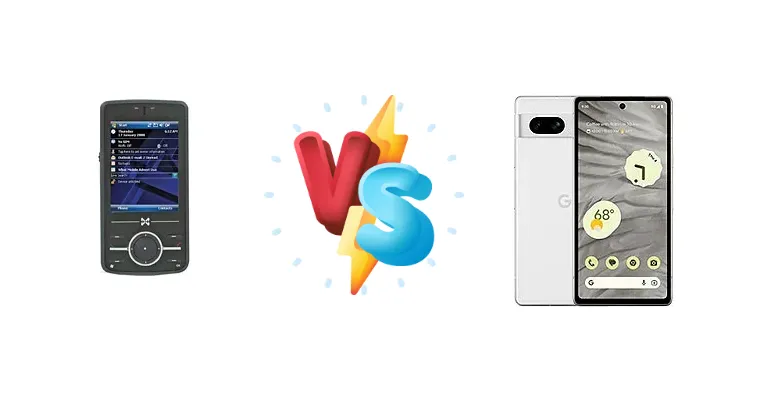
|
🏆 Quick Verdict
For the vast majority of users, the Google Pixel 7a is the clear winner. Its vastly superior processing power, modern features, and excellent camera capabilities make it a far more practical and versatile device. The MWg Atom V is a niche device for collectors and enthusiasts interested in retro computing.
| PHONES | ||
|---|---|---|
| Phone Names | MWg Atom V | Google Pixel 7a |
| Network | ||
|---|---|---|
| 2G bands | GSM 850 / 900 / 1800 / 1900 | GSM 850 / 900 / 1800 / 1900 |
| 3G bands | HSDPA 2100 | HSDPA 800 / 850 / 900 / 1700(AWS) / 1900 / 2100 |
| 4G bands | - | 1, 2, 3, 4, 5, 7, 8, 12, 13, 14, 17, 20, 25, 26, 28, 29, 30, 38, 40, 41, 48, 66, 71 - GWKK3, G0DZQ |
| 5G bands | - | 1, 2, 3, 5, 7, 8, 12, 14, 20, 25, 28, 30, 38, 41, 48, 66, 71, 77, 78 SA/NSA/Sub6 - GWKK3 |
| Speed | HSPA 7.2/0.384 Mbps | HSPA, LTE, 5G |
| Technology | GSM / HSPA | GSM / HSPA / LTE / 5G |
| - | 1, 2, 3, 5, 7, 8, 12, 20, 25, 28, 38, 40, 41, 66, 75, 76, 77, 78, 79 SA/NSA/Sub6 - GHL1X, G82U8 | |
| Launch | ||
|---|---|---|
| Announced | 2008, March | 2023, May 10 |
| Status | Discontinued | Available. Released 2023, May 10 |
| Body | ||
|---|---|---|
| Build | - | Glass front (Gorilla Glass 3), aluminum frame, plastic back |
| Dimensions | 116 x 59 x 15 mm (4.57 x 2.32 x 0.59 in) | 152 x 72.9 x 9 mm (5.98 x 2.87 x 0.35 in) |
| SIM | Mini-SIM | Nano-SIM + eSIM |
| Weight | 133 g (4.69 oz) | 193.5 g (6.84 oz) |
| - | IP67 dust/water resistant (up to 1m for 30 min) | |
| Display | ||
|---|---|---|
| Protection | - | Corning Gorilla Glass 3 |
| Resolution | 240 x 320 pixels, 4:3 ratio (~143 ppi density) | 1080 x 2400 pixels, 20:9 ratio (~429 ppi density) |
| Size | 2.8 inches, 24.3 cm2 (~35.5% screen-to-body ratio) | 6.1 inches, 90.7 cm2 (~81.8% screen-to-body ratio) |
| Type | TFT resistive touchscreen, 256K colors (65K effective) | OLED, HDR, 90Hz |
| Handwriting recognition | Always-on display | |
| Platform | ||
|---|---|---|
| CPU | Intel XScale PXA 270 520 MHz | Octa-core (2x2.85 GHz Cortex-X1 & 2x2.35 GHz Cortex-A78 & 4x1.80 GHz Cortex-A55) |
| Chipset | - | Google Tensor G2 (5 nm) |
| GPU | - | Mali-G710 MP7 |
| OS | Microsoft Windows Mobile 6 Professional | Android 13, upgradable to Android 15, up to 5 major Android upgrades |
| Memory | ||
|---|---|---|
| Card slot | microSDHC (dedicated slot) | No |
| Internal | 64MB RAM, 256MB ROM | 128GB 8GB RAM |
| - | UFS 3.1 | |
| Main Camera | ||
|---|---|---|
| Dual | - | 64 MP, f/1.9, 26mm (wide), 1/1.73", 0.8µm, dual pixel PDAF, OIS 13 MP, f/2.2, 120˚ (ultrawide), 1.12µm |
| Features | LED flash | Dual-LED flash, Pixel Shift, Auto-HDR, panorama |
| Single | 2 MP | - |
| Video | Yes | 4K@30/60fps, 1080p@30/60/120/240fps, OIS |
| Selfie camera | ||
|---|---|---|
| Features | - | HDR, panorama |
| Single | - | 13 MP, f/2.2, 20mm (ultrawide), 1.12µm |
| Video | - | 4K@30fps, 1080p@30fps |
| No | - | |
| Sound | ||
|---|---|---|
| 3.5mm jack | No | No |
| 35mm jack | No | No |
| Loudspeaker | Yes, with stereo speakers | Yes, with stereo speakers |
| Comms | ||
|---|---|---|
| Bluetooth | 2.0, A2DP | 5.3, A2DP, LE |
| Infrared port | Yes | - |
| NFC | - | Yes |
| Positioning | GPS, SiRF Star III chipset | GPS, GLONASS, GALILEO, BDS, QZSS, NavIC |
| Radio | Stereo FM radio, RDS | No |
| USB | miniUSB | USB Type-C 3.2 |
| WLAN | Wi-Fi 802.11b/g | Wi-Fi 802.11 a/b/g/n/ac/6e, tri-band |
| Features | ||
|---|---|---|
| Browser | WAP 2.0/xHTML, HTML (PocketIE) | - |
| Sensors | - | Fingerprint (under display, optical), accelerometer, gyro, proximity, compass, barometer |
| Pocket Office Voice memo MP3/AAC/MP4 player Predictive text input | - | |
| Battery | ||
|---|---|---|
| Charging | - | 18W wired, PD3.0 7.5W wireless |
| Stand-by | Up to 150 h | - |
| Talk time | Up to 3 h 30 min | - |
| Type | Removable Li-Po 1300 mAh battery | Li-Po 4385 mAh |
| Misc | ||
|---|---|---|
| Colors | Black | Charcoal, Snow, Sea, Coral |
| Models | - | GWKK3, GHL1X, G0DZQ, G82U8 |
| Price | - | € 179.90 / $ 150.00 / £ 170.00 / ₹ 25,980 |
MWg Atom V
- Extremely portable and lightweight
- Nostalgic appeal for retro tech enthusiasts
- Simple operating system (Windows Mobile)
- Extremely limited processing power
- Outdated display technology
- Poor camera capabilities
- Limited software support
Google Pixel 7a
- Powerful Google Tensor G2 processor
- Excellent camera system with computational photography
- Long battery life and fast charging
- Modern Android operating system with access to apps
- May be too large for some users
- Not as unique or collectible as the Atom V
- No expandable storage
Display Comparison
The Pixel 7a boasts a significantly more advanced display, achieving a measured peak brightness of 1070 nits. This is crucial for outdoor visibility, something the Atom V, with its older LCD technology, simply cannot match. While the Atom V's screen size isn't specified, it's likely smaller and lower resolution than the Pixel 7a's, impacting readability and usability. The Pixel 7a's modern panel likely incorporates features like color calibration and potentially a higher refresh rate (though not specified), further enhancing the viewing experience.
Camera Comparison
The Pixel 7a's camera system is in a different league. While specific sensor details aren't provided, Google's computational photography prowess, powered by the Tensor G2, delivers exceptional image quality. The Pixel 7a excels in low-light conditions and offers features like portrait mode and video stabilization. The Atom V, if equipped with a camera (often a low-resolution VGA sensor), would offer a drastically inferior experience, limited by its sensor size, lack of image stabilization, and primitive image processing capabilities. The Pixel 7a's photo and video capabilities are a core selling point, while the Atom V's are largely non-existent for practical use.
Performance
The performance gap is immense. The Intel XScale PXA 270 at 520 MHz in the Atom V is dwarfed by the Google Tensor G2's octa-core configuration (2x2.85 GHz Cortex-X1, 2x2.35 GHz Cortex-A78, 4x1.80 GHz Cortex-A55) fabricated on a 5nm process. The Tensor G2's architecture allows for complex tasks like AI-powered image processing and smooth multitasking, which are impossible for the Atom V. The 5nm process also contributes to significantly better thermal efficiency, preventing throttling during sustained workloads. The Atom V is limited to basic tasks and older applications.
Battery Life
The Pixel 7a's endurance rating of 76 hours suggests a well-optimized power management system. While the Atom V's battery capacity is unknown, its older processor and smaller screen likely result in a shorter runtime, but also lower overall power demands. The Pixel 7a offers the convenience of 18W wired charging with PD3.0 and 7.5W wireless charging, features unavailable on the Atom V, which would rely on a proprietary charging connector and slower charging speeds.
Buying Guide
Buy the MWg Atom V if you're a collector of vintage technology, enjoy tinkering with legacy operating systems (Windows Mobile), and prioritize portability above all else. Buy the Google Pixel 7a if you need a powerful, feature-rich smartphone with a high-quality camera, long battery life, and access to the latest Android updates and applications.