
Motorola ThinkPhone vs. Edge 40: A Head-to-Head Showdown
| Phones Images | |||||
|---|---|---|---|---|---|
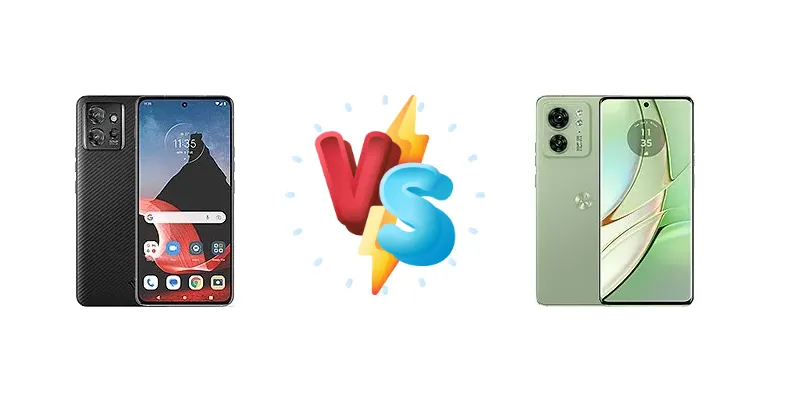
|
🏆 Quick Verdict
The ThinkPhone edges out the Edge 40 thanks to its significantly better battery life and the more powerful Snapdragon 8+ Gen 1 chipset. While the Edge 40 offers a sleek design and vibrant display, the ThinkPhone's performance and endurance make it the overall winner for most users.
| PHONES | ||
|---|---|---|
| Phone Names | Motorola ThinkPhone | Motorola Edge 40 |
| Network | ||
|---|---|---|
| 2G bands | GSM 850 / 900 / 1800 / 1900 | GSM 850 / 900 / 1800 / 1900 |
| 3G bands | HSDPA 800 / 850 / 900 / 1700(AWS) / 1900 / 2100 - ROW | HSDPA 850 / 900 / 1700(AWS) / 1900 / 2100 |
| 4G bands | 1, 2, 3, 4, 5, 7, 8, 12, 13, 17, 18, 19, 20, 25, 26, 28, 32, 38, 38, 39, 40, 41, 42, 43, 48, 66 - ROW | 1, 2, 3, 4, 5, 7, 8, 12, 13, 17, 20, 26, 28, 32, 38, 39, 40, 41, 42, 43, 66 |
| 5G bands | 1, 2, 3, 5, 7, 8, 20, 28, 38, 40, 41, 66, 77, 78 SA/NSA/Sub6 - ROW | 1, 2, 3, 5, 7, 8, 20, 28, 38, 40, 41, 66, 77, 78 SA/NSA/Sub6 |
| Speed | HSPA, LTE, 5G | HSPA, LTE, 5G |
| Technology | GSM / HSPA / LTE / 5G | GSM / HSPA / LTE / 5G |
| 1, 2, 3, 5, 7, 8, 20, 28, 38, 41, 66, 77, 78 SA/NSA/Sub6 - China | - | |
| Launch | ||
|---|---|---|
| Announced | 2023, January 05 | 2023, May 04 |
| Status | Available. Released 2023, January 29 | Available. Released 2023, May 04 |
| Body | ||
|---|---|---|
| Build | Glass front (Gorilla Glass Victus), aramid fibre back, aluminum frame | Glass front, aluminum frame, plastic back or eco leather back |
| Dimensions | 158.8 x 74.4 x 8.3 mm (6.25 x 2.93 x 0.33 in) | 158.4 x 72 x 7.6 mm (6.24 x 2.83 x 0.30 in) |
| SIM | · Nano-SIM· Nano-SIM + Nano-SIM | · Nano-SIM· Nano-SIM + eSIM· Nano-SIM + Nano-SIM |
| Weight | 188.5 g (6.67 oz) | 167 g or 171 g (5.89 oz) |
| IP68 dust/water resistant (up to 1.5m for 30 min) Drop-to-concrete resistance from up to 1.3m MIL-STD-810H compliant | IP68 dust/water resistant (up to 1.5m for 30 min) | |
| Display | ||
|---|---|---|
| Protection | Corning Gorilla Glass Victus | - |
| Resolution | 1080 x 2400 pixels, 20:9 ratio (~399 ppi density) | 1080 x 2400 pixels, 20:9 ratio (~402 ppi density) |
| Size | 6.6 inches, 105.2 cm2 (~89.0% screen-to-body ratio) | 6.55 inches, 103.6 cm2 (~90.8% screen-to-body ratio) |
| Type | P-OLED, 1B colors, 144Hz, HDR10+ | P-OLED, 144Hz, HDR10+, 1200 nits (peak) |
| Platform | ||
|---|---|---|
| CPU | Octa-core (1x3.19 GHz Cortex-X2 & 3x2.75 GHz Cortex-A710 & 4x1.80 GHz Cortex-A510) | Octa-core (4x2.6 GHz Cortex-A78 & 4x2.0 GHz Cortex-A55) |
| Chipset | Qualcomm SM8475 Snapdragon 8+ Gen 1 (4 nm) | Mediatek Dimensity 8020 (6 nm) |
| GPU | Adreno 730 | Mali-G77 MC9 |
| OS | Android 13, upgradable to Android 15 | Android 13, up to 2 major Android upgrades |
| Memory | ||
|---|---|---|
| Card slot | No | No |
| Internal | 128GB 8GB RAM, 256GB 8GB RAM, 256GB 12GB RAM, 512GB 12GB RAM | 128GB 8GB RAM, 256GB 8GB RAM |
| UFS 3.1 | UFS 3.1 | |
| Main Camera | ||
|---|---|---|
| Dual | - | 50 MP, f/1.4, (wide), 1/1.55", 1.0µm, multi-directional PDAF, OIS 13 MP, f/2.2, 120˚ (ultrawide), 1/3.0", 1.12µm, AF |
| Features | LED flash, panorama, HDR | Dual-LED flash, HDR, panorama |
| Triple | 50 MP, f/1.8, (wide), 1/1.5", 1.0µm, multi-directional PDAF, OIS 13 MP, f/2.2, 120˚ (ultrawide), 1/3.0", 1.12µm, AF Auxiliary lens | - |
| Video | 8K@30fps, 4K@30/60fps, 4K@30fps HDR10, 1080p@30/60/120/240/960fps, gyro-EIS | 4K@30fps, 1080p@30/60/120fps, 720p@960fps, HDR10, gyro-EIS |
| Selfie camera | ||
|---|---|---|
| Features | HDR | HDR |
| Single | 32 MP, f/2.5, (wide), 1/3.0", 0.7µm - ROW model 16 MP, f/2.0, (wide), 1.0µm - PRC model | 32 MP, f/2.4, (wide), 1/3.0", 0.7µm |
| Video | 4K@30fps, 1080p@30/60fps | 4K@30fps, 1080p@30/120fps |
| Sound | ||
|---|---|---|
| 3.5mm jack | No | No |
| 35mm jack | No | No |
| Loudspeaker | Yes, with stereo speakers | Yes, with stereo speakers |
| Comms | ||
|---|---|---|
| Bluetooth | 5.2, A2DP, LE, aptX HD, aptX Adaptive | 5.2, A2DP, LE |
| NFC | Yes | Yes |
| Positioning | GPS, GLONASS, GALILEO | GPS, GLONASS, GALILEO, BDS |
| Radio | No | No |
| USB | USB Type-C 3.1, OTG | USB Type-C 2.0, OTG |
| WLAN | Wi-Fi 802.11 a/b/g/n/ac/6e, tri-band, Wi-Fi Direct | Wi-Fi 802.11 a/b/g/n/ac/6e, tri-band, Wi-Fi Direct |
| Features | ||
|---|---|---|
| Sensors | Fingerprint (under display, optical), accelerometer, gyro, proximity, compass, barometer (North America only) | Fingerprint (under display, optical), accelerometer, gyro, proximity, compass |
| - | Moto Ready For support | |
| Battery | ||
|---|---|---|
| Charging | 68W wired 15W wireless | 68W wired 15W wireless |
| Type | Li-Po 5000 mAh | Li-Po 4400 mAh |
| Misc | ||
|---|---|---|
| Colors | Carbon Black | Nebula Green, Lunar Blue, Eclipse Black, Viva Magenta |
| Models | XT2309-2 | XT2303-2 |
| Price | € 249.79 | € 202.03 / $ 419.99 / £ 199.00 / ₹ 29,999 |
| Tests | ||
|---|---|---|
| Battery life | Endurance rating 116h | Endurance rating 98h |
| Camera | Photo / Video | Photo / Video |
| Display | Contrast ratio: Infinite (nominal) | Contrast ratio: Infinite (nominal) |
| Loudspeaker | -21.6 LUFS (Excellent) | -24.2 LUFS (Very good) |
| Performance | AnTuTu: 1081805 (v9) GeekBench: 4207 (v5.1) GFXBench: 90fps (ES 3.1 onscreen) | AnTuTu: 688347 (v9) GeekBench: 3320 (v5.1), 3603 (v6) GFXBench: 33fps (ES 3.1 onscreen) |
Motorola ThinkPhone
- Exceptional battery life
- Powerful Snapdragon 8+ Gen 1 chipset
- High peak brightness display
- Premium build quality (likely)
- Good performance for gaming
- Design might be less striking than Edge 40
- Camera performance needs further testing
- Potentially higher price
Motorola Edge 40
- Sleek and stylish design
- Vibrant OLED display
- Good overall performance
- Competitive price
- Slim bezels for immersive viewing
- Shorter battery life compared to ThinkPhone
- Dimensity 8020 chipset less powerful than Snapdragon 8+ Gen 1
- Camera performance potentially trails ThinkPhone
Display Comparison
Both phones feature vibrant OLED displays with excellent color accuracy and infinite contrast ratios. The ThinkPhone boasts a slightly higher peak brightness of 1069 nits compared to the Edge 40's 1043 nits, making it marginally better for outdoor visibility. However, the Edge 40's design might offer a more immersive viewing experience due to its slimmer bezels.
Camera Comparison
While both phones offer capable camera systems, detailed camera comparisons require more in-depth testing. Based on available information, both likely offer good image quality in well-lit conditions. The ThinkPhone might have a slight edge in low-light performance due to the more powerful processor assisting image processing. Video recording capabilities are likely comparable.
Performance
The ThinkPhone's Snapdragon 8+ Gen 1 chipset is a clear winner here. It offers significantly faster processing speeds and better graphics performance than the Edge 40's Dimensity 8020. This translates to smoother multitasking, faster app loading times, and a better gaming experience. The ThinkPhone's cooling system is also likely superior, preventing throttling during extended use.
Battery Life
The ThinkPhone's battery life is a standout feature, boasting an endurance rating of 116 hours, significantly surpassing the Edge 40's 98 hours. This means the ThinkPhone can easily last for multiple days on a single charge, making it a champion for users who prioritize longevity.
Buying Guide
The Motorola ThinkPhone is ideal for power users, professionals, and anyone prioritizing long battery life and top-tier performance. The Motorola Edge 40 is a great choice for those seeking a stylish, well-rounded phone with a beautiful display and a focus on aesthetics, especially if battery life isn't a primary concern.