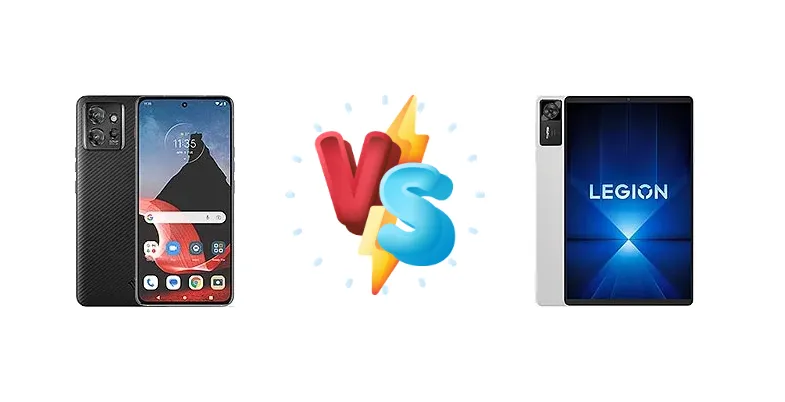
The Motorola ThinkPhone aims to recapture the spirit of the classic ThinkPad in smartphone form, prioritizing a refined user experience and business-centric features. Conversely, the Lenovo Legion Y700 (Gen 4) is a dedicated gaming phone, built for maximum performance and sustained gaming sessions. This comparison dissects their core differences, focusing on how their contrasting chipsets and design philosophies translate into real-world benefits.
🏆 Quick Verdict
For the average user prioritizing a balanced experience with solid battery life and a refined software experience, the Motorola ThinkPhone emerges as the better choice. However, gamers and power users demanding the absolute highest performance will find the Lenovo Legion Y700 (Gen 4) a more compelling option, despite its potentially shorter battery endurance.
| Network |
|---|
| 2G bands | GSM 850 / 900 / 1800 / 1900 | N/A |
| 3G bands | HSDPA 800 / 850 / 900 / 1700(AWS) / 1900 / 2100 - ROW | N/A |
| 4G bands | 1, 2, 3, 4, 5, 7, 8, 12, 13, 17, 18, 19, 20, 25, 26, 28, 32, 38, 38, 39, 40, 41, 42, 43, 48, 66 - ROW | N/A |
| 5G bands | 1, 2, 3, 5, 7, 8, 20, 28, 38, 40, 41, 66, 77, 78 SA/NSA/Sub6 - ROW | - |
| EDGE | - | No |
| GPRS | - | No |
| Speed | HSPA, LTE, 5G | - |
| Technology | GSM / HSPA / LTE / 5G | No cellular connectivity |
| | 1, 2, 3, 5, 7, 8, 20, 28, 38, 41, 66, 77, 78 SA/NSA/Sub6 - China | - |
| Launch |
|---|
| Announced | 2023, January 05 | 2025, May 08 |
| Status | Available. Released 2023, January 29 | Available. Released 2025, May |
| Body |
|---|
| Build | Glass front (Gorilla Glass Victus), aramid fibre back, aluminum frame | Glass front, aluminum frame, aluminum back |
| Dimensions | 158.8 x 74.4 x 8.3 mm (6.25 x 2.93 x 0.33 in) | 7 mm thickness |
| SIM | · Nano-SIM· Nano-SIM + Nano-SIM | No |
| Weight | 188.5 g (6.67 oz) | 340 g (11.99 oz) |
| | IP68 dust/water resistant (up to 1.5m for 30 min)
Drop-to-concrete resistance from up to 1.3m
MIL-STD-810H compliant | - |
| Display |
|---|
| Protection | Corning Gorilla Glass Victus | - |
| Resolution | 1080 x 2400 pixels, 20:9 ratio (~399 ppi density) | 1904 x 3040 pixels, 16:10 ratio (~408 ppi density) |
| Size | 6.6 inches, 105.2 cm2 (~89.0% screen-to-body ratio) | 8.8 inches, 224.8 cm2 |
| Type | P-OLED, 1B colors, 144Hz, HDR10+ | IPS LCD, 68B colors, 165Hz, HDR, 600 nits (typ) |
| Platform |
|---|
| CPU | Octa-core (1x3.19 GHz Cortex-X2 & 3x2.75 GHz Cortex-A710 & 4x1.80 GHz Cortex-A510) | Octa-core (2x4.32 GHz Oryon V2 Phoenix L + 6x3.53 GHz Oryon V2 Phoenix M) |
| Chipset | Qualcomm SM8475 Snapdragon 8+ Gen 1 (4 nm) | Qualcomm SM8750-AB Snapdragon 8 Elite (3 nm) |
| GPU | Adreno 730 | Adreno 830 |
| OS | Android 13, upgradable to Android 15 | Android 15 |
| Memory |
|---|
| Card slot | No | microSDXC |
| Internal | 128GB 8GB RAM, 256GB 8GB RAM, 256GB 12GB RAM, 512GB 12GB RAM | 256GB 12GB RAM, 512GB 16GB RAM, 1TB 16GB RAM |
| | UFS 3.1 | - |
| Main Camera |
|---|
| Features | LED flash, panorama, HDR | LED flash |
| Single | - | 50 MP, (wide), PDAF |
| Triple | 50 MP, f/1.8, (wide), 1/1.5", 1.0µm, multi-directional PDAF, OIS
13 MP, f/2.2, 120˚ (ultrawide), 1/3.0", 1.12µm, AF
Auxiliary lens | - |
| Video | 8K@30fps, 4K@30/60fps, 4K@30fps HDR10, 1080p@30/60/120/240/960fps, gyro-EIS | Yes |
| Selfie camera |
|---|
| Features | HDR | - |
| Single | 32 MP, f/2.5, (wide), 1/3.0", 0.7µm - ROW model
16 MP, f/2.0, (wide), 1.0µm - PRC model | 8 MP |
| Video | 4K@30fps, 1080p@30/60fps | 1080p@30fps |
| Sound |
|---|
| 3.5mm jack | No | - |
| 35mm jack | No | No |
| Loudspeaker | Yes, with stereo speakers | Yes, with stereo speakers |
| Comms |
|---|
| Bluetooth | 5.2, A2DP, LE, aptX HD, aptX Adaptive | Yes |
| NFC | Yes | No |
| Positioning | GPS, GLONASS, GALILEO | No |
| Radio | No | Unspecified |
| USB | USB Type-C 3.1, OTG | 1x USB Type-C 2.0 & 1x USB Type-C 3.2 Gen2, DisplayPort 1.4 |
| WLAN | Wi-Fi 802.11 a/b/g/n/ac/6e, tri-band, Wi-Fi Direct | Yes |
| Features |
|---|
| Sensors | Fingerprint (under display, optical), accelerometer, gyro, proximity, compass, barometer (North America only) | Unspecified |
| Battery |
|---|
| Charging | 68W wired
15W wireless | 68W wired
Bypass charging |
| Type | Li-Po 5000 mAh | Li-Po 7600 mAh |
| Misc |
|---|
| Colors | Carbon Black | Black, White |
| Models | XT2309-2 | TB322FC, ZAG40002CN |
| Price | € 249.79 | About 400 EUR |
| Tests |
|---|
| Battery life |
Endurance rating 116h
| - |
| Camera |
Photo / Video | - |
| Display |
Contrast ratio: Infinite (nominal) | - |
| Loudspeaker |
-21.6 LUFS (Excellent)
| - |
| Performance |
AnTuTu: 1081805 (v9)
GeekBench: 4207 (v5.1)
GFXBench: 90fps (ES 3.1 onscreen) | - |
Motorola ThinkPhone
- Exceptional battery life (116h endurance)
- Refined software experience and security features
- Bright and accurate display (1069 nits)
- Older chipset (Snapdragon 8+ Gen 1)
- Limited camera details available
Lenovo Legion Y700 (Gen 4)
- Cutting-edge Snapdragon 8 Elite chipset (3nm)
- Advanced Oryon CPU architecture for superior performance
- Bypass charging for cooler gaming
- Potentially shorter battery life due to power-hungry chipset
- Limited information on display quality
Display Comparison
The Motorola ThinkPhone boasts a display capable of reaching 1069 nits of peak brightness, ensuring excellent visibility even in direct sunlight. While the Legion Y700’s display specs are not provided, Lenovo’s gaming focus suggests a high refresh rate panel is likely present. The ThinkPhone’s 'Infinite' contrast ratio (nominal) indicates a strong OLED panel, but without comparable data for the Legion Y700, a direct comparison is difficult. The ThinkPhone’s display is geared towards accurate color reproduction and comfortable viewing, while the Legion Y700 likely prioritizes responsiveness for gaming.
Camera Comparison
Both devices feature 'Photo / Video' capabilities, but detailed camera specifications are absent. Given the ThinkPhone’s positioning, it likely emphasizes balanced image quality and reliable performance in various lighting conditions. The Legion Y700, while capable, likely prioritizes video recording for streaming and content creation. Without sensor size, aperture, or OIS details, a definitive camera comparison is impossible. It's safe to assume both will offer adequate performance for social media and casual photography.
Performance
The core difference lies in the chipsets. The Motorola ThinkPhone utilizes the Qualcomm Snapdragon 8+ Gen 1 (4nm), a proven performer. The Lenovo Legion Y700 (Gen 4) leaps ahead with the Snapdragon 8 Elite (3nm), featuring Oryon V2 Phoenix CPU cores. This 3nm process node offers significant gains in power efficiency and transistor density compared to the ThinkPhone’s 4nm node, translating to potentially higher sustained performance and reduced thermal throttling. The Legion Y700’s CPU configuration (2x4.32 GHz Oryon V2 Phoenix L + 6x3.53 GHz Oryon V2 Phoenix M) is architecturally more advanced than the ThinkPhone’s (1x3.19 GHz Cortex-X2 & 3x2.75 GHz Cortex-A710 & 4x1.80 GHz Cortex-A510), promising a noticeable performance uplift in demanding tasks and games.
Battery Life
The Motorola ThinkPhone achieves an impressive endurance rating of 116 hours, suggesting excellent battery optimization. Both phones support 68W wired charging, allowing for relatively quick top-ups. The Legion Y700 adds 'bypass charging,' which allows the phone to be used while charging, minimizing heat buildup and potentially extending battery lifespan during long gaming sessions. However, the more powerful chipset in the Legion Y700 is likely to consume more power, potentially offsetting the benefits of bypass charging and resulting in shorter real-world battery life compared to the ThinkPhone.
Buying Guide
Buy the Motorola ThinkPhone if you need a reliable, secure, and long-lasting smartphone with a focus on productivity and a clean software experience. Its 116-hour endurance rating and business-oriented features make it ideal for professionals. Buy the Lenovo Legion Y700 (Gen 4) if you prioritize raw gaming performance, cutting-edge CPU architecture, and are willing to trade some battery life for the fastest possible Android experience.
Frequently Asked Questions
❓ Does the Snapdragon 8 Elite in the Legion Y700 get noticeably hotter than the Snapdragon 8+ Gen 1 in the ThinkPhone during extended gaming?
While the Snapdragon 8 Elite's 3nm process is more efficient, its higher performance ceiling means it will likely generate more heat under sustained load. The Legion Y700's bypass charging feature is designed to mitigate this by allowing the phone to be powered directly while charging, reducing heat buildup. However, the ThinkPhone will likely remain cooler overall due to its less demanding chipset.
❓ How does the software experience differ between the ThinkPhone and the Legion Y700, and which is better for productivity?
The ThinkPhone is expected to offer a near-stock Android experience with Motorola's signature additions, focusing on security and productivity features. The Legion Y700 likely features Lenovo's gaming-focused software, which may include performance boosters and game-specific optimizations. For productivity, the ThinkPhone's cleaner software and emphasis on security make it the superior choice.
❓ Is the 68W charging on both phones equally fast, considering the different battery capacities (which are unknown for the Legion Y700)?
While both phones support 68W charging, the actual charging speed will depend on battery capacity and charging curve. The Legion Y700's bypass charging could potentially allow for faster charging while gaming, but without knowing the battery size, it's difficult to definitively say which phone charges faster overall. The ThinkPhone's optimized battery management may result in more efficient charging.