
Motorola ThinkPhone 25 vs. Sony Xperia 1 VII: A Deep Dive Comparison
| Phones Images | |||||
|---|---|---|---|---|---|
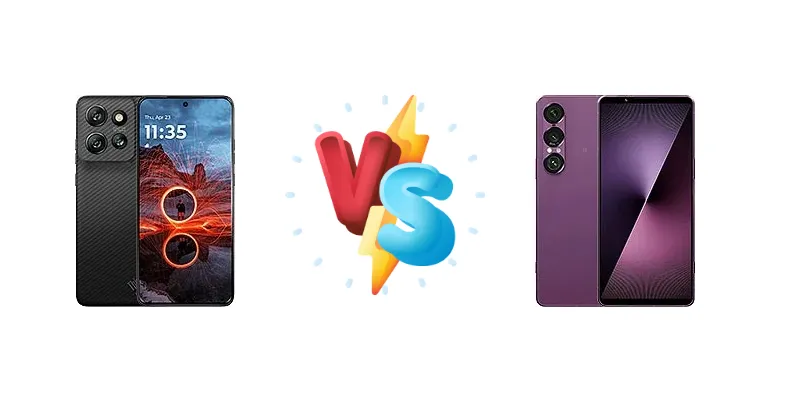
|
🏆 Quick Verdict
For the average user prioritizing raw performance and display quality, the Sony Xperia 1 VII is the superior choice. Its Snapdragon 8 Elite chipset and brighter display offer a noticeable advantage. However, the ThinkPhone 25 provides excellent battery endurance and faster charging for those prioritizing longevity and convenience.
| PHONES | ||
|---|---|---|
| Phone Names | Motorola ThinkPhone 25 | Sony Xperia 1 VII |
| Network | ||
|---|---|---|
| 2G bands | GSM 850 / 900 / 1800 / 1900 | GSM 850 / 900 / 1800 / 1900 |
| 3G bands | HSDPA 850 / 900 / 1700(AWS) / 1900 / 2100 | HSDPA 800 / 850 / 900 / 1700(AWS) / 1900 / 2100 |
| 4G bands | 1, 2, 3, 4, 5, 7, 8, 12, 13, 17, 18, 19, 20, 25, 26, 28, 32, 38, 39, 40, 41, 42, 43, 66 | 1, 2, 3, 4, 5, 7, 8, 12, 13, 17, 19, 20, 25, 26, 28, 32, 34, 38, 39, 40, 41, 66 - Europe |
| 5G bands | 1, 2, 3, 5, 7, 8, 20, 26, 28, 38, 40, 41, 66, 75, 77, 78 SA/NSA/Sub6 | 1, 3, 5, 7, 8, 20, 28, 38, 40, 41, 75, 77, 78 SA/NSA/Sub6 - Europe |
| Speed | HSPA, LTE, 5G | HSPA, LTE, 5G |
| Technology | GSM / HSPA / LTE / 5G | GSM / HSPA / LTE / 5G |
| Launch | ||
|---|---|---|
| Announced | 2024, October 01 | 2025, May 13 |
| Status | Available. Released 2024, November 11 | Available. Released 2025, June 04 |
| Body | ||
|---|---|---|
| Build | Glass front (Gorilla Glass 7i), aramid fibre back, plastic frame | Glass front (Gorilla Glass Victus 2), glass back (Gorilla Glass Victus), aluminum frame |
| Dimensions | 154.1 x 71.2 x 8.1 mm (6.07 x 2.80 x 0.32 in) | 162 x 74 x 8.2 mm (6.38 x 2.91 x 0.32 in) |
| SIM | · Nano-SIM + eSIM· Nano-SIM + Nano-SIM | · Nano-SIM + eSIM· Nano-SIM + Nano-SIM |
| Weight | 171 g (6.03 oz) | 197 g (6.95 oz) |
| Display | ||
|---|---|---|
| Protection | Corning Gorilla Glass 7i, Mohs level 4 | Corning Gorilla Glass Victus 2, Mohs level 5 |
| Resolution | 1220 x 2670 pixels, 19.5:9 ratio (~462 ppi density) | 1080 x 2340 pixels, 19.5:9 ratio (~396 ppi density) |
| Size | 6.36 inches, 98.6 cm2 (~89.9% screen-to-body ratio) | 6.5 inches, 103.7 cm2 (~86.5% screen-to-body ratio) |
| Type | P-OLED, 1B colors, 120Hz, HDR10+, 3000 nits (peak) | LTPO OLED, 1B colors, 120Hz, HDR BT.2020 |
| Platform | ||
|---|---|---|
| CPU | Octa-core (4x2.5 GHz Cortex-A78 & 4x2.0 GHz Cortex-A55) | Octa-core (2x4.32 GHz Oryon V2 Phoenix L + 6x3.53 GHz Oryon V2 Phoenix M) |
| Chipset | Mediatek Dimensity 7300 (4 nm) | Qualcomm SM8750-AB Snapdragon 8 Elite (3 nm) |
| GPU | Mali-G615 MC2 | Adreno 830 |
| OS | Android 14, up to 5 major Android upgrades | Android 15, up to 4 major Android upgrades |
| Memory | ||
|---|---|---|
| Card slot | No | microSDXC (uses shared SIM slot) |
| Internal | 256GB 8GB RAM, 512GB 12GB RAM | 256GB 12GB RAM, 512GB 12GB RAM |
| Main Camera | ||
|---|---|---|
| Features | LED flash, panorama, HDR | Zeiss optics, Zeiss T* lens coating, color spectrum sensor, LED flash, panorama, HDR, eye tracking |
| Triple | 50 MP, f/1.8, (wide), 1.0µm, dual pixel PDAF, OIS 10 MP, f/2.0, (telephoto), 1.0µm, PDAF, OIS, 3x optical zoom 13 MP, f/2.2, 120˚ (ultrawide), 1.12µm, PDAF | 48 MP, f/1.9, 24mm (wide), 1/1.35", 1.12µm, dual pixel PDAF, OIS 12 MP, f/2.3, 85mm (telephoto), f/3.5, 170mm (telephoto), 1/3.5", 1.0µm, dual pixel PDAF, 3.5x-7.1x continuous optical zoom, OIS, 4cm macro @ 120mm, no AF 48 MP, f/2.0, 16mm (ultrawide), 1/1.56", 1.0µm, PDAF |
| Video | 4K@30/60fps, 1080p@30/60/120/240fps, gyro-EIS | 4K@24/30/60/120fps HDR, 1080p@30/60/120fps; 5-axis gyro-EIS, OIS |
| Selfie camera | ||
|---|---|---|
| Features | - | HDR |
| Single | 32 MP, f/2.4, (wide), 0.7µm | 12 MP, f/2.0, 24mm (wide), 1/2.9", 1.22µm |
| Video | 4K@30fps, 1080p@30/60/120fps | 4K@30/60fps, 1080p@30/60fps, 5-axis gyro-EIS |
| Sound | ||
|---|---|---|
| 35mm jack | No | Yes |
| Loudspeaker | Yes, with stereo speakers | Yes, with stereo speakers |
| Comms | ||
|---|---|---|
| Bluetooth | 5.4, A2DP, LE | 6.0, A2DP, LE Audio, aptX HD, aptX Adaptive, aptX Lossless |
| NFC | Yes | Yes |
| Positioning | GPS, GLONASS, GALILEO | GPS, GLONASS, BDS, GALILEO, QZSS |
| Radio | FM radio | No |
| USB | USB Type-C 2.0 | USB Type-C 3.2, OTG, video output |
| WLAN | Wi-Fi 802.11 a/b/g/n/ac/6e, tri-band | Wi-Fi 802.11 a/b/g/n/ac/6e/7, tri-band, Wi-Fi Direct, DLNA |
| Features | ||
|---|---|---|
| Sensors | Fingerprint (under display, optical), accelerometer, gyro, proximity, compass | Fingerprint (side-mounted), accelerometer, gyro, proximity, barometer, compass |
| Battery | ||
|---|---|---|
| Charging | 68W wired, 50% in 11 min 15W wireless | 30W wired, PD3.0, PPS, 50% in 30 min 15W wireless Reverse wireless |
| Type | 4310 mAh | 5000 mAh |
| Misc | ||
|---|---|---|
| Colors | Carbon Black | Moss Green, Orchid Purple, Slate Black |
| Models | XT2409-6 | XQ-FS54, XQFS54EUKCG.GC, XQFS54EUKCV.GC, XQFS54EUKCB.GC, PDX256 |
| Price | € 350.20 / £ 278.98 | € 1,338.99 / $ 1,394.99 / £ 1,149.94 |
| EU LABEL | ||
|---|---|---|
| Battery | 50:44h endurance, 1200 cycles | 43:30h endurance, 1400 cycles |
| Energy | Class A | Class B |
| Free fall | Class B (180 falls) | Class B (181 falls) |
| Repairability | Class B | Class D |
Motorola ThinkPhone 25
- Exceptional battery endurance (50:44h)
- Faster 68W wired charging
- More affordable price point
- Less powerful chipset (Dimensity 7300)
- Likely lower display brightness and quality
Sony Xperia 1 VII
- Superior performance (Snapdragon 8 Elite)
- Brighter, higher-quality display (1475 nits)
- Reverse wireless charging
- Shorter battery life (43:30h)
- Slower 30W wired charging
- Higher price
Display Comparison
The Sony Xperia 1 VII boasts a significant advantage in display technology, achieving a measured peak brightness of 1475 nits. This is substantially brighter than what we’d expect from the ThinkPhone 25, making it far more usable in direct sunlight. While the ThinkPhone 25’s panel specs are not provided, Sony’s focus on color accuracy and brightness caters to content creators and media consumers. The Xperia 1 VII’s display is likely to offer a wider color gamut and superior HDR performance. The absence of LTPO information for the ThinkPhone 25 suggests a potentially less efficient variable refresh rate implementation compared to Sony’s likely inclusion of this technology.
Camera Comparison
Without detailed camera specifications for either device, a direct comparison is limited. However, Sony’s history with camera technology suggests a strong emphasis on image processing and sensor quality in the Xperia 1 VII. The absence of any mention of a high-resolution sensor on the ThinkPhone 25 implies a more modest camera system focused on everyday photography. The Xperia 1 VII likely features a larger main sensor and more advanced image stabilization (OIS) for superior low-light performance and video recording. We can assume Sony will prioritize natural color reproduction and dynamic range, while Motorola may lean towards more saturated, social media-friendly images.
Performance
The core difference lies in the chipsets: the Motorola ThinkPhone 25 utilizes the Mediatek Dimensity 7300 (4nm), while the Sony Xperia 1 VII is powered by the Qualcomm Snapdragon 8 Elite (3nm). The Snapdragon 8 Elite, with its Oryon V2 Phoenix CPU cores (2x4.32 GHz + 6x3.53 GHz), offers a substantial performance leap over the Dimensity 7300’s Cortex-A78/A55 configuration (2.5 GHz/2.0 GHz). The 3nm process node of the Snapdragon 8 Elite also translates to improved thermal efficiency, reducing the likelihood of throttling during sustained workloads like gaming or video editing. The Xperia 1 VII will deliver a smoother experience in graphically intensive applications and multitasking.
Battery Life
The Motorola ThinkPhone 25 claims a 50:44h endurance rating, while the Sony Xperia 1 VII offers 43:30h. This suggests the ThinkPhone 25 provides significantly longer battery life under typical usage. However, the Xperia 1 VII’s active use score of 15:32h provides a more realistic measure of performance during intensive tasks. The ThinkPhone 25’s 68W wired charging (50% in 11 minutes) is considerably faster than the Xperia 1 VII’s 30W charging (50% in 30 minutes). Both support 15W wireless charging, but the Xperia 1 VII adds reverse wireless charging, a convenient feature for topping up accessories. The ThinkPhone 25’s 1200 charge cycles suggest a longer lifespan for the battery itself.
Buying Guide
Buy the Motorola ThinkPhone 25 if you need exceptional battery life, fast 68W charging, and a more affordable price point. It’s ideal for professionals who rely heavily on their phone throughout the day and value practicality. Buy the Sony Xperia 1 VII if you prefer a brighter, more vibrant display, top-tier processing power for demanding tasks, and a premium build quality, even if it means sacrificing some battery endurance and paying a higher price.