
Motorola ThinkPhone 25 vs. Asus ROG Phone 8 Pro: A Deep Dive Comparison
| Phones Images | |||||
|---|---|---|---|---|---|
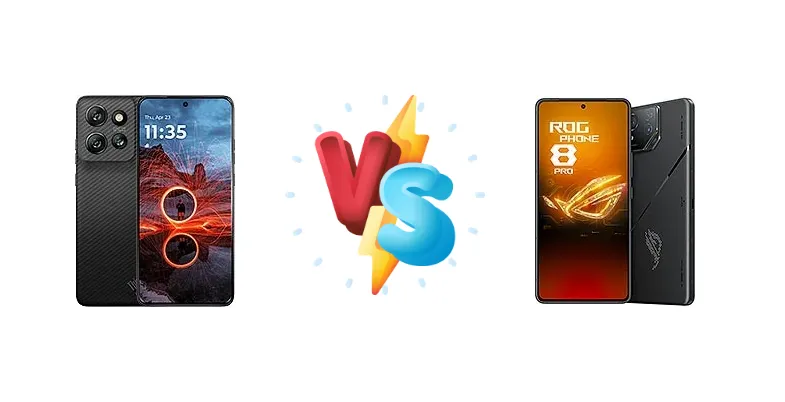
|
🏆 Quick Verdict
For the average user prioritizing battery life and a secure, business-oriented experience, the Motorola ThinkPhone 25 emerges as the winner. Its exceptional 50:44h endurance and focus on software security outweigh the ROG Phone 8 Pro’s raw processing power. However, gamers will find the ROG Phone 8 Pro’s Snapdragon 8 Gen 3 and advanced features indispensable.
| PHONES | ||
|---|---|---|
| Phone Names | Motorola ThinkPhone 25 | Asus ROG Phone 8 Pro |
| Network | ||
|---|---|---|
| 2G bands | GSM 850 / 900 / 1800 / 1900 | GSM 850 / 900 / 1800 / 1900 |
| 3G bands | HSDPA 850 / 900 / 1700(AWS) / 1900 / 2100 | HSDPA 850 / 900 / 1700(AWS) / 1800 / 1900 / 2100 - International |
| 4G bands | 1, 2, 3, 4, 5, 7, 8, 12, 13, 17, 18, 19, 20, 25, 26, 28, 32, 38, 39, 40, 41, 42, 43, 66 | 1, 2, 3, 4, 5, 7, 8, 12, 17, 18, 19, 20, 25, 26, 28, 32, 34, 38, 39, 40, 41, 42, 43, 48, 66 - International |
| 5G bands | 1, 2, 3, 5, 7, 8, 20, 26, 28, 38, 40, 41, 66, 75, 77, 78 SA/NSA/Sub6 | 1, 2, 3, 5, 7, 8, 12, 18, 20, 25, 26, 28, 38, 40, 41, 48, 66, 77, 78, 79 SA/NSA/Sub6 - International |
| Speed | HSPA, LTE, 5G | HSPA, LTE (Up to 7CA), 5G |
| Technology | GSM / HSPA / LTE / 5G | GSM / CDMA / HSPA / LTE / 5G |
| Launch | ||
|---|---|---|
| Announced | 2024, October 01 | 2024, January 08 |
| Status | Available. Released 2024, November 11 | Available. Released 2024, January 18 |
| Body | ||
|---|---|---|
| Build | Glass front (Gorilla Glass 7i), aramid fibre back, plastic frame | Glass front (Gorilla Glass Victus 2), glass back (Gorilla Glass), aluminum frame |
| Dimensions | 154.1 x 71.2 x 8.1 mm (6.07 x 2.80 x 0.32 in) | 163.8 x 76.8 x 8.9 mm (6.45 x 3.02 x 0.35 in) |
| SIM | · Nano-SIM + eSIM· Nano-SIM + Nano-SIM | Nano-SIM + Nano-SIM |
| Weight | 171 g (6.03 oz) | 225 g (7.94 oz) |
| Display | ||
|---|---|---|
| Protection | Corning Gorilla Glass 7i, Mohs level 4 | Corning Gorilla Glass Victus 2 |
| Resolution | 1220 x 2670 pixels, 19.5:9 ratio (~462 ppi density) | 1080 x 2400 pixels, 20:9 ratio (~388 ppi density) |
| Size | 6.36 inches, 98.6 cm2 (~89.9% screen-to-body ratio) | 6.78 inches, 111.0 cm2 (~88.2% screen-to-body ratio) |
| Type | P-OLED, 1B colors, 120Hz, HDR10+, 3000 nits (peak) | LTPO AMOLED, 1B colors, 165Hz, HDR10, 1600 nits (HBM), 2500 nits (peak) |
| Platform | ||
|---|---|---|
| CPU | Octa-core (4x2.5 GHz Cortex-A78 & 4x2.0 GHz Cortex-A55) | Octa-core (1x3.3 GHz Cortex-X4 & 3x3.2 GHz Cortex-A720 & 2x3.0 GHz Cortex-A720 & 2x2.3 GHz Cortex-A520) |
| Chipset | Mediatek Dimensity 7300 (4 nm) | Qualcomm SM8650-AB Snapdragon 8 Gen 3 (4 nm) |
| GPU | Mali-G615 MC2 | Adreno 750 |
| OS | Android 14, up to 5 major Android upgrades | Android 14, up to 2 major Android upgrades |
| Memory | ||
|---|---|---|
| Card slot | No | No |
| Internal | 256GB 8GB RAM, 512GB 12GB RAM | 512GB 16GB RAM, 1TB 24GB RAM |
| Main Camera | ||
|---|---|---|
| Features | LED flash, panorama, HDR | LED flash, HDR, panorama |
| Triple | 50 MP, f/1.8, (wide), 1.0µm, dual pixel PDAF, OIS 10 MP, f/2.0, (telephoto), 1.0µm, PDAF, OIS, 3x optical zoom 13 MP, f/2.2, 120˚ (ultrawide), 1.12µm, PDAF | 50 MP, f/1.9, 24mm (wide), 1/1.56", 1.0µm, PDAF, gimbal OIS 32 MP, f/2.4, (telephoto), 1/3.2", 0.7µm, PDAF, OIS, 3x optical zoom 13 MP, f/2.2, 13mm, 120˚ (ultrawide) |
| Video | 4K@30/60fps, 1080p@30/60/120/240fps, gyro-EIS | 8K@24fps, 4K@30/60fps, 1080p@30/60/120/240fps, 720p@480fps; gyro-EIS, HDR10+ |
| Selfie camera | ||
|---|---|---|
| Features | - | Panorama, HDR |
| Single | 32 MP, f/2.4, (wide), 0.7µm | 32 MP, f/2.5, 22mm (wide), 1/3.2", 0.7µm |
| Video | 4K@30fps, 1080p@30/60/120fps | 1080p@30fps |
| Sound | ||
|---|---|---|
| 35mm jack | No | Yes |
| Loudspeaker | Yes, with stereo speakers | Yes, with stereo speakers |
| Comms | ||
|---|---|---|
| Bluetooth | 5.4, A2DP, LE | 5.4, A2DP, LE, aptX HD, aptX Adaptive, aptX Lossless |
| NFC | Yes | Yes |
| Positioning | GPS, GLONASS, GALILEO | GPS (L1+L5), BDS (B1I+B1c+B2a), GALILEO (E1+E5a), QZSS (L1+L5), NavIC (L5), GLONASS |
| Radio | FM radio | No |
| USB | USB Type-C 2.0 | USB Type-C (side), DisplayPort 1.4; USB Type-C (bottom), OTG |
| WLAN | Wi-Fi 802.11 a/b/g/n/ac/6e, tri-band | Wi-Fi 802.11 a/b/g/n/ac/6e/7, tri-band, Wi-Fi Direct |
| Features | ||
|---|---|---|
| Sensors | Fingerprint (under display, optical), accelerometer, gyro, proximity, compass | Fingerprint (under display, optical), accelerometer, gyro, proximity, compass |
| Battery | ||
|---|---|---|
| Charging | 68W wired, 50% in 11 min 15W wireless | 65W wired, PD3.0, PPS, QC5, 100% in 39 min - International 30W wired, PD3.0, PPS - India 15W wireless (Qi) 10W reverse wired |
| Type | 4310 mAh | 5500 mAh |
| Misc | ||
|---|---|---|
| Colors | Carbon Black | Phantom Black |
| Models | XT2409-6 | AI2401, AI2401_A, AI2401_D |
| Price | € 350.20 / £ 278.98 | $ 1,157.98 / £ 1,693.75 / € 632.66 |
| EU LABEL | ||
|---|---|---|
| Battery | 50:44h endurance, 1200 cycles | - |
| Energy | Class A | - |
| Free fall | Class B (180 falls) | - |
| Repairability | Class B | - |
Motorola ThinkPhone 25
- Exceptional battery life (50:44h endurance)
- Fast charging (68W wired)
- Focus on security and productivity
- Less powerful processor than the ROG Phone 8 Pro
- Limited camera details available
Asus ROG Phone 8 Pro
- Flagship Snapdragon 8 Gen 3 processor
- Extremely bright and responsive display (1765 nits)
- Fast wired charging (65W)
- Significantly shorter battery life (14:43h)
- Higher price point
Display Comparison
The Asus ROG Phone 8 Pro boasts a significantly brighter display, reaching a measured 1765 nits, making it far more usable in direct sunlight compared to the ThinkPhone 25 (brightness data unavailable). While the ThinkPhone 25’s panel specifications are unknown, the ROG Phone 8 Pro’s likely utilizes an AMOLED panel with a high refresh rate, crucial for smooth gaming. The ROG Phone 8 Pro’s display is geared towards visual fidelity and responsiveness, while the ThinkPhone 25 likely prioritizes efficiency.
Camera Comparison
The context data for both devices is limited regarding camera specifics. However, the ROG Phone 8 Pro’s branding suggests a more comprehensive camera system, likely including advanced features for both photo and video capture. The ThinkPhone 25, geared towards business users, likely prioritizes a reliable and functional camera for conferencing and document scanning over advanced photography capabilities. Without detailed sensor information, it’s difficult to make a definitive judgment, but the ROG Phone 8 Pro is expected to offer greater versatility.
Performance
The core difference lies in the chipsets. The Asus ROG Phone 8 Pro’s Qualcomm Snapdragon 8 Gen 3 (4nm) is a flagship powerhouse, featuring an octa-core configuration with a prime Cortex-X4 core clocked at 3.3 GHz. This architecture delivers substantially higher CPU and GPU performance than the Motorola ThinkPhone 25’s MediaTek Dimensity 7300 (4nm). The Dimensity 7300, while efficient, is positioned in a lower performance tier, with its Cortex-A78 cores clocked at 2.5 GHz. This translates to faster app loading, smoother multitasking, and superior gaming performance on the ROG Phone 8 Pro. The ROG Phone 8 Pro’s LPDDR5x RAM further enhances performance, while the ThinkPhone 25’s RAM specification is unknown.
Battery Life
The Motorola ThinkPhone 25 excels in battery endurance, achieving an impressive 50:44h of usage. This is significantly longer than the Asus ROG Phone 8 Pro’s 14:43h active use score. While the ROG Phone 8 Pro offers faster wired charging at 65W (100% in 39 minutes internationally, 30W in India), the ThinkPhone 25’s 68W charging (50% in 11 minutes) is competitive. The ThinkPhone 25’s longevity is a major advantage for users who prioritize minimizing charging frequency, while the ROG Phone 8 Pro’s faster charging mitigates the impact of its shorter battery life.
Buying Guide
Buy the Motorola ThinkPhone 25 if you need a phone that prioritizes all-day battery life, robust security features, and a clean, efficient software experience for work and communication. Buy the Asus ROG Phone 8 Pro if you prefer a device optimized for demanding mobile games, boasting the latest Snapdragon processor, a high-refresh-rate display, and specialized gaming accessories.