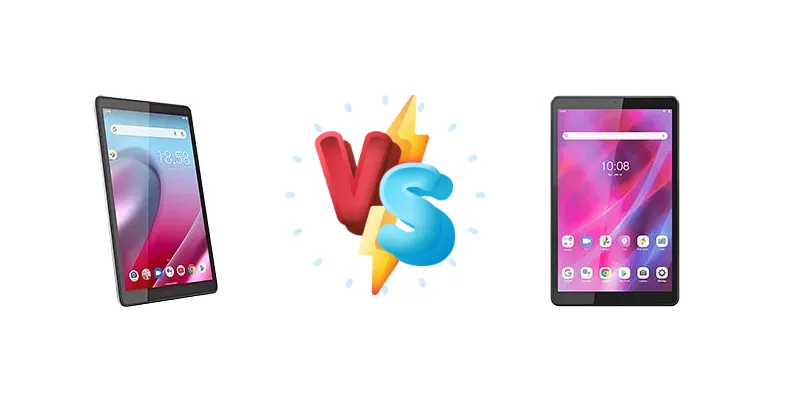
In the crowded budget tablet space, differentiation is key. However, the Motorola Tab G20 and Lenovo Tab M8 (3rd Gen) present a unique challenge: they both utilize the same Mediatek MT8768T Helio P22T chipset. This comparison dives deep to uncover where, if anywhere, these tablets diverge, and which one offers the best value for your money.
🏆 Quick Verdict
For the average user prioritizing a clean Android experience and potential software updates, the Motorola Tab G20 is the slightly better choice. However, given the identical core hardware, price will likely be the deciding factor, making the Lenovo Tab M8 a viable alternative if significantly cheaper.
| Network |
|---|
| 2G bands | N/A | GSM 850 / 900 / 1800 / 1900 |
| 3G bands | N/A | HSDPA 850 / 900 / 1700(AWS) / 1900 / 2100 - International |
| 4G bands | N/A | 1, 2, 3, 4, 5, 19, 7, 8, 20, 26, 28, 38, 40, 41 - International |
| EDGE | No | - |
| GPRS | No | - |
| Speed | - | HSPA, LTE - cellular model only |
| Technology | No cellular connectivity | GSM / CDMA / HSPA / LTE |
| | - | 1, 3, 5, 7, 8, 34, 38, 39, 40, 41 - China |
| Launch |
|---|
| Announced | 2021, September 30 | 2021, June 28 |
| Status | Available. Released 2021, October 02 | Available. Released 2022, February |
| Body |
|---|
| Build | Glass front, aluminum back, aluminum frame | Glass front, aluminum back, aluminum frame |
| Dimensions | 199.1 x 121.8 x 8.2 mm (7.84 x 4.80 x 0.32 in) | 199.1 x 121.8 x 8.2 mm (7.84 x 4.80 x 0.32 in) |
| SIM | No | Nano-SIM (cellular model only) |
| Weight | 305 g (10.76 oz) | 305 g (10.76 oz) |
| Display |
|---|
| Resolution | 800 x 1280 pixels, 16:10 ratio (~189 ppi density) | 800 x 1280 pixels, 16:10 ratio (~189 ppi density) |
| Size | 8.0 inches, 185.6 cm2 (~76.5% screen-to-body ratio) | 8.0 inches, 185.6 cm2 (~76.5% screen-to-body ratio) |
| Type | TDDI IPS LCD, 350 nits (typ) | TDDI IPS LCD, 350 nits (typ) |
| Platform |
|---|
| CPU | Octa-core (4x2.3 GHz Cortex-A53 & 4x1.8 GHz Cortex-A53) | Octa-core (4x2.3 GHz Cortex-A53 & 4x1.8 GHz Cortex-A53) |
| Chipset | Mediatek MT8768T Helio P22T (12 nm) | Mediatek MT8768T Helio P22T (12 nm) |
| GPU | PowerVR GE8320 | PowerVR GE8320 |
| OS | Android 11 | Android 11 (Go edition) - 2 GB RAM versionAndroid 11 - 3 GB RAM version |
| Memory |
|---|
| Card slot | microSDXC (dedicated slot) | microSDXC (dedicated slot) |
| Internal | 32GB 3GB RAM | 32GB 2GB RAM, 32GB 3GB RAM |
| | eMMC 5.1 | eMMC 5.1 |
| Main Camera |
|---|
| Single | 5 MP, AF | 5 MP, AF |
| Video | 1080p@30fps | 1080p |
| Selfie camera |
|---|
| Single | 2 MP | 2 MP |
| Video | 720p@30fps | 720p |
| Sound |
|---|
| 3.5mm jack | Yes | Yes |
| 35mm jack | Yes | Yes |
| Loudspeaker | Yes | Yes |
| Comms |
|---|
| Bluetooth | 5.0, A2DP, LE | 5.0, A2DP, LE |
| NFC | No | No |
| Positioning | GPS, GLONASS | GPS, GLONASS, BDS - cellular model only |
| Radio | FM radio | FM radio |
| USB | USB Type-C 2.0, OTG | USB Type-C 2.0, OTG |
| WLAN | Wi-Fi 802.11 a/b/g/n/ac, dual-band, Wi-Fi Direct | Wi-Fi 802.11 a/b/g/n, dual-band, Wi-Fi Direct |
| Features |
|---|
| Sensors | Accelerometer, proximity | Accelerometer, proximity |
| Battery |
|---|
| Charging | 10W wired | - |
| Type | Li-Po 5100 mAh | Li-Po 5100 mAh |
| Misc |
|---|
| Colors | Platinum Grey | Iron Grey, Platinum Grey |
| Price | About 130 EUR | - |
Motorola Tab G20
- Potentially cleaner Android software experience
- Motorola's reputation for timely security updates (relative to Lenovo)
- Likely similar performance to Lenovo Tab M8
- 10W charging is slow
- Performance limited by Helio P22T chipset
Lenovo Tab M8 (3rd Gen)
- Lenovo brand recognition and ecosystem integration
- Likely similar performance to Motorola Tab G20
- Potentially lower price point
- 10W charging is slow
- Potential for bloatware and less frequent updates
Display Comparison
Both the Motorola Tab G20 and Lenovo Tab M8 (3rd Gen) are expected to feature similar LCD panels, given their target market. Without specific display specs like resolution or brightness, it's safe to assume both offer a basic viewing experience suitable for media consumption and web browsing. The 12nm process node of the Helio P22T doesn't demand a high-end display to avoid excessive battery drain, suggesting both manufacturers likely opted for cost-effective panel solutions. Bezels are likely to be substantial on both devices, contributing to a larger overall footprint relative to screen size.
Camera Comparison
Camera performance is unlikely to be a strong suit for either tablet. Given the target price point, both the Motorola Tab G20 and Lenovo Tab M8 (3rd Gen) likely feature basic camera sensors. Without specific details, it's reasonable to assume image quality will be adequate for casual snapshots in good lighting conditions, but struggle in low-light environments. Focusing on megapixel counts alone is misleading; sensor size and image processing algorithms play a more significant role in overall image quality.
Performance
The core of both tablets is the Mediatek MT8768T Helio P22T, featuring an octa-core CPU configuration with four cores clocked at 2.3 GHz and another four at 1.8 GHz. This means performance will be virtually identical for everyday tasks like web browsing, video playback, and light gaming. The 12nm fabrication process offers a reasonable balance between power efficiency and performance, but don't expect to run demanding games at high settings. RAM configurations, which are not specified, will be a key differentiator; more RAM will improve multitasking capabilities on either device.
Battery Life
Both tablets are equipped with a 10W wired charging capability. This slow charging speed suggests neither device prioritizes quick top-ups. Battery capacity, which is not specified, will be a crucial factor in determining real-world battery life. A larger capacity battery will naturally provide longer usage times, but the power efficiency of the Helio P22T chipset and the display panel will also play a significant role. Expect several hours of moderate use from both tablets on a single charge.
Buying Guide
Buy the Motorola Tab G20 if you value a near-stock Android experience and potentially faster software updates from Motorola. This makes it ideal for users who dislike bloatware and prefer a streamlined interface. Buy the Lenovo Tab M8 (3rd Gen) if you prioritize brand familiarity within the Lenovo ecosystem or find it at a substantially lower price point, accepting a potentially more customized Android experience.
Frequently Asked Questions
❓ Will the Mediatek Helio P22T struggle with multitasking?
The Helio P22T is a budget chipset. While capable of handling basic multitasking, running numerous apps simultaneously or switching between demanding applications may result in noticeable slowdowns. The amount of RAM will significantly impact multitasking performance; more RAM is always better.
❓ Is 10W charging sufficient for daily use?
10W charging is relatively slow. Expect several hours to fully charge the tablet from 0%. This is acceptable for overnight charging, but inconvenient if you need a quick top-up during the day. Plan to charge the tablet overnight to ensure it's ready for use.
❓ Can these tablets handle popular mobile games like PUBG or Call of Duty?
While technically capable of running these games, the Helio P22T will likely require significant graphics settings reductions to achieve playable frame rates. Expect low to medium settings at lower resolutions for a smoother experience. Don't expect a high-end gaming experience.
❓ How does Motorola's software support compare to Lenovo's on these budget tablets?
Motorola generally provides more consistent and timely security updates on its budget tablets compared to Lenovo. While neither brand is known for extensive software support, Motorola typically offers a cleaner Android experience with less bloatware.