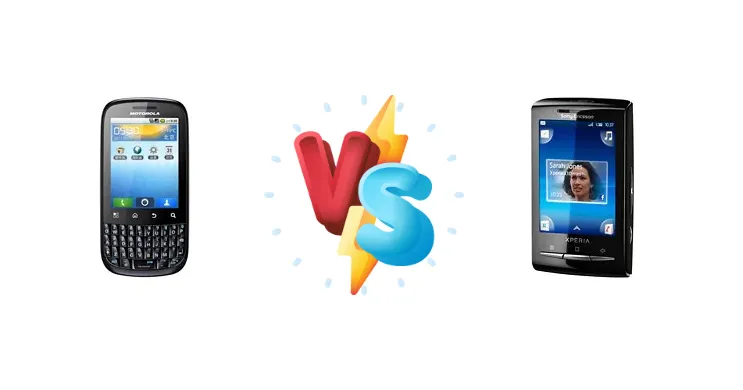
Released in the early days of Android, the Motorola SPICE Key and Sony Ericsson Xperia X10 mini represent a pivotal moment in smartphone evolution. Both devices leveraged the Qualcomm Snapdragon S1 platform, but targeted slightly different user needs. This comparison dissects their similarities and differences, offering insight for collectors and those curious about the roots of modern Android.
🏆 Quick Verdict
For the average user seeking a functional piece of Android history, the Sony Ericsson Xperia X10 mini edges out the Motorola SPICE Key. While both share the same Snapdragon S1 chipset, the X10 mini’s focus on camera functionality, even if basic by today’s standards, provides a slightly more versatile experience.
| Network |
|---|
| 2G bands | GSM 850 / 900 / 1800 / 1900 | GSM 850 / 900 / 1800 / 1900 |
| 3G bands | HSDPA 850 / 1900 | HSDPA 900 / 2100 - E10i |
| Speed | HSPA 7.2/0.384 Mbps | HSPA 7.2/2 Mbps |
| Technology | GSM / HSPA | GSM / HSPA |
| | - | HSDPA 850 / 1900 / 2100 - E10a |
| Launch |
|---|
| Announced | 2011, July. Released 2011, Q3 | 2010, February. Released 2010, May |
| Status | Discontinued | Discontinued |
| Body |
|---|
| Dimensions | 116.5 x 58 x 13.5 mm (4.59 x 2.28 x 0.53 in) | 83 x 50 x 16 mm (3.27 x 1.97 x 0.63 in) |
| Keyboard | QWERTY | - |
| SIM | Mini-SIM | Mini-SIM |
| Weight | 110 g (3.88 oz) | 88 g (3.10 oz) |
| Display |
|---|
| Protection | - | Scratch-resistant glass |
| Resolution | 240 x 320 pixels, 4:3 ratio (~143 ppi density) | 240 x 320 pixels, 4:3 ratio (~157 ppi density) |
| Size | 2.8 inches, 24.3 cm2 (~35.9% screen-to-body ratio) | 2.55 inches, 20.1 cm2 (~48.5% screen-to-body ratio) |
| Type | TFT, 256K colors | TFT (65K effective) |
| | Moto Switch UI
| Timescape UI |
| Platform |
|---|
| CPU | 600 MHz ARM 11 | 600 MHz ARM 11 |
| Chipset | Qualcomm MSM7227-1 Snapdragon S1 | Qualcomm MSM7227 Snapdragon S1 |
| GPU | Adreno 200 | Adreno 200 |
| OS | Android 2.3 (Gingerbread) | Android 1.6 (Donut), upgradable to 2.1 (Eclair) |
| Memory |
|---|
| Card slot | microSDHC (dedicated slot) | microSDHC (dedicated slot), 2 GB included |
| Internal | 512MB 256MB RAM | 128MB |
| Main Camera |
|---|
| Features | - | LED flash |
| Single | 3.15 MP | 5 MP, AF |
| Video | 480p@24fps | 480p@30fps |
| Sound |
|---|
| 3.5mm jack | Yes | Yes |
| 35mm jack | Yes | Yes |
| Loudspeaker | Yes | Yes |
| Comms |
|---|
| Bluetooth | 2.1, A2DP, EDR | 2.0, A2DP, EDR |
| Positioning | GPS, A-GPS | GPS, A-GPS |
| Radio | Stereo FM radio, RDS | Stereo FM radio, RDS |
| USB | microUSB 2.0 | microUSB 2.0 |
| WLAN | Wi-Fi 802.11 b/g/n | Wi-Fi 802.11 b/g, hotspot (v2.2 or higher) |
| Features |
|---|
| Browser | - | HTML |
| Sensors | Accelerometer, proximity, compass | Accelerometer, proximity, compass |
| | MP3/WAV/eAAC+ player
MP4/H.264 player
Document viewer
Photo viewer
Organizer
Voice memo/dial
Predictive text input | ANT+
MP4/H.264/WMV player
MP3/eAAC+/WMA/WAV player
TrackID music recognition
Document viewer
Voice memo
Predictive text input |
| Battery |
|---|
| Stand-by | Up to 720 h (3G) | Up to 285 h (2G) / Up to 360 h (3G) |
| Talk time | Up to 9 h 16 min (2G) / Up to 8 h (3G) | Up to 4 h (2G) / Up to 3 h 30 min (3G) |
| Type | Removable Li-Ion 1420 mAh battery | Non-removable Li-Po 950 mAh battery |
| Misc |
|---|
| Colors | Black | Gold, Pearl White, Black, Pink, Lime, Red, Silver |
| Price | About 100 EUR | About 70 EUR |
| SAR | 0.96 W/kg (head) 1.11 W/kg (body) | - |
| SAR EU | - | 1.17 W/kg (head) |
| Tests |
|---|
| Audio quality | - |
Noise -86.5dB / Crosstalk -83.8dB |
| Camera | - |
Photo |
| Loudspeaker | - |
Voice 65dB / Noise 66dB / Ring 67dB |
Motorola SPICE Key
- Potentially more durable build quality
- Simpler Android experience
- May be easier to find in good condition
- Less documented camera capabilities
- Likely inferior camera performance
- Limited feature set compared to competitors
Sony Ericsson Xperia X10 mini
- Dedicated camera application
- More polished user interface (TimeScape)
- Compact form factor
- Potentially less durable build
- Smaller battery capacity (speculative)
- Limited RAM and processing power
Display Comparison
Neither Motorola nor Sony Ericsson provided detailed display specifications for these models. Given the era, both likely utilized resistive touchscreen technology with relatively low resolutions. The X10 mini’s ‘mini’ designation suggests a smaller screen size, potentially offering a slightly higher pixel density, but this is speculative. Bezels were substantial on both devices, typical of the time, and color accuracy was likely limited by the panel technology.
Camera Comparison
The Sony Ericsson Xperia X10 mini explicitly lists a camera, while the SPICE Key’s camera capabilities are less documented. This gives the X10 mini a clear advantage in terms of dedicated photographic functionality. While the sensor resolution is unknown, the X10 mini likely offered basic features like digital zoom and potentially some rudimentary image processing. The SPICE Key may have had a camera, but its quality and features would likely be inferior. The absence of detailed camera specs on the SPICE Key suggests it wasn't a primary selling point.
Performance
Both the Motorola SPICE Key and Sony Ericsson Xperia X10 mini are powered by the Qualcomm MSM7227 Snapdragon S1 chipset, featuring a 600 MHz ARM 11 CPU. This means raw processing power is virtually identical. Performance will be constrained by the limited RAM available (likely around 256-512MB, though not specified) and the Android Gingerbread operating system. Expect sluggish performance with modern apps, but adequate functionality for basic tasks like calling, texting, and light web browsing. Thermal management shouldn’t be a concern given the low-power CPU.
Battery Life
Battery capacity is not specified for either device. However, given the 600 MHz CPU and resistive touchscreens, battery life was likely comparable – potentially a full day of moderate use. Charging times would have been significantly longer than modern smartphones, likely requiring several hours via micro-USB. The X10 mini’s smaller size might necessitate a slightly smaller battery, but efficient power management in Gingerbread could mitigate this.
Buying Guide
Buy the Motorola SPICE Key if you prioritize a more straightforward, potentially more durable build, and are interested in a device that represents a purer Android experience of its time. Buy the Sony Ericsson Xperia X10 mini if you value a slightly more polished user interface, and a dedicated camera application, even with its limitations. Both are best suited for collectors or those interested in experiencing early Android.
Frequently Asked Questions
❓ Will these phones work on modern cellular networks?
Likely not reliably. These phones were designed for 2G and 3G networks, which are being phased out in many regions. Compatibility will depend on your carrier and location.
❓ Can I install modern apps on these phones?
No. The Android versions on these devices are too old to support modern apps. Even if you could sideload them, the limited RAM and processing power would result in extremely poor performance.
❓ What kind of storage do these phones use, and is it expandable?
Storage details are scarce, but they likely used internal ROM. Expandability via microSD card was common in this era, but not guaranteed on either model. Checking specific model variations is crucial.
❓ Are replacement batteries readily available for these phones?
Replacement batteries are becoming increasingly difficult to find. Sourcing a compatible battery will likely require searching online marketplaces and may involve aftermarket options of questionable quality.