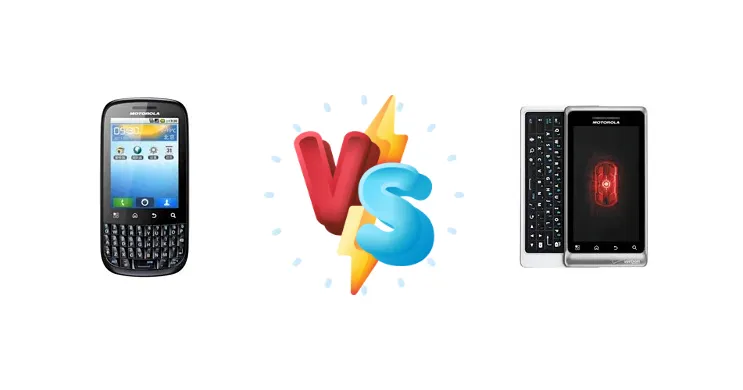
Released in the early days of Android, the Motorola SPICE Key and DROID 2 Global represent different approaches to the burgeoning smartphone market. The SPICE Key aimed for affordability, while the DROID 2 Global targeted users wanting a more powerful experience. This comparison dissects their core hardware to determine which device holds up better considering their original intent and today's understanding of mobile architecture.
🏆 Quick Verdict
For the average user seeking a functional, albeit basic, smartphone experience, the Motorola DROID 2 Global is the superior choice. Its 1.2 GHz Cortex-A8 processor delivers a significantly faster and more responsive experience than the SPICE Key’s 600 MHz ARM 11, making it better suited for multitasking and demanding applications.
| Network |
|---|
| 2G bands | GSM 850 / 900 / 1800 / 1900 | CDMA 800 / 1900 |
| 3G bands | HSDPA 850 / 1900 | CDMA2000 1xEV-DO |
| Speed | HSPA 7.2/0.384 Mbps | HSPA 10.2/5.76 Mbps, EV-DO Rev.A 3.1 Mbps |
| Technology | GSM / HSPA | GSM / CDMA / HSPA / EVDO |
| | - | HSDPA 850 / 1900 / 2100 |
| Launch |
|---|
| Announced | 2011, July. Released 2011, Q3 | 2010, November. Released 2010, November |
| Status | Discontinued | Discontinued |
| Body |
|---|
| Dimensions | 116.5 x 58 x 13.5 mm (4.59 x 2.28 x 0.53 in) | 116.3 x 60.5 x 13.7 mm (4.58 x 2.38 x 0.54 in) |
| Keyboard | QWERTY | QWERTY |
| SIM | Mini-SIM | Mini-SIM |
| Weight | 110 g (3.88 oz) | 173 g (6.10 oz) |
| Display |
|---|
| Protection | - | Corning Gorilla Glass |
| Resolution | 240 x 320 pixels, 4:3 ratio (~143 ppi density) | 480 x 854 pixels, 16:9 ratio (~265 ppi density) |
| Size | 2.8 inches, 24.3 cm2 (~35.9% screen-to-body ratio) | 3.7 inches, 37.7 cm2 (~53.6% screen-to-body ratio) |
| Type | TFT, 256K colors | TFT |
| | Moto Switch UI
| - |
| Platform |
|---|
| CPU | 600 MHz ARM 11 | 1.2 GHz Cortex-A8 |
| Chipset | Qualcomm MSM7227-1 Snapdragon S1 | TI OMAP 3640 |
| GPU | Adreno 200 | PowerVR SGX530 |
| OS | Android 2.3 (Gingerbread) | Android 2.2 (Froyo), upgradable to 2.3 (Gingerbread) |
| Memory |
|---|
| Card slot | microSDHC (dedicated slot) | microSDHC (dedicated slot), 8 GB included |
| Internal | 512MB 256MB RAM | 8GB 512MB RAM |
| Main Camera |
|---|
| Single | 3.15 MP | 5 MP, AF |
| Video | 480p@24fps | 480p@30fps |
| Sound |
|---|
| 3.5mm jack | Yes | Yes |
| 35mm jack | Yes | Yes |
| Loudspeaker | Yes | Yes |
| Comms |
|---|
| Bluetooth | 2.1, A2DP, EDR | 2.1, A2DP |
| Positioning | GPS, A-GPS | GPS, A-GPS |
| Radio | Stereo FM radio, RDS | No |
| USB | microUSB 2.0 | microUSB 2.0 |
| WLAN | Wi-Fi 802.11 b/g/n | Wi-Fi 802.11 b/g/n, DLNA, hotspot |
| Features |
|---|
| Browser | - | HTML, Adobe Flash |
| Sensors | Accelerometer, proximity, compass | Accelerometer, proximity, compass |
| | MP3/WAV/eAAC+ player
MP4/H.264 player
Document viewer
Photo viewer
Organizer
Voice memo/dial
Predictive text input | MP3/WAV/WMA/AAC+ player
MP4/WMV/H.264 player
Document viewer
Photo viewer/editor
Organizer
Voice memo/dial/commands
Predictive text input (Swype) |
| Battery |
|---|
| Stand-by | Up to 720 h (3G) | Up to 230 h |
| Talk time | Up to 9 h 16 min (2G) / Up to 8 h (3G) | Up to 8 h 20 min |
| Type | Removable Li-Ion 1420 mAh battery | Removable Li-Po 1420 mAh battery |
| Misc |
|---|
| Colors | Black | White, Black |
| Price | About 100 EUR | About 200 EUR |
| SAR | 0.96 W/kg (head) 1.11 W/kg (body) | 1.58 W/kg (head) 0.89 W/kg (body) |
Motorola SPICE Key
- Lower price point (originally)
- Simpler user experience
- Potentially better battery life under light use
- Significantly slower performance
- Limited multitasking capabilities
- Outdated processor architecture
Motorola DROID 2 Global
- Faster processor (Cortex-A8)
- More responsive user interface
- Better multitasking performance
- Higher price point (originally)
- Potentially shorter battery life
- More complex software features
Display Comparison
Context data lacks display specifics for both devices. However, given their release timeframe, both likely featured resistive touchscreen displays with relatively low resolutions. The SPICE Key, being the budget option, likely had a smaller and lower-quality display. The DROID 2 Global, positioned higher, likely offered a slightly larger and more vibrant display, though neither would compete with modern LCD or OLED standards. Bezels were substantial on both devices, typical of the era.
Camera Comparison
Without specific camera specs, it’s safe to assume both devices featured basic camera modules typical of the time. The DROID 2 Global, being a more premium device, likely had a slightly higher resolution sensor and potentially a more advanced image processing pipeline. However, image quality on both would be limited by the technology of the era. Expect low-light performance to be poor and dynamic range to be limited. The absence of Optical Image Stabilization (OIS) on either device would further hinder image quality in challenging conditions.
Performance
The core difference lies in the chipsets. The Motorola SPICE Key utilizes the Qualcomm MSM7227-1 Snapdragon S1 with a 600 MHz ARM 11 CPU. This architecture, while foundational, is significantly less efficient and powerful than the TI OMAP 3640 found in the DROID 2 Global. The OMAP 3640 boasts a 1.2 GHz Cortex-A8 CPU, representing a substantial leap in processing power. The Cortex-A8’s architecture allows for more efficient instruction processing and better multitasking capabilities. This translates to faster app loading times, smoother scrolling, and a more responsive overall user experience on the DROID 2 Global. The Snapdragon S1’s ARM 11 struggles with even moderate workloads.
Battery Life
Battery capacity data is unavailable. However, the more powerful OMAP 3640 in the DROID 2 Global likely consumed more power than the Snapdragon S1 in the SPICE Key. This means the DROID 2 Global might have had a shorter battery life despite potentially having a larger battery. Charging speeds were slow on both devices, likely taking several hours to fully charge via their respective proprietary connectors. The efficiency gains of the Cortex-A8 architecture might partially offset the higher clock speed, but the SPICE Key would likely have a slight edge in longevity under light usage.
Buying Guide
Buy the Motorola SPICE Key if you prioritize extreme affordability and a simple, no-frills Android experience. It’s ideal for basic communication and light use. Buy the Motorola DROID 2 Global if you value performance and responsiveness, even within the constraints of early Android. Its faster processor and more capable chipset make it a better choice for users who want to run more apps and enjoy a smoother user interface.
Frequently Asked Questions
❓ Is the Motorola DROID 2 Global's OMAP 3640 prone to overheating under heavy use?
While the OMAP 3640 is more powerful, it was built on a 45nm process. Prolonged use of demanding applications could lead to thermal throttling, reducing performance to prevent overheating. However, this is less likely to be a significant issue with the types of applications available on Android at the time.
❓ Can the Motorola SPICE Key run modern Android versions through custom ROMs?
While technically possible, running a modern Android version on the SPICE Key is not recommended. The ARM 11 processor and limited RAM will result in an extremely sluggish and frustrating user experience. Custom ROM development for this device is also limited due to its age and relatively low popularity.
❓ What type of storage does the DROID 2 Global use, and is it expandable?
The DROID 2 Global utilized microSD card storage for expansion, allowing users to increase the available storage beyond the internal capacity. This was a crucial feature given the limited internal storage options available at the time and the growing size of apps and media files.