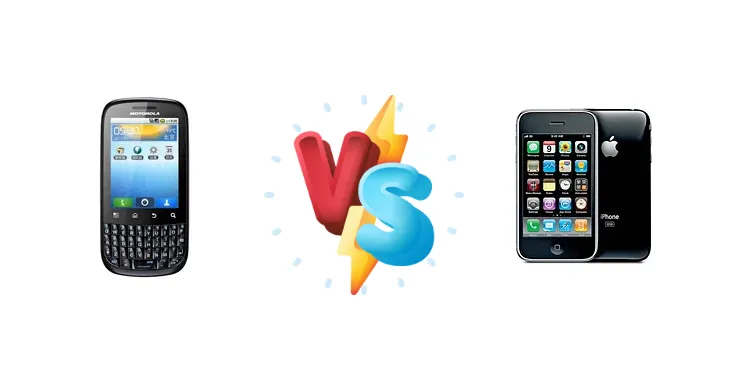
The late 2000s marked a pivotal moment in mobile technology. The Motorola SPICE Key, running Android, and the Apple iPhone 3GS, representing iOS’s second iteration, both aimed to redefine the smartphone experience. While separated by operating systems and philosophies, both devices were significant players in the burgeoning smartphone market. This comparison revisits these devices, analyzing their strengths and weaknesses through a modern lens.
🏆 Quick Verdict
For the average user interested in experiencing early smartphone technology, the Apple iPhone 3GS offers a more polished and refined experience. While the Motorola SPICE Key provided Android access at a potentially lower price point, the iPhone 3GS’s Cortex-A8 processor and optimized software deliver a smoother, more responsive user interface.
| Network |
|---|
| 2G bands | GSM 850 / 900 / 1800 / 1900 | GSM 850 / 900 / 1800 / 1900 |
| 3G bands | HSDPA 850 / 1900 | HSDPA 850 / 1900 / 2100 |
| Speed | HSPA 7.2/0.384 Mbps | HSPA 7.2/0.384 Mbps |
| Technology | GSM / HSPA | GSM / HSPA |
| Launch |
|---|
| Announced | 2011, July. Released 2011, Q3 | 2009, June. Released 2009, June |
| Status | Discontinued | Discontinued |
| Body |
|---|
| Dimensions | 116.5 x 58 x 13.5 mm (4.59 x 2.28 x 0.53 in) | 115.5 x 62.1 x 12.3 mm (4.55 x 2.44 x 0.48 in) |
| Keyboard | QWERTY | - |
| SIM | Mini-SIM | Mini-SIM |
| Weight | 110 g (3.88 oz) | 135 g (4.76 oz) |
| Display |
|---|
| Protection | - | Corning Gorilla Glass, oleophobic coating |
| Resolution | 240 x 320 pixels, 4:3 ratio (~143 ppi density) | 320 x 480 pixels, 3:2 ratio (~165 ppi density) |
| Size | 2.8 inches, 24.3 cm2 (~35.9% screen-to-body ratio) | 3.5 inches, 36.5 cm2 (~50.9% screen-to-body ratio) |
| Type | TFT, 256K colors | TFT |
| | Moto Switch UI
| - |
| Platform |
|---|
| CPU | 600 MHz ARM 11 | 600 MHz Cortex-A8 |
| Chipset | Qualcomm MSM7227-1 Snapdragon S1 | - |
| GPU | Adreno 200 | PowerVR SGX535 |
| OS | Android 2.3 (Gingerbread) | iOS 3, upgradable to iOS 6.1.6 |
| Memory |
|---|
| Card slot | microSDHC (dedicated slot) | No |
| Internal | 512MB 256MB RAM | 8GB 256MB RAM, 16GB 256MB RAM, 32GB 256MB RAM |
| Main Camera |
|---|
| Single | 3.15 MP | 3.15 MP, f/2.8, AF |
| Video | 480p@24fps | 480p@30fps |
| Sound |
|---|
| 3.5mm jack | Yes | Yes |
| 35mm jack | Yes | Yes |
| Loudspeaker | Yes | Yes |
| Comms |
|---|
| Bluetooth | 2.1, A2DP, EDR | 2.1, A2DP (headset support only) |
| Positioning | GPS, A-GPS | GPS, A-GPS |
| Radio | Stereo FM radio, RDS | No |
| USB | microUSB 2.0 | 2.0 |
| WLAN | Wi-Fi 802.11 b/g/n | Wi-Fi 802.11 b/g |
| Features |
|---|
| Browser | - | HTML (Safari) |
| Sensors | Accelerometer, proximity, compass | Accelerometer, proximity, compass |
| | MP3/WAV/eAAC+ player
MP4/H.264 player
Document viewer
Photo viewer
Organizer
Voice memo/dial
Predictive text input | iCloud cloud service
Maps
Organizer
TV-out
Audio/video player/editor
Photo viewer/editor
Voice command/dial
Predictive text input |
| Battery |
|---|
| Stand-by | Up to 720 h (3G) | - |
| Talk time | Up to 9 h 16 min (2G) / Up to 8 h (3G) | Up to 5 h (3G) |
| Type | Removable Li-Ion 1420 mAh battery | Li-Ion 1400 mAh, non-removable |
| Misc |
|---|
| Colors | Black | Black, White |
| Models | - | A1325, A1303, iPhone2,1 |
| Price | About 100 EUR | About 110 EUR |
| SAR | 0.96 W/kg (head) 1.11 W/kg (body) | 0.26 W/kg (head) 0.79 W/kg (body) |
| SAR EU | - | 0.45 W/kg (head) 0.40 W/kg (body) |
| Tests |
|---|
| Audio quality | - |
Noise -92.1dB / Crosstalk -95.0dB |
| Camera | - |
Photo |
| Display | - |
Contrast ratio: 201:1 (nominal) |
| Loudspeaker | - |
Voice 69dB / Noise 69dB / Ring 71dB
|
Motorola SPICE Key
- Early Android experience for enthusiasts
- Potentially lower purchase price (at launch)
- Snapdragon S1 chipset offered a dedicated GPU
- Less refined user experience
- Inferior CPU architecture (ARM 11)
- Limited camera capabilities
Apple iPhone 3GS
- More responsive user interface (Cortex-A8)
- Better camera quality and features
- Polished iOS ecosystem (for its time)
- Closed ecosystem
- Higher initial cost
- Limited customization options
Display Comparison
Both devices share a nominal contrast ratio of 201:1, indicating limited display technology by today’s standards. However, the iPhone 3GS’s 3.5-inch display likely benefited from Apple’s tighter quality control, potentially resulting in more consistent color reproduction. The SPICE Key’s display size is not specified, but given its market positioning, it likely featured a smaller, lower-resolution panel. Neither device offers any advanced display features like high refresh rates or HDR support.
Camera Comparison
Both devices feature a 'Photo' camera, a vague descriptor. However, the iPhone 3GS was known for its relatively capable 3.2MP camera with autofocus, a feature likely absent on the SPICE Key. The iPhone’s image processing, even in 2009, was more sophisticated, resulting in better image quality in various lighting conditions. The SPICE Key’s camera specifications are largely unknown, but it likely featured a lower-resolution sensor and lacked advanced features like autofocus or image stabilization.
Performance
The core difference lies in the CPU architecture. The Motorola SPICE Key utilizes a 600 MHz ARM 11 processor, a relatively simple design. The iPhone 3GS, conversely, boasts a 600 MHz Cortex-A8 processor. The Cortex-A8 architecture is significantly more advanced, offering improved instruction set efficiency and overall performance. This translates to faster application loading times and a more responsive user interface on the iPhone 3GS. While both are clocked at the same speed, the architectural advantage of the Cortex-A8 is substantial. The SPICE Key’s Qualcomm MSM7227-1 Snapdragon S1 chipset, while introducing a dedicated GPU, couldn’t fully compensate for the CPU disparity.
Battery Life
Battery capacity details for both devices are unavailable in the provided context. However, considering the SPICE Key’s focus on affordability, it likely featured a smaller battery. The iPhone 3GS, while not known for exceptional battery life even at launch, benefited from Apple’s software optimization, potentially squeezing more usage time from its battery. Charging times would have been significantly longer than modern smartphones, regardless of the device.
Buying Guide
Buy the Motorola SPICE Key if you need a historically significant Android device for experimentation and tinkering, or if you are specifically interested in the early Android experience. Buy the Apple iPhone 3GS if you prefer a more streamlined, user-friendly experience with a focus on multimedia and a relatively stable software ecosystem, even within the constraints of its age.
Frequently Asked Questions
❓ Is the Motorola SPICE Key a good option for running modern Android apps?
No. The ARM 11 processor and limited RAM in the SPICE Key are insufficient to run modern Android applications. The device is primarily of interest to collectors and enthusiasts interested in experiencing the early days of Android.
❓ Can the iPhone 3GS be updated to the latest version of iOS?
No. The iPhone 3GS is no longer supported by Apple and cannot be updated beyond iOS 6.1.6. While jailbreaking is possible, it introduces security risks and instability.
❓ What kind of connectivity options did the Motorola SPICE Key offer?
The SPICE Key, powered by the Snapdragon S1, likely included basic connectivity options for its time, such as 3G, Wi-Fi (802.11 b/g), and Bluetooth. However, it lacked features like GPS or 4G LTE.
❓ How does the iPhone 3GS's camera compare to modern smartphone cameras?
The iPhone 3GS's 3.2MP camera is vastly inferior to modern smartphone cameras in terms of resolution, image quality, and features. It lacks features like optical image stabilization, HDR, and advanced image processing algorithms.