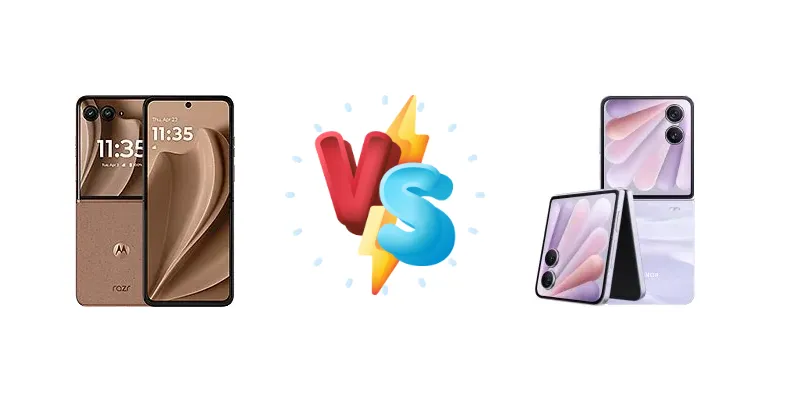
The foldable market is heating up, and the Motorola Razr+ 2025 and Honor Magic V Flip 2 represent the cutting edge of flip phone design. While both aim to deliver a pocketable, stylish experience, they diverge significantly in their internal hardware and charging capabilities, creating a clear choice for different user priorities.
🏆 Quick Verdict
For the average user prioritizing longevity and rapid replenishment, the Honor Magic V Flip 2 emerges as the winner. Its significantly longer 12:43h active use battery life, coupled with the blazing-fast 80W charging (0-100% in 42 minutes), outweighs the Razr+'s slightly more efficient chipset.
| Network |
|---|
| 2G bands | GSM 900 / 1800 / 1900 | GSM 850 / 900 / 1800 / 1900 |
| 3G bands | HSDPA 850 / 900 / 1700(AWS) / 1900 / 2100 | HSDPA 800 / 850 / 900 / 1700(AWS) / 1900 / 2100 |
| 4G bands | 1, 2, 3, 4, 5, 7, 8, 12, 13, 14, 17, 18, 19, 20, 25, 26, 28, 29, 30, 38, 39, 40, 41, 46, 48, 66, 71 | LTE |
| 5G bands | 1, 2, 3, 5, 7, 12, 14, 20, 25, 26, 28, 29, 30, 38, 40, 41, 48, 66, 70, 71, 77, 78 SA/NSA/Sub6 | SA/NSA |
| Speed | HSPA, LTE, 5G | HSPA, LTE, 5G |
| Technology | GSM / HSPA / LTE / 5G | GSM / CDMA / HSPA / CDMA2000 / LTE / 5G |
| Launch |
|---|
| Announced | 2025, April 24 | 2025, August 21 |
| Status | Available. Released 2025, June 03 | Available. Released 2025, August 21 |
| Body |
|---|
| Build | Plastic front (unfolded), glass front (folded, Gorilla Glass Victus), silicone polymer back (eco leather), aluminum frame (6000 series), hinge (titanium) | Aluminum frame |
| Dimensions | Unfolded: 171.4 x 74 x 7.1 mmFolded: 88.1 x 74 x 15.3 mm | Unfolded: 167.1 x 75.6 x 6.9 mm Folded: 86.2 x 75.6 x 15.5 mm |
| SIM | Nano-SIM + eSIM | Nano-SIM + Nano-SIM |
| Weight | 189 g (6.67 oz) | 204 g (7.20 oz) |
| Display |
|---|
| Resolution | 1080 x 2640 pixels (~413 ppi density) | 1232 x 2868 pixels, 21:9 ratio (~458 ppi density) |
| Size | 6.9 inches, 107.6 cm2 (~84.9% screen-to-body ratio) | 6.82 inches, 108.8 cm2 (~86.1% screen-to-body ratio) |
| Type | Foldable LTPO AMOLED, 1B colors, Dolby Vision, 165Hz, HDR10+, 3000 nits (peak) | Foldable LTPO OLED, 1B colors, 120Hz, 4320Hz PWM, HDR, Dolby Vision, BT.2020, 5000 nits (peak) |
| Platform |
|---|
| CPU | Octa-core (1x3.0 GHz Cortex-X4 & 4x2.8 GHz Cortex-A720 & 3x2.0 GHz Cortex-A520) | Octa-core (1x3.3 GHz Cortex-X4 & 3x3.2 GHz Cortex-A720 & 2x3.0 GHz Cortex-A720 & 2x2.3 GHz Cortex-A520) |
| Chipset | Qualcomm SM8635 Snapdragon 8s Gen 3 (4 nm) | Qualcomm SM8650-AB Snapdragon 8 Gen 3 (4 nm) |
| GPU | Adreno 735 | Adreno 750 |
| OS | Android 15 | Android 15, MagicOS 9 |
| Memory |
|---|
| Card slot | No | No |
| Internal | 256GB 12GB RAM | 256GB 12GB RAM, 512GB 12GB RAM, 1TB 12GB RAM, 1TB 16GB RAM |
| Main Camera |
|---|
| Dual | 50 MP, f/1.7, 24mm (wide), 1/1.95", 0.8µm, dual pixel PDAF, OIS
50 MP, f/2.0, 47mm (telephoto), 1/2.76", 0.64µm, PDAF, 2x optical zoom | 200 MP, f/1.9, (wide), 1/1.3", 0.6µm, multi-directional PDAF, OIS
50 MP, f/2.0, 120˚ (ultrawide), AF |
| Features | LED flash, panorama, HDR | LED flash, HDR, panorama |
| Video | 4K@30/60fps, 1080p@30/60/120/240/960fps, HDR10+, gyro-EIS | 4K, 1080p, gyro-EIS |
| Selfie camera |
|---|
| Features | HDR | - |
| Single | 32 MP, f/2.4, 25mm (wide), 1/3.14", 0.7µm | 50 MP, f/2.0, (wide), AF |
| Video | 4K@30/60fps, 1080p@30/60fps | 4K, 1080p |
| Sound |
|---|
| 35mm jack | No | No |
| Loudspeaker | Yes, with stereo speakers (with Dolby Atmos) | Yes, with stereo speakers |
| Comms |
|---|
| Bluetooth | 5.4, A2DP, LE, aptX HD, aptX Adaptive, aptX Lossless | 5.4, A2DP, LE, aptX HD, aptX Adaptive, ASHA |
| Infrared port | - | Yes |
| NFC | Yes | Yes |
| Positioning | GPS (L1+L5), GLONASS (L1), BDS (B1I+B1c+B2a), GALILEO (E1+E5a), QZSS (L1+L5) | GPS (L1+L5), BDS (B1I+B1C+B2a+B2b), GALILEO (E1+E5a+E5b), QZSS (L1+L5), NavIC (L5), GLONASS |
| Radio | No | No |
| USB | USB Type-C 2.0, OTG | USB Type-C 2.0, OTG |
| WLAN | Wi-Fi 802.11 a/b/g/n/ac/6e/7, tri-band | Wi-Fi 802.11 a/b/g/n/ac/6, dual-band, Wi-Fi Direct |
| Features |
|---|
| Sensors | Fingerprint (side-mounted), accelerometer, gyro, proximity, compass, barometer | Fingerprint (side-mounted), gyro, accelerometer, proximity (ultrasonic), compass |
| Battery |
|---|
| Charging | 45W wired
15W wireless
5W reverse wired | 80W wired, 100% in 42 min
50W wireless
5W reverse wired
Reverse wireless |
| Type | 4000 mAh | Si/C Li-Po 5500 mAh |
| Misc |
|---|
| Colors | Pantone: Mocha Mousse, Midnight Blue, Hot Pink | Purple, Silver, Gray, Blue |
| Models | XT2451-1 | CLE-AN00 |
| Price | $ 500.00 | - |
Motorola Razr+ 2025
- Efficient Snapdragon 8s Gen 3 chipset
- Compact and portable design
- Potentially more affordable price point
- Shorter battery life compared to the Magic V Flip 2
- Slower charging speeds (45W wired)
Honor Magic V Flip 2
- Exceptional battery life (12:43h active use)
- Ultra-fast 80W wired charging (42 minutes to 100%)
- High peak display brightness (1786 nits)
- Snapdragon 8 Gen 3 may run warmer under sustained load
- Potentially higher price tag
Display Comparison
The Honor Magic V Flip 2 boasts a substantial advantage in display technology, achieving a measured peak brightness of 1786 nits. This translates to superior visibility in direct sunlight, a crucial factor for outdoor use. While the Razr+ 2025’s display specs are not provided, Honor’s figure sets a high bar. The Magic V Flip 2’s panel likely utilizes LTPO technology, enabling variable refresh rates for improved power efficiency, a feature commonly found in flagship foldables. Bezels are expected to be minimal on both, but the brightness difference is a key differentiator.
Camera Comparison
Without detailed camera specifications for either device, a direct comparison is limited. However, the market positioning suggests both will feature capable camera systems. The focus should be on the main sensor size and optical image stabilization (OIS). Given Honor’s history, the Magic V Flip 2 is likely to prioritize computational photography and image processing algorithms for vibrant and detailed photos. The Razr+ 2025 may lean towards a more natural color profile. The absence of information on secondary sensors (ultrawide, telephoto) makes a definitive assessment impossible, but the main sensor will be the deciding factor.
Performance
The Honor Magic V Flip 2 is equipped with the Qualcomm SM8650-AB Snapdragon 8 Gen 3 (4nm), featuring an octa-core CPU configuration with a peak clock speed of 3.3 GHz on its Cortex-X4 prime core. This is a step up from the Motorola Razr+ 2025’s Snapdragon 8s Gen 3 (4nm) which clocks in at 3.0 GHz. The Magic V Flip 2’s CPU benefits from higher clock speeds on its A720 cores (3.2 GHz vs 2.8 GHz), resulting in faster processing for demanding applications. While both chips are built on a 4nm process, the Gen 3 offers a performance edge. The Razr+ 2025’s 8s Gen 3 will still deliver excellent performance, but the Magic V Flip 2 has a clear advantage in raw processing power.
Battery Life
Battery life is where the Honor Magic V Flip 2 truly shines. Its active use score of 12:43h significantly surpasses the Motorola Razr+ 2025’s 10:12h. This nearly 2.5-hour difference is substantial and will be noticeable in daily use. Furthermore, the Magic V Flip 2’s 80W wired charging, capable of a full charge in just 42 minutes, is dramatically faster than the Razr+ 2025’s 45W charging. The Magic V Flip 2 also offers 50W wireless charging and reverse wireless charging, features the Razr+ 2025 matches with 15W wireless and 5W reverse wired. The combination of capacity and charging speed makes the Magic V Flip 2 the clear winner for users concerned about battery anxiety.
Buying Guide
Buy the Motorola Razr+ 2025 if you prioritize a balance of performance and portability, and value the efficiency of the Snapdragon 8s Gen 3 for sustained tasks. Buy the Honor Magic V Flip 2 if you demand the longest possible battery life and the fastest charging speeds, even if it means a slightly warmer device under heavy load. The Magic V Flip 2 is ideal for power users and those frequently away from a charger.
Frequently Asked Questions
❓ Does the Snapdragon 8 Gen 3 in the Honor Magic V Flip 2 tend to overheat during prolonged gaming sessions?
While the Snapdragon 8 Gen 3 is a powerful chip, it can generate heat under sustained load. However, Honor typically employs advanced cooling solutions, such as vapor chambers, to mitigate thermal throttling. Expect some warmth during extended gaming, but the Magic V Flip 2 is unlikely to experience severe overheating that significantly impacts performance.
❓ How does the 45W charging on the Motorola Razr+ 2025 compare to typical smartphone charging speeds?
45W charging is considered relatively fast, but it's noticeably slower than the 80W charging offered by the Honor Magic V Flip 2. A full charge on the Razr+ 2025 will take considerably longer, likely exceeding an hour, compared to the Magic V Flip 2’s 42-minute timeframe. This difference is significant for users who prioritize quick top-ups.
❓ Is the difference in battery life between the two phones noticeable in everyday use?
Absolutely. The 2.5-hour difference in active use scores translates to a tangible advantage for the Honor Magic V Flip 2. Users will likely experience a full day of moderate to heavy use without needing to recharge, whereas the Razr+ 2025 may require a top-up in the late afternoon or evening.