
Motorola Razr+ 2024 vs. Samsung Galaxy S24 FE: A Deep Dive Comparison
| Phones Images | |||||
|---|---|---|---|---|---|
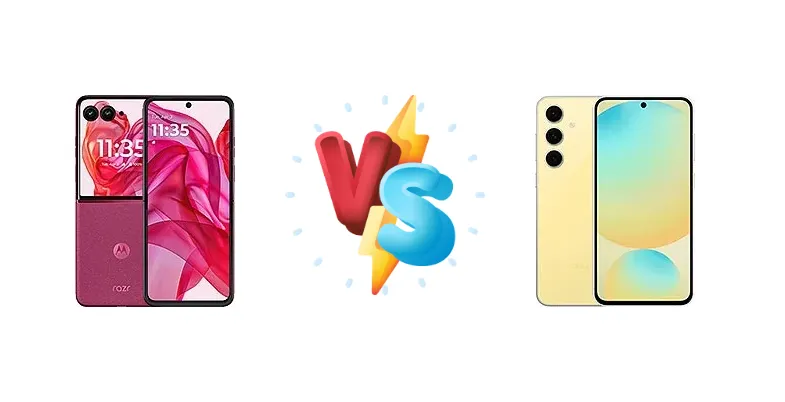
|
🏆 Quick Verdict
For the average user prioritizing consistent performance and a proven track record, the Samsung Galaxy S24 FE is the safer bet. Its Exynos 2400e, coupled with excellent battery endurance, provides a reliable experience. However, the Razr+ 2024’s Snapdragon 8s Gen 3 and innovative folding design appeal to those seeking cutting-edge technology and portability.
| PHONES | ||
|---|---|---|
| Phone Names | Motorola Razr+ 2024 | Samsung Galaxy S24 FE |
| Network | ||
|---|---|---|
| 2G bands | GSM 900 / 1800 / 1900 | GSM 850 / 900 / 1800 / 1900 |
| 3G bands | HSDPA 850 / 900 / 1700(AWS) / 1900 / 2100 | HSDPA 850 / 900 / 1700(AWS) / 1900 / 2100 |
| 4G bands | 1, 2, 3, 4, 5, 7, 8, 12, 13, 14, 17, 18, 19, 20, 25, 26, 28, 29, 30, 38, 39, 40, 41, 46, 48, 66, 71 | 1, 2, 3, 4, 5, 7, 8, 12, 17, 18, 19, 20, 25, 26, 28, 32, 38, 40, 41, 66 - International |
| 5G bands | 1, 2, 3, 5, 7, 12, 14, 20, 25, 26, 28, 29, 30, 38, 40, 41, 48, 66, 70, 71, 77, 78 SA/NSA/Sub6 | 1, 2, 3, 5, 7, 8, 12, 20, 25, 26, 28, 38, 40, 41, 66, 75, 77, 78 SA/NSA/Sub6 - International |
| Speed | HSPA, LTE, 5G | HSPA, LTE, 5G |
| Technology | GSM / HSPA / LTE / 5G | GSM / HSPA / LTE / 5G |
| Launch | ||
|---|---|---|
| Announced | 2024, June 25 | 2024, September 26 |
| Status | Available. Released 2024, July 17 | Available. Released 2024, October 03 |
| Body | ||
|---|---|---|
| Build | Plastic front (unfolded), glass front (folded, Gorilla Glass Victus), silicone polymer back (eco leather), aluminum frame (6000 series), hinge (stainless steel) | Glass front (Gorilla Glass Victus+), glass back (Gorilla Glass Victus+), aluminum frame |
| Dimensions | Unfolded: 171.4 x 74 x 7.1 mmFolded: 88.1 x 74 x 15.3 mm | 162 x 77.3 x 8 mm (6.38 x 3.04 x 0.31 in) |
| SIM | Nano-SIM + eSIM | · Nano-SIM· Nano-SIM + Nano-SIM· Nano-SIM + eSIM· eSIM + eSIM |
| Weight | 189 g (6.67 oz) | 213 g (7.51 oz) |
| Display | ||
|---|---|---|
| Protection | - | Corning Gorilla Glass Victus+, Mohs level 5 |
| Resolution | 1080 x 2640 pixels (~413 ppi density) | 1080 x 2340 pixels, 19.5:9 ratio (~385 ppi density) |
| Size | 6.9 inches, 107.6 cm2 (~84.9% screen-to-body ratio) | 6.7 inches, 110.2 cm2 (~88.0% screen-to-body ratio) |
| Type | Foldable LTPO AMOLED, 1B colors, Dolby Vision, 165Hz, HDR10+, 3000 nits (peak) | Dynamic AMOLED 2X, 120Hz, HDR10+, 1900 nits (peak) |
| Platform | ||
|---|---|---|
| CPU | Octa-core (1x3.0 GHz Cortex-X4 & 4x2.8 GHz Cortex-A720 & 3x2.0 GHz Cortex-A520) | 10-core (1x3.1 GHz + 2x2.9 GHz + 3x2.6 GHz + 4x1.95 GHz) |
| Chipset | Qualcomm SM8635 Snapdragon 8s Gen 3 (4 nm) | Exynos 2400e (4 nm) |
| GPU | Adreno 735 | Xclipse 940 |
| OS | Android 14 | Android 14, up to 7 major Android upgrades, One UI 8.0 |
| Memory | ||
|---|---|---|
| Card slot | No | No |
| Internal | 256GB 12GB RAM | 128GB 8GB RAM, 256GB 8GB RAM, 512GB 8GB RAM |
| Main Camera | ||
|---|---|---|
| Dual | 50 MP, f/1.7, 24mm (wide), 1/1.95", 0.8µm, dual pixel PDAF, OIS 50 MP, f/2.0, 47mm (telephoto), 1/2.76", 0.64µm, PDAF, 2x optical zoom | - |
| Features | LED flash, panorama, HDR | LED flash, HDR, panorama |
| Triple | - | 50 MP, f/1.8, 24mm (wide), 1/1.57", 1.0µm, dual pixel PDAF, OIS 8 MP, f/2.4, 75mm (telephoto), 1/4.4", 1.0µm, PDAF, OIS, 3x optical zoom 12 MP, f/2.2, 13mm, 123˚ (ultrawide), 1/3.0", 1.12µm |
| Video | 4K@30/60fps, 1080p@30/60/120/240/960fps, HDR10+, gyro-EIS | 8K@30fps, 4K@30/60/120fps, 1080p@30/60/120/240fps |
| Selfie camera | ||
|---|---|---|
| Features | HDR | - |
| Single | 32 MP, f/2.4, 25mm (wide), 1/3.14", 0.7µm | 10 MP, f/2.4, 26mm (wide), 1/3.0", 1.22µm |
| Video | 4K@30/60fps, 1080p@30/60fps | 4K@30/60fps, 1080p@30/60fps; gyro-EIS |
| Sound | ||
|---|---|---|
| 35mm jack | No | No |
| Loudspeaker | Yes, with stereo speakers | Yes, with stereo speakers |
| Comms | ||
|---|---|---|
| Bluetooth | 5.4, A2DP, LE, aptX HD, aptX Adaptive, aptX Lossless | 5.3, A2DP, LE |
| NFC | Yes | Yes |
| Positioning | GPS (L1+L5), GLONASS (L1), BDS (B1I+B1c+B2a), GALILEO (E1+E5a), QZSS (L1+L5) | GPS, GLONASS, GALILEO, BDS |
| Radio | No | Unspecified |
| USB | USB Type-C 2.0, OTG | USB Type-C 3.2, OTG |
| WLAN | Wi-Fi 802.11 a/b/g/n/ac/6e/7, dual-band or tri-band (region dependent) | Wi-Fi 802.11 a/b/g/n/ac/6e, dual-band or tri-band (market/region dependent), Wi-Fi Direct |
| Features | ||
|---|---|---|
| Sensors | Fingerprint (side-mounted), accelerometer, gyro, proximity, compass, barometer | Fingerprint (under display, optical), accelerometer, gyro, compass |
| Battery | ||
|---|---|---|
| Charging | 45W wired 15W wireless 5W reverse wired | 25W wired, PD, QC2, 50% in 30 min 15W wireless Reverse wireless |
| Type | 4000 mAh | 4700 mAh |
| Misc | ||
|---|---|---|
| Colors | Midnight Blue, Hot Pink, Spring Green, Peach Fuzz, Paris Hilton Edition | Blue, Graphite, Gray, Mint, Yellow |
| Models | - | SM-S721B, SM-S721B/DS, SM-S721U1, SM-S721U, SM-S721W, SM-S7210, SM-S721N |
| Price | $ 260.99 | $ 249.74 / C$ 498.99 / £ 335.00 / € 387.00 / ₹ 34,180 |
| SAR | - | 0.94 W/kg (head) 0.71 W/kg (body) |
| SAR EU | - | 0.86 W/kg (head) 1.29 W/kg (body) |
| EU LABEL | ||
|---|---|---|
| Battery | - | 42:00h endurance, 2000 cycles |
| Energy | - | Class B |
| Free fall | - | Class A (270 falls) |
| Repairability | - | Class C |
Motorola Razr+ 2024
- Innovative folding design for ultimate portability
- Powerful Snapdragon 8s Gen 3 processor
- 45W fast wired charging
- Potential durability concerns with folding screen
- Battery capacity likely smaller than S24 FE
- Uncertain camera performance details
Samsung Galaxy S24 FE
- Exceptional battery life and longevity (42h endurance, 2000 cycles)
- Bright and vibrant display (1372 nits)
- Reliable Exynos 2400e processor
- Less innovative design compared to Razr+
- 25W charging is slower than Razr+'s 45W
- Potential for Samsung's software bloat
Display Comparison
The Galaxy S24 FE boasts a measured peak brightness of 1372 nits, ensuring excellent visibility even in direct sunlight. While the Razr+ 2024’s display specs aren’t provided, its folding nature inherently introduces a crease, a trade-off for the compact form. The S24 FE’s display technology likely incorporates LTPO for adaptive refresh rates, contributing to battery efficiency, a feature not confirmed for the Razr+. The S24 FE’s larger display area also provides a more immersive viewing experience for media consumption.
Camera Comparison
Without detailed camera specifications for the Razr+ 2024, a direct comparison is challenging. The S24 FE’s camera system is expected to feature a capable main sensor with OIS, prioritizing image stabilization and low-light performance. The focus should be on the primary sensor’s megapixel count and aperture. The inclusion of a 2MP macro camera on the S24 FE is likely a marketing feature with limited practical benefit. Image processing styles will differ – Samsung typically favors vibrant, saturated colors, while Motorola often aims for a more natural look.
Performance
The Motorola Razr+ 2024 is powered by the Qualcomm SM8635 Snapdragon 8s Gen 3 (4nm), featuring an octa-core CPU with a prime Cortex-X4 core clocked at 3.0 GHz. This architecture prioritizes peak performance. The Samsung Galaxy S24 FE utilizes the Exynos 2400e (4nm) with a 10-core CPU configuration, potentially offering better multi-tasking capabilities due to its higher core count. However, the Snapdragon 8s Gen 3’s more efficient architecture may translate to better sustained performance and thermal management, especially during demanding tasks. Both chips are built on a 4nm process, suggesting comparable efficiency, but the Snapdragon’s core arrangement is geared towards bursts of speed.
Battery Life
The Samsung Galaxy S24 FE shines in battery endurance, offering a remarkable 42-hour endurance rating and 2000 charge cycles, indicating long-term battery health. Its active use score of 11:48h demonstrates real-world longevity. The Razr+ 2024’s battery capacity is unknown, but its folding design likely necessitates a smaller battery. While the Razr+ 2024 supports 45W wired charging, potentially offering faster top-ups, the S24 FE’s 25W charging with PD and QC2 is still respectable, reaching 50% charge in 30 minutes. Both devices offer 15W wireless charging and reverse wireless charging capabilities.
Buying Guide
Buy the Motorola Razr+ 2024 if you prioritize a truly unique, pocketable form factor and are willing to embrace the potential quirks of a first-generation foldable. You’ll benefit from the Snapdragon 8s Gen 3’s strong performance in a compact package. Buy the Samsung Galaxy S24 FE if you prefer a more conventional, refined smartphone experience with exceptional battery life and a well-established software ecosystem. It’s the ideal choice for users who value reliability and a broader feature set.