
Motorola Razr+ 2024 vs OnePlus Open: Which Foldable Phone Wins?
| Phones Images | |||||
|---|---|---|---|---|---|
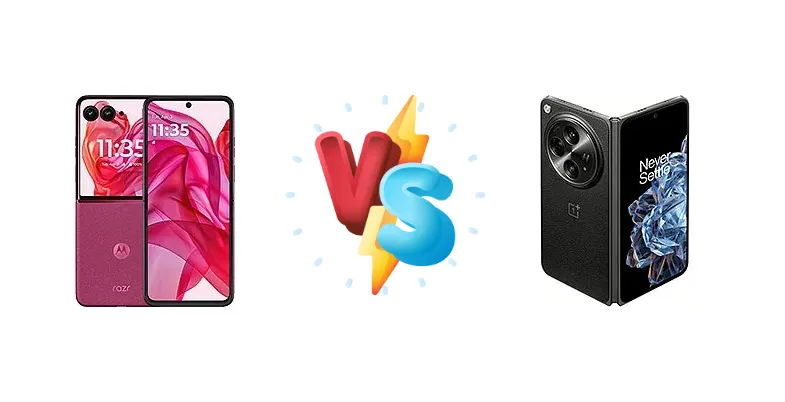
|
🏆 Quick Verdict
For the average user prioritizing all-day battery life and a consistently powerful experience, the OnePlus Open emerges as the winner. Its Snapdragon 8 Gen 2 chipset and impressive 11:59h active use battery score provide a more reliable performance profile than the Razr+’s newer, but slightly less powerful, Snapdragon 8s Gen 3.
| PHONES | ||
|---|---|---|
| Phone Names | Motorola Razr+ 2024 | OnePlus Open |
| Network | ||
|---|---|---|
| 2G bands | GSM 900 / 1800 / 1900 | GSM 850 / 900 / 1800 / 1900 |
| 3G bands | HSDPA 850 / 900 / 1700(AWS) / 1900 / 2100 | HSDPA 800 / 850 / 900 / 1700(AWS) / 1900 / 2100 |
| 4G bands | 1, 2, 3, 4, 5, 7, 8, 12, 13, 14, 17, 18, 19, 20, 25, 26, 28, 29, 30, 38, 39, 40, 41, 46, 48, 66, 71 | 1, 2, 3, 4, 5, 7, 8, 12, 13, 17, 18, 19, 20, 25, 26, 28, 30, 32, 38, 39, 40, 41, 46, 48, 66, 71 |
| 5G bands | 1, 2, 3, 5, 7, 12, 14, 20, 25, 26, 28, 29, 30, 38, 40, 41, 48, 66, 70, 71, 77, 78 SA/NSA/Sub6 | 1, 2, 3, 5, 7, 8, 12, 20, 25, 28, 30, 38, 40, 41, 66, 71, 75, 77, 78 SA/NSA |
| Speed | HSPA, LTE, 5G | HSPA, LTE, 5G |
| Technology | GSM / HSPA / LTE / 5G | GSM / HSPA / LTE / 5G |
| Launch | ||
|---|---|---|
| Announced | 2024, June 25 | 2023, October 19 |
| Status | Available. Released 2024, July 17 | Available. Released 2023, October 26 |
| Body | ||
|---|---|---|
| Build | Plastic front (unfolded), glass front (folded, Gorilla Glass Victus), silicone polymer back (eco leather), aluminum frame (6000 series), hinge (stainless steel) | Glass front (Ceramic Guard) (folded), plastic front (unfolded), glass back or eco leather back, aluminum frame |
| Dimensions | Unfolded: 171.4 x 74 x 7.1 mmFolded: 88.1 x 74 x 15.3 mm | Unfolded: 153.4 x 143.1 x 5.8 mmFolded: 153.4 x 73.3 x 11.7 mm |
| SIM | Nano-SIM + eSIM | Nano-SIM + Nano-SIM + eSIM (max 2 at a time) |
| Weight | 189 g (6.67 oz) | 239 g or 245 g (8.43 oz) |
| Display | ||
|---|---|---|
| Resolution | 1080 x 2640 pixels (~413 ppi density) | 2268 x 2440 pixels (~426 ppi density) |
| Size | 6.9 inches, 107.6 cm2 (~84.9% screen-to-body ratio) | 7.82 inches, 196.7 cm2 (~89.6% screen-to-body ratio) |
| Type | Foldable LTPO AMOLED, 1B colors, Dolby Vision, 165Hz, HDR10+, 3000 nits (peak) | Foldable LTPO3 Flexi-fluid AMOLED, 1B colors, Dolby Vision, 120Hz, 2800 nits (peak) |
| Platform | ||
|---|---|---|
| CPU | Octa-core (1x3.0 GHz Cortex-X4 & 4x2.8 GHz Cortex-A720 & 3x2.0 GHz Cortex-A520) | Octa-core (1x3.2 GHz Cortex-X3 & 2x2.8 GHz Cortex-A715 & 2x2.8 GHz Cortex-A710 & 3x2.0 GHz Cortex-A510) |
| Chipset | Qualcomm SM8635 Snapdragon 8s Gen 3 (4 nm) | Qualcomm SM8550-AB Snapdragon 8 Gen 2 (4 nm) |
| GPU | Adreno 735 | Adreno 740 |
| OS | Android 14 | Android 13, upgradable to Android 15, OxygenOS 15 |
| Memory | ||
|---|---|---|
| Card slot | No | No |
| Internal | 256GB 12GB RAM | 512GB 16GB RAM, 1TB 16GB RAM |
| Main Camera | ||
|---|---|---|
| Dual | 50 MP, f/1.7, 24mm (wide), 1/1.95", 0.8µm, dual pixel PDAF, OIS 50 MP, f/2.0, 47mm (telephoto), 1/2.76", 0.64µm, PDAF, 2x optical zoom | - |
| Features | LED flash, panorama, HDR | Hasselblad Color Calibration, LED flash, HDR, panorama |
| Triple | - | 48 MP, f/1.7, 24mm (wide), 1/1.43", 1.12µm, multi-directional PDAF, OIS 64 MP, f/2.6, 70mm (telephoto), 1/2.0", 0.7µm, PDAF, OIS, 3x optical zoom 48 MP, f/2.2, 14mm, 114˚ (ultrawide), 1/2.0", 0.8µm, PDAF |
| Video | 4K@30/60fps, 1080p@30/60/120/240/960fps, HDR10+, gyro-EIS | 4K@30/60fps, 1080p@30/60/120/240/480fps gyro-EIS, HDR10+, Dolby Vision |
| Selfie camera | ||
|---|---|---|
| Features | HDR | HDR |
| Single | 32 MP, f/2.4, 25mm (wide), 1/3.14", 0.7µm | 20MP, f/2.2, 20mm (ultrawide), 1/4.0", 0.7µm Cover camera: 32MP, f/2.4, 22mm (ultrawide), 1/3.14", 0.7µm |
| Video | 4K@30/60fps, 1080p@30/60fps | 4K@30fps, 1080p@30fps, gyro-EIS |
| Sound | ||
|---|---|---|
| 35mm jack | No | No |
| Loudspeaker | Yes, with stereo speakers | Yes, with stereo speakers (Dolby Atmos enhanced) |
| Comms | ||
|---|---|---|
| Bluetooth | 5.4, A2DP, LE, aptX HD, aptX Adaptive, aptX Lossless | 5.3, A2DP, LE, aptX HD |
| Infrared port | - | Yes |
| NFC | Yes | Yes |
| Positioning | GPS (L1+L5), GLONASS (L1), BDS (B1I+B1c+B2a), GALILEO (E1+E5a), QZSS (L1+L5) | GPS (L1+L5), GLONASS, BDS, GALILEO (E1+E5a), QZSS |
| Radio | No | No |
| USB | USB Type-C 2.0, OTG | USB Type-C 3.1, OTG |
| WLAN | Wi-Fi 802.11 a/b/g/n/ac/6e/7, dual-band or tri-band (region dependent) | Wi-Fi 802.11 a/b/g/n/ac/6e/7, tri-band |
| Features | ||
|---|---|---|
| Sensors | Fingerprint (side-mounted), accelerometer, gyro, proximity, compass, barometer | Fingerprint (side-mounted), accelerometer, gyro, proximity, compass |
| Battery | ||
|---|---|---|
| Charging | 45W wired 15W wireless 5W reverse wired | 67W wired, PD, 100% in 42 min Reverse wired |
| Type | 4000 mAh | Li-Po 4805 mAh |
| Misc | ||
|---|---|---|
| Colors | Midnight Blue, Hot Pink, Spring Green, Peach Fuzz, Paris Hilton Edition | Emerald Dusk, Voyager Black, Apex Edition |
| Models | - | CPH2551 |
| Price | $ 260.99 | $ 1,059.99 / € 926.54 |
| SAR | - | 0.98 W/kg (head) 0.76 W/kg (body) |
Motorola Razr+ 2024
- More compact and pocketable design
- Unique and fashionable aesthetic
- Latest Snapdragon 8s Gen 3 chipset
- Likely shorter battery life
- Potentially more thermal throttling
- Less detailed camera information
OnePlus Open
- Exceptional battery life (11:59h active use)
- Faster 67W wired charging
- Brighter display (1238 nits)
- Larger and less pocketable form factor
- Older Snapdragon 8 Gen 2 chipset
- Higher price point (potentially)
Display Comparison
The OnePlus Open boasts a significantly brighter display, reaching a measured 1238 nits, making it far more usable in direct sunlight compared to the Razr+ (brightness data unavailable). While both likely utilize LTPO technology for adaptive refresh rates, the OnePlus’s larger panel size and higher peak brightness provide a more immersive viewing experience. The Razr+'s smaller cover screen and internal display cater to a different user, prioritizing one-handed use and portability over sheer screen real estate. Bezels are a key consideration, and while not specified, the OnePlus Open is generally regarded as having very slim bezels for a foldable.
Camera Comparison
Detailed camera analysis is limited by the provided data. However, the OnePlus Open’s camera system is known for its versatility and image quality. While sensor sizes and apertures aren’t specified, the OnePlus Open’s reputation suggests a more refined camera experience, particularly in video recording. The Razr+’s camera capabilities are less well-defined, and the inclusion of a 2MP macro lens is likely a marketing feature with limited practical benefit. The focus should be on the main sensor performance and image processing algorithms, where the OnePlus Open likely holds an advantage.
Performance
The OnePlus Open’s Snapdragon 8 Gen 2 (4nm) chipset, while a generation older than the Razr+’s Snapdragon 8s Gen 3 (4nm), offers a slight edge in sustained performance. The 8 Gen 2’s Cortex-X3 prime core, clocked at 3.2 GHz, is marginally faster than the Razr+’s Cortex-X4 at 3.0 GHz. More importantly, the 8 Gen 2’s proven thermal management capabilities minimize throttling during extended gaming sessions. The Razr+’s 8s Gen 3, while efficient, may exhibit more performance degradation under heavy load. Both devices utilize a similar 4nm process, but the architectural differences favor the OnePlus in demanding scenarios.
Battery Life
The OnePlus Open clearly wins in battery endurance. Its active use score of 11:59h and endurance rating of 96h significantly outperform the Razr+ (battery data unavailable). The OnePlus Open’s 67W wired charging, capable of a full charge in 42 minutes, is also considerably faster than the Razr+’s 45W charging. While the Razr+ offers 15W wireless and 5W reverse wired charging, the OnePlus Open’s faster wired charging is more practical for most users. The larger battery capacity of the OnePlus Open, combined with the efficient Snapdragon 8 Gen 2, translates to a significantly longer-lasting mobile experience.
Buying Guide
Buy the Motorola Razr+ 2024 if you prioritize pocketability and a unique, compact foldable form factor, and are willing to trade some battery life and raw processing power for it. Buy the OnePlus Open if you prefer a larger, more traditional smartphone experience with a focus on sustained performance, exceptional battery endurance, and a brighter, more visible display in outdoor conditions.