
Motorola Razr+ 2024 vs Google Pixel Fold: Which Foldable Phone Wins?
| Phones Images | |||||
|---|---|---|---|---|---|
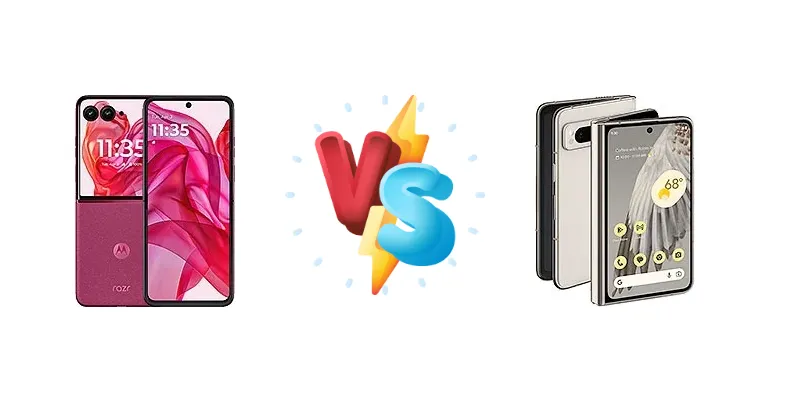
|
🏆 Quick Verdict
For the average user prioritizing raw performance and faster charging, the Motorola Razr+ 2024 emerges as the winner. Its Snapdragon 8s Gen 3 chipset delivers a noticeable speed advantage over the Google Tensor G2, and the 45W charging is significantly quicker. However, the Pixel Fold’s software integration and larger display may appeal to power users.
| PHONES | ||
|---|---|---|
| Phone Names | Motorola Razr+ 2024 | Google Pixel Fold |
| Network | ||
|---|---|---|
| 2G bands | GSM 900 / 1800 / 1900 | GSM 850 / 900 / 1800 / 1900 |
| 3G bands | HSDPA 850 / 900 / 1700(AWS) / 1900 / 2100 | HSDPA 800 / 850 / 900 / 1700(AWS) / 1900 / 2100 |
| 4G bands | 1, 2, 3, 4, 5, 7, 8, 12, 13, 14, 17, 18, 19, 20, 25, 26, 28, 29, 30, 38, 39, 40, 41, 46, 48, 66, 71 | 1, 2, 3, 4, 5, 7, 8, 12, 13, 14, 17, 18, 19, 20, 21, 25, 26, 28, 29, 30, 32, 38, 39, 40, 41, 42, 46, 48, 66, 71 |
| 5G bands | 1, 2, 3, 5, 7, 12, 14, 20, 25, 26, 28, 29, 30, 38, 40, 41, 48, 66, 70, 71, 77, 78 SA/NSA/Sub6 | 1, 2, 3, 5, 7, 8, 12, 14, 20, 25, 28, 30, 38, 40, 41, 48, 66, 71, 75, 76, 77, 78, 79, 257, 258, 260, 261 SA/NSA/Sub6/mmWave |
| Speed | HSPA, LTE, 5G | HSPA, LTE, 5G |
| Technology | GSM / HSPA / LTE / 5G | GSM / CDMA / HSPA / EVDO / LTE / 5G |
| - | CDMA2000 1xEV-DO | |
| Launch | ||
|---|---|---|
| Announced | 2024, June 25 | 2023, May 10 |
| Status | Available. Released 2024, July 17 | Available. Released 2023, June 27 |
| Body | ||
|---|---|---|
| Build | Plastic front (unfolded), glass front (folded, Gorilla Glass Victus), silicone polymer back (eco leather), aluminum frame (6000 series), hinge (stainless steel) | Glass front (Gorilla Glass Victus) (folded), plastic front (unfolded), glass back (Gorilla Glass Victus), aluminum frame |
| Dimensions | Unfolded: 171.4 x 74 x 7.1 mmFolded: 88.1 x 74 x 15.3 mm | Unfolded: 139.7 x 158.7 x 5.8 mmFolded: 139.7 x 79.5 x 12.1 mm |
| SIM | Nano-SIM + eSIM | Nano-SIM + eSIM |
| Weight | 189 g (6.67 oz) | 283 g (9.98 oz) |
| - | IPX8 water resistant | |
| Display | ||
|---|---|---|
| Resolution | 1080 x 2640 pixels (~413 ppi density) | 1840 x 2208 pixels (~378 ppi density) |
| Size | 6.9 inches, 107.6 cm2 (~84.9% screen-to-body ratio) | 7.6 inches, 183.3 cm2 (~82.7% screen-to-body ratio) |
| Type | Foldable LTPO AMOLED, 1B colors, Dolby Vision, 165Hz, HDR10+, 3000 nits (peak) | Foldable OLED, 120Hz, HDR10+, 1000 nits (HBM), 1450 nits (peak) |
| - | Cover display: OLED, 120Hz, HDR, Corning Gorilla Glass Victus 5.8 inches, 1080 x 2092 pixels, 17.4:9 ratio, 408 ppi 1200 nits (HBM), 1550 nits (peak) | |
| Platform | ||
|---|---|---|
| CPU | Octa-core (1x3.0 GHz Cortex-X4 & 4x2.8 GHz Cortex-A720 & 3x2.0 GHz Cortex-A520) | Octa-core (2x2.85 GHz Cortex-X1 & 2x2.35 GHz Cortex-A78 & 4x1.80 GHz Cortex-A55) |
| Chipset | Qualcomm SM8635 Snapdragon 8s Gen 3 (4 nm) | Google Tensor G2 (5 nm) |
| GPU | Adreno 735 | Mali-G710 MP7 |
| OS | Android 14 | Android 13, upgradable to Android 15, up to 5 major Android upgrades |
| Memory | ||
|---|---|---|
| Card slot | No | No |
| Internal | 256GB 12GB RAM | 256GB 12GB RAM, 512GB 12GB RAM |
| - | UFS 3.1 | |
| Main Camera | ||
|---|---|---|
| Dual | 50 MP, f/1.7, 24mm (wide), 1/1.95", 0.8µm, dual pixel PDAF, OIS 50 MP, f/2.0, 47mm (telephoto), 1/2.76", 0.64µm, PDAF, 2x optical zoom | - |
| Features | LED flash, panorama, HDR | Laser AF, Dual-LED flash, HDR, panorama |
| Triple | - | 48 MP, f/1.7, 25mm (wide), 1/2.0", 0.8µm, dual pixel PDAF, OIS 10.8 MP, f/3.1, 112mm (telephoto), 1/3.1", 1.22µm, dual pixel PDAF, OIS, 5x optical zoom 10.8 MP, f/2.2, 121˚, (ultrawide), 1/3.0", 1.25µm |
| Video | 4K@30/60fps, 1080p@30/60/120/240/960fps, HDR10+, gyro-EIS | 4K@30/60fps, 1080p@30/60/120/240fps, 10-bit HDR |
| Selfie camera | ||
|---|---|---|
| Features | HDR | HDR, panorama |
| Single | 32 MP, f/2.4, 25mm (wide), 1/3.14", 0.7µm | 8 MP, f/2.0, 24mm (wide), 1/4.0", 1.12µm Cover camera: 9.5 MP, f/2.2, 24mm (wide), 1.22µm, dual pixel PDAF |
| Video | 4K@30/60fps, 1080p@30/60fps | 4K@30/60fps, 1080p@30/60fps |
| Sound | ||
|---|---|---|
| 3.5mm jack | - | No |
| 35mm jack | No | No |
| Loudspeaker | Yes, with stereo speakers | Yes, with stereo speakers |
| Comms | ||
|---|---|---|
| Bluetooth | 5.4, A2DP, LE, aptX HD, aptX Adaptive, aptX Lossless | 5.2, A2DP, LE, aptX HD |
| NFC | Yes | Yes |
| Positioning | GPS (L1+L5), GLONASS (L1), BDS (B1I+B1c+B2a), GALILEO (E1+E5a), QZSS (L1+L5) | GPS, GLONASS, GALILEO, BDS |
| Radio | No | No |
| USB | USB Type-C 2.0, OTG | USB Type-C 3.2, OTG |
| WLAN | Wi-Fi 802.11 a/b/g/n/ac/6e/7, dual-band or tri-band (region dependent) | Wi-Fi 802.11 a/b/g/n/ac/6e, tri-band, Wi-Fi Direct |
| Features | ||
|---|---|---|
| Sensors | Fingerprint (side-mounted), accelerometer, gyro, proximity, compass, barometer | Fingerprint (side-mounted), accelerometer, gyro, proximity, compass, barometer |
| - | Ultra Wideband (UWB) support | |
| Battery | ||
|---|---|---|
| Charging | 45W wired 15W wireless 5W reverse wired | Wired, PD3.0 Wireless |
| Type | 4000 mAh | Li-Po 4821 mAh |
| Misc | ||
|---|---|---|
| Colors | Midnight Blue, Hot Pink, Spring Green, Peach Fuzz, Paris Hilton Edition | Porcelain, Obsidian |
| Models | - | G9FPL |
| Price | $ 260.99 | € 670.87 / $ 389.26 / £ 899.99 |
Motorola Razr+ 2024
- Faster Snapdragon 8s Gen 3 processor
- 45W fast wired charging
- More affordable price point (likely)
- Potentially less refined software experience
- May have a smaller inner display
Google Pixel Fold
- Google’s software and AI features
- Larger, more tablet-like inner display
- Strong computational photography
- Slower Tensor G2 processor
- Slower charging speeds
- Higher price
Display Comparison
While both devices feature foldable OLED displays, key differences exist. The Pixel Fold’s larger inner display offers a more immersive experience, but specifics like peak brightness and refresh rate are not provided in the context data. The Razr+ 2024, likely prioritizing cost, may have a slightly less vibrant panel. Both will likely employ LTPO technology for variable refresh rates, conserving battery, but the Pixel Fold’s larger surface area could benefit from more aggressive power management. Bezels are a critical factor in the foldable experience, and without specific data, it's reasonable to assume the Razr+ may have slightly larger bezels to manage costs.
Camera Comparison
Without detailed sensor information, a direct camera comparison is difficult. However, the focus should be on the main sensors. The Pixel Fold benefits from Google’s renowned computational photography, which excels in dynamic range and image processing. The Razr+ 2024 will need a strong main sensor to compete, but the Tensor G2’s dedicated image signal processor (ISP) gives the Pixel Fold an edge in software-driven image quality. The absence of details on OIS and lens apertures makes a definitive judgment impossible, but Google’s history suggests a more sophisticated camera system overall.
Performance
The core performance difference lies in the chipsets. The Motorola Razr+ 2024’s Snapdragon 8s Gen 3 (4nm) is a newer generation chip built on a more efficient node than the Google Pixel Fold’s Tensor G2 (5nm). The Snapdragon’s Cortex-X4 prime core, clocked at 3.0 GHz, offers a significant performance uplift over the Tensor G2’s Cortex-X1 cores at 2.85 GHz. The Snapdragon’s architecture, with its mix of A720 and A520 cores, is optimized for both sustained performance and power efficiency, potentially leading to less thermal throttling during demanding tasks. The Tensor G2 prioritizes AI and machine learning tasks, but falls behind in raw CPU and GPU power. The Razr+ will likely benefit from faster LPDDR5x RAM, further enhancing performance.
Battery Life
Battery capacity isn’t specified, but the charging speeds are. The Razr+ 2024’s 45W wired charging is a substantial advantage over the Pixel Fold’s unspecified wired charging (PD3.0 implies fast charging, but likely slower than 45W). The Razr+ also offers 15W wireless and 5W reverse wired charging, adding versatility. The Pixel Fold’s wireless charging is a plus, but the slower wired charging could be a drawback for users who frequently need to top up their battery quickly. The Snapdragon 8s Gen 3’s 4nm process should contribute to better battery efficiency, potentially offsetting a smaller battery capacity.
Buying Guide
Buy the Motorola Razr+ 2024 if you need a stylish, pocketable foldable with strong performance for everyday tasks and gaming, and value faster charging speeds. Buy the Google Pixel Fold if you prefer a larger, more tablet-like experience, prioritize Google’s software features and ecosystem integration, and are willing to trade some raw processing power for a more refined software experience.