
Motorola Razr 60 vs. Google Pixel Fold: A Deep Dive into Foldable Futures
| Phones Images | |||||
|---|---|---|---|---|---|
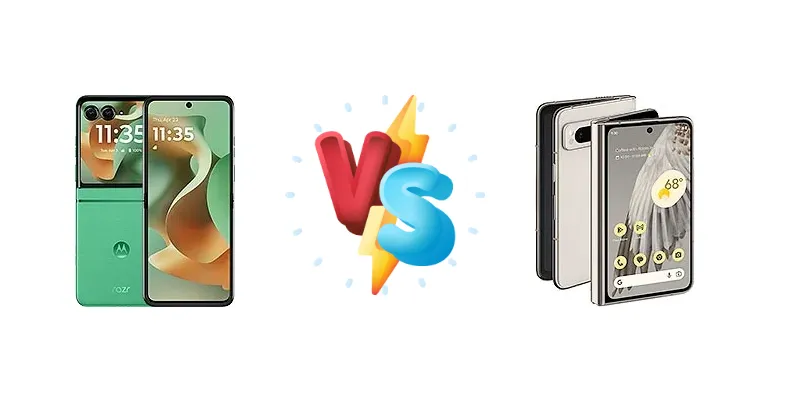
|
🏆 Quick Verdict
For the average user prioritizing software experience and a more polished foldable design, the Google Pixel Fold is the superior choice. However, the Motorola Razr 60 delivers exceptional battery life and a more affordable entry point into the foldable world, making it ideal for those on a budget.
| PHONES | ||
|---|---|---|
| Phone Names | Motorola Razr 60 | Google Pixel Fold |
| Network | ||
|---|---|---|
| 2G bands | GSM 900 / 1800 / 1900 | GSM 850 / 900 / 1800 / 1900 |
| 3G bands | HSDPA 850 / 900 / 1700(AWS) / 1900 / 2100 | HSDPA 800 / 850 / 900 / 1700(AWS) / 1900 / 2100 |
| 4G bands | 1, 2, 3, 4, 5, 7, 8, 12, 13, 17, 18, 19, 20, 25, 26, 28, 32, 38, 39, 40, 41, 42, 43, 66 | 1, 2, 3, 4, 5, 7, 8, 12, 13, 14, 17, 18, 19, 20, 21, 25, 26, 28, 29, 30, 32, 38, 39, 40, 41, 42, 46, 48, 66, 71 |
| 5G bands | 1, 2, 3, 5, 7, 8, 20, 26, 28, 38, 40, 41, 66, 75, 77, 78 SA/NSA/Sub6 | 1, 2, 3, 5, 7, 8, 12, 14, 20, 25, 28, 30, 38, 40, 41, 48, 66, 71, 75, 76, 77, 78, 79, 257, 258, 260, 261 SA/NSA/Sub6/mmWave |
| Speed | HSPA, LTE, 5G | HSPA, LTE, 5G |
| Technology | GSM / CDMA / HSPA / EVDO / LTE / 5G | GSM / CDMA / HSPA / EVDO / LTE / 5G |
| - | CDMA2000 1xEV-DO | |
| Launch | ||
|---|---|---|
| Announced | 2025, April 24 | 2023, May 10 |
| Status | Available. Released 2025, April 25 | Available. Released 2023, June 27 |
| Body | ||
|---|---|---|
| Build | Plastic front (unfolded), glass front (folded, Gorilla Glass Victus), silicone polymer back (eco leather), aluminum frame (6000 series), hinge (stainless steel) | Glass front (Gorilla Glass Victus) (folded), plastic front (unfolded), glass back (Gorilla Glass Victus), aluminum frame |
| Dimensions | Unfolded: 171.3 x 74 x 7.3 mmFolded: 88.1 x 74 x 15.9 mm | Unfolded: 139.7 x 158.7 x 5.8 mmFolded: 139.7 x 79.5 x 12.1 mm |
| SIM | · Nano-SIM + eSIM· Nano-SIM + Nano-SIM | Nano-SIM + eSIM |
| Weight | 188 g (6.63 oz) | 283 g (9.98 oz) |
| - | IPX8 water resistant | |
| Display | ||
|---|---|---|
| Protection | Mohs level 4 | - |
| Resolution | 1080 x 2640 pixels (~413 ppi density) | 1840 x 2208 pixels (~378 ppi density) |
| Size | 6.9 inches, 107.6 cm2 (~84.9% screen-to-body ratio) | 7.6 inches, 183.3 cm2 (~82.7% screen-to-body ratio) |
| Type | Foldable LTPO AMOLED, 1B colors, 120Hz, HDR10+, 3000 nits (peak) | Foldable OLED, 120Hz, HDR10+, 1000 nits (HBM), 1450 nits (peak) |
| - | Cover display: OLED, 120Hz, HDR, Corning Gorilla Glass Victus 5.8 inches, 1080 x 2092 pixels, 17.4:9 ratio, 408 ppi 1200 nits (HBM), 1550 nits (peak) | |
| Platform | ||
|---|---|---|
| CPU | Octa-core (4x2.6 GHz Cortex-A78 & 4x2.0 GHz Cortex-A55) | Octa-core (2x2.85 GHz Cortex-X1 & 2x2.35 GHz Cortex-A78 & 4x1.80 GHz Cortex-A55) |
| Chipset | Mediatek Dimensity 7400X (4 nm) | Google Tensor G2 (5 nm) |
| GPU | Mali-G615 MC2 | Mali-G710 MP7 |
| OS | Android 15 | Android 13, upgradable to Android 15, up to 5 major Android upgrades |
| Memory | ||
|---|---|---|
| Card slot | No | No |
| Internal | 256GB 8GB RAM, 256GB 12GB RAM, 512GB 12GB RAM | 256GB 12GB RAM, 512GB 12GB RAM |
| - | UFS 3.1 | |
| Main Camera | ||
|---|---|---|
| Dual | 50 MP, f/1.7, 25mm (wide), 1/1.95", 0.8µm, dual pixel PDAF, OIS 13 MP, f/2.2, 120˚ (ultrawide), 1/3.0", 1.12µm, AF | - |
| Features | LED flash, panorama, HDR, Pantone Validated Colour and Skin Tones | Laser AF, Dual-LED flash, HDR, panorama |
| Triple | - | 48 MP, f/1.7, 25mm (wide), 1/2.0", 0.8µm, dual pixel PDAF, OIS 10.8 MP, f/3.1, 112mm (telephoto), 1/3.1", 1.22µm, dual pixel PDAF, OIS, 5x optical zoom 10.8 MP, f/2.2, 121˚, (ultrawide), 1/3.0", 1.25µm |
| Video | 4K@30fps, 1080p@30/60fps, gyro-EIS | 4K@30/60fps, 1080p@30/60/120/240fps, 10-bit HDR |
| Selfie camera | ||
|---|---|---|
| Features | HDR | HDR, panorama |
| Single | 32 MP, f/2.4, 25mm (wide), 1/3.14", 0.7µm | 8 MP, f/2.0, 24mm (wide), 1/4.0", 1.12µm Cover camera: 9.5 MP, f/2.2, 24mm (wide), 1.22µm, dual pixel PDAF |
| Video | 4K@30fps, 1080p@30/60fps | 4K@30/60fps, 1080p@30/60fps |
| Sound | ||
|---|---|---|
| 3.5mm jack | - | No |
| 35mm jack | No | No |
| Loudspeaker | Yes, with stereo speakers (with Dolby Atmos) | Yes, with stereo speakers |
| Comms | ||
|---|---|---|
| Bluetooth | 5.4, A2DP, LE | 5.2, A2DP, LE, aptX HD |
| NFC | Yes | Yes |
| Positioning | GPS, GLONASS, BDS, GALILEO, QZSS | GPS, GLONASS, GALILEO, BDS |
| Radio | No | No |
| USB | USB Type-C 2.0 | USB Type-C 3.2, OTG |
| WLAN | Wi-Fi 802.11 a/b/g/n/ac/6 or 6e, dual-band or tri-band (region dependent) | Wi-Fi 802.11 a/b/g/n/ac/6e, tri-band, Wi-Fi Direct |
| Features | ||
|---|---|---|
| Sensors | Fingerprint (side-mounted), gyro, accelerometer, proximity, compass | Fingerprint (side-mounted), accelerometer, gyro, proximity, compass, barometer |
| - | Ultra Wideband (UWB) support | |
| Battery | ||
|---|---|---|
| Charging | 30W wired 15W wireless | Wired, PD3.0 Wireless |
| Type | Si/C Li-Ion 4500 mAh | Li-Po 4821 mAh |
| Misc | ||
|---|---|---|
| Colors | Pantone: Gibraltar Sea, Spring Bud, Lightest Sky, Parfait Pink, Swarovski edition | Porcelain, Obsidian |
| Models | XT2553-1 | G9FPL |
| Price | € 549.90 | € 670.87 / $ 389.26 / £ 899.99 |
| EU LABEL | ||
|---|---|---|
| Battery | 45:08h endurance, 1000 cycles | - |
| Energy | Class A | - |
| Free fall | Class C (70 falls) | - |
| Repairability | Class B | - |
Motorola Razr 60
- Exceptional battery life (45:08h endurance)
- More affordable price point
- Potentially better thermal management due to 4nm Dimensity 7400X
- Less powerful processor compared to Tensor G2
- Likely less refined software experience
- Potentially lower-quality display panel
Google Pixel Fold
- Powerful Google Tensor G2 chipset
- Superior software experience and updates
- Likely higher-quality display and build materials
- Potentially shorter battery life
- Significantly higher price
- Tensor G2 can run warmer under sustained load
Display Comparison
While specific display specs (resolution, refresh rate) are missing for both, the core difference lies in the overall implementation. The Pixel Fold likely benefits from Google’s display calibration expertise, aiming for greater color accuracy. The Razr 60, positioned as a more value-oriented device, may utilize a slightly less advanced panel. The hinge mechanism is also a key differentiator; the Pixel Fold’s wider aspect ratio when unfolded suggests a more tablet-like experience, while the Razr 60 likely maintains a taller, narrower form factor. Bezels will be a critical visual distinction, with the Pixel Fold likely minimizing them for a more immersive experience.
Camera Comparison
Without detailed camera specs, it’s difficult to make a definitive judgment. However, Google’s computational photography prowess, powered by the Tensor G2’s image signal processor (ISP), gives the Pixel Fold a likely edge in image quality, particularly in challenging lighting conditions. The Pixel Fold will likely excel in dynamic range and detail preservation. The Razr 60 will likely focus on providing a competent camera experience, but may not match the Pixel Fold’s advanced features like Magic Eraser or Photo Unblur. Sensor size and lens apertures will be crucial factors, but without that data, we can only assume Google prioritizes camera performance.
Performance
The Google Pixel Fold’s Tensor G2 (5nm) chipset, featuring a Cortex-X1 prime core, offers a performance advantage over the Motorola Razr 60’s Mediatek Dimensity 7400X (4nm). The X1 core in the Tensor G2, clocked at 2.85 GHz, provides a significant boost in single-core performance, crucial for responsive app launching and smooth multitasking. While the Dimensity 7400X is efficient, its Cortex-A78 cores, clocked at 2.6 GHz, are a generation behind. The 4nm process node of the Dimensity 7400X will contribute to better thermal efficiency, potentially mitigating throttling during sustained workloads, but the Tensor G2’s overall processing power is likely higher. The Pixel Fold’s software optimization further enhances its performance.
Battery Life
The Motorola Razr 60’s standout feature is its impressive 45:08h battery endurance and 1000 cycle lifespan. This suggests a highly optimized power management system and a battery designed for longevity. The Pixel Fold, while offering both wired (PD3.0) and wireless charging, doesn’t have its endurance publicly available. The Tensor G2, while powerful, is known to be less power-efficient than some competing chipsets. The Razr 60’s 30W wired and 15W wireless charging are adequate, but the Pixel Fold’s PD3.0 support may offer faster wired charging speeds, depending on the adapter used.
Buying Guide
Buy the Motorola Razr 60 if you need a long-lasting foldable that prioritizes battery life and value. Its 45:08h endurance is a standout feature for power users. Buy the Google Pixel Fold if you prefer a seamless software experience, a more robust build quality, and are willing to pay a premium for Google’s Tensor G2 chipset and optimized foldable software.