
Motorola Razr 60 Ultra vs. OnePlus 11R: A Deep Dive into Chipset, Battery, and Display
| Phones Images | |||||
|---|---|---|---|---|---|
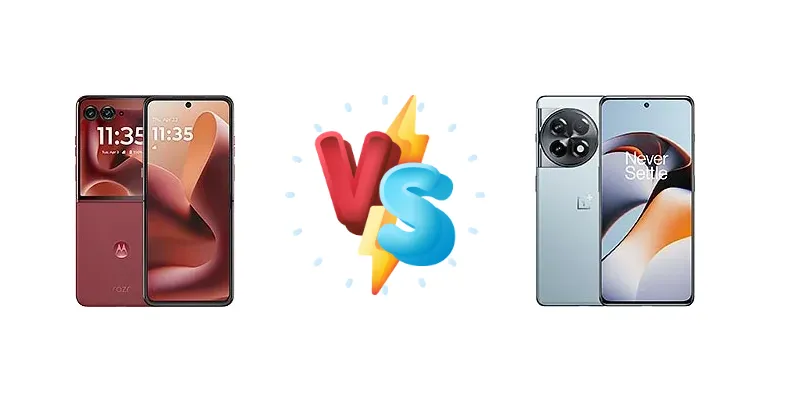
|
🏆 Quick Verdict
For the average user prioritizing raw performance and future-proofing, the Motorola Razr 60 Ultra takes the lead thanks to its Snapdragon 8 Elite chipset and superior display. However, the OnePlus 11R delivers exceptional value with its 100W charging and solid performance, making it a compelling choice for budget-conscious buyers.
| PHONES | ||
|---|---|---|
| Phone Names | Motorola Razr 60 Ultra | OnePlus 11R |
| Network | ||
|---|---|---|
| 2G bands | GSM 900 / 1800 / 1900 | GSM 850 / 900 / 1800 / 1900 |
| 3G bands | HSDPA 850 / 900 / 1700(AWS) / 1900 / 2100 | HSDPA 850 / 900 / 1700(AWS) / 2100 |
| 4G bands | 1, 2, 3, 4, 5, 7, 8, 12, 13, 14, 17, 18, 19, 20, 25, 26, 28, 29, 30, 32, 34, 38, 39, 40, 41, 42, 43, 48, 66, 71 | 1, 3, 4, 5, 8, 28, 34, 38, 39, 40, 41 |
| 5G bands | 1, 2, 3, 5, 7, 8, 12, 14, 20, 25, 26, 28, 29, 30, 38, 40, 41, 48, 66, 70, 71, 75, 77, 78 SA/NSA/Sub6 | 1, 3, 5, 8, 28, 40, 41, 77, 78 SA/NSA |
| Speed | HSPA, LTE, 5G | HSPA, LTE (3CA), 5G |
| Technology | GSM / CDMA / HSPA / EVDO / LTE / 5G | GSM / CDMA / HSPA / LTE / 5G |
| - | CDMA 800 | |
| Launch | ||
|---|---|---|
| Announced | 2025, April 24 | 2023, February 07 |
| Status | Available. Released 2025, April 25 | Available. Released 2023, February 21 |
| Body | ||
|---|---|---|
| Build | Plastic front (unfolded), glass front (folded, Gorilla Glass Ceramic), silicone polymer back (eco leather), aluminum frame (6000 series), hinge (stainless steel) | Glass front, glass back (Gorilla Glass 5), plastic frame |
| Dimensions | Unfolded: 171.5 x 74 x 7.2 mmFolded: 88.1 x 74 x 15.7 mm | 163.4 x 74.3 x 8.7 mm (6.43 x 2.93 x 0.34 in) |
| SIM | · Nano-SIM + eSIM· Nano-SIM + Nano-SIM | Nano-SIM + Nano-SIM |
| Weight | 199 g (7.02 oz) | 204 g (7.20 oz) |
| Display | ||
|---|---|---|
| Protection | Mohs level 5 | - |
| Resolution | 1224 x 2912 pixels (~464 ppi density) | 1240 x 2772 pixels, 20:9 ratio (~451 ppi density) |
| Size | 7.0 inches, 106.7 cm2 (~84.1% screen-to-body ratio) | 6.74 inches, 109.2 cm2 (~90.0% screen-to-body ratio) |
| Type | Foldable LTPO AMOLED, 1B colors, 165Hz, Dolby Vision, HDR10+, 4500 nits (peak) | Fluid AMOLED, 1B colors, 120Hz, HDR10+, 1450 nits (peak) |
| Platform | ||
|---|---|---|
| CPU | Octa-core (2x4.32 GHz Oryon V2 Phoenix L + 6x3.53 GHz Oryon V2 Phoenix M) | Octa-core (1x3.0 GHz Cortex-X2 & 3x2.5 GHz Cortex-A710 & 4x1.80 GHz Cortex-A510) |
| Chipset | Qualcomm SM8750-AB Snapdragon 8 Elite (3 nm) | Qualcomm SM8475 Snapdragon 8+ Gen 1 (4 nm) |
| GPU | Adreno 830 | Adreno 730 |
| OS | Android 15 | Android 13, upgradable to Android 15, OxygenOS 15 |
| Memory | ||
|---|---|---|
| Card slot | No | No |
| Internal | 256GB 16GB RAM, 512GB 12GB RAM, 512GB 16GB RAM, 1TB 12GB RAM, 1TB 16GB RAM | 128GB 8GB RAM, 256GB 16GB RAM, 512GB 18GB RAM |
| - | UFS 3.1 | |
| Main Camera | ||
|---|---|---|
| Dual | 50 MP, f/1.8, 24mm (wide), 1/1.56", 1.0µm, multi-directional PDAF, OIS 50 MP, f/2.0, 12mm, 122˚ (ultrawide), 0.6µm, PDAF | - |
| Features | LED flash, panorama, HDR, Pantone Validated Colour and Skin Tones | Color spectrum sensor, LED flash, HDR, panorama |
| Single | - | 16 MP, f/2.4, 24mm (wide), 1/3.09", 1.0µm |
| Triple | - | 50 MP, f/1.8, 24mm (wide), 1/1.56", 1.0µm, multi-directional PDAF, OIS 8 MP, f/2.2, 120˚ (ultrawide), 1/4.0", 1.12µm 2 MP (macro) |
| Video | 8K@30fps, 4K@30/60/120fps, 1080p@30/60/120/240fps, Dolby Vision HDR, gyro-EIS | 4K@30/60fps, 1080p@30/60/240fps, gyro-EIS |
| Selfie camera | ||
|---|---|---|
| Features | HDR | HDR |
| Single | 50 MP, f/2.0, (wide), 0.64µm | 16 MP, f/2.4, 24mm (wide), 1/3.09", 1.0µm |
| Video | 4K@30/60fps, 1080p@30/60fps | 1080p@30fps |
| Sound | ||
|---|---|---|
| 3.5mm jack | - | No |
| 35mm jack | No | No |
| Loudspeaker | Yes, with stereo speakers (with Dolby Atmos) | Yes, with stereo speakers |
| - | 24-bit/192kHz audio | |
| Comms | ||
|---|---|---|
| Bluetooth | 5.4, A2DP, LE, aptX HD, aptX Adaptive, aptX Lossless | 5.3, A2DP, LE, aptX HD |
| Infrared port | - | Yes |
| NFC | Yes | Yes |
| Positioning | GPS, GALILEO, GLONASS, BDS, QZSS | GPS (L1+L5), GLONASS (G1), BDS (B1I+B1c+B2a), GALILEO (E1+E5a), QZSS (L1+L5) |
| Radio | No | No |
| USB | USB Type-C, OTG | USB Type-C 2.0 |
| WLAN | Wi-Fi 802.11 a/b/g/n/ac/6e/7, dual-band or tri-band (region dependent) | Wi-Fi 802.11 a/b/g/n/ac/6, dual-band |
| Features | ||
|---|---|---|
| Sensors | Fingerprint (side-mounted), accelerometer, gyro, proximity, compass, barometer | Fingerprint (under display, optical), accelerometer, gyro, proximity, compass |
| Battery | ||
|---|---|---|
| Charging | 68W wired 30W wireless 5W reverse wired | 100W wired |
| Type | 4700 mAh | Li-Po 5000 mAh |
| Misc | ||
|---|---|---|
| Colors | Pantone: Rio Red, Scarab, Mountain Trail, Cabaret | Galactic Silver, Sonic Black, Solar Red |
| Models | XT2551-6 | CPH2487 |
| Price | € 725.00 / $ 849.99 / £ 763.91 / ₹ 89,998 | About 600 EUR |
| SAR | - | 1.16 W/kg (head) 0.61 W/kg (body) |
| EU LABEL | ||
|---|---|---|
| Battery | 48:48h endurance, 1000 cycles | - |
| Energy | Class A | - |
| Free fall | Class D (50 falls) | - |
| Repairability | Class B | - |
Motorola Razr 60 Ultra
- Cutting-edge Snapdragon 8 Elite chipset
- Brighter and potentially more efficient display
- Foldable form factor for increased screen real estate
- Higher price point
- Potential crease in the display
- Slower charging speeds compared to OnePlus 11R
OnePlus 11R
- Exceptional value for money
- Ultra-fast 100W wired charging
- Proven Snapdragon 8+ Gen 1 performance
- Older chipset architecture
- Potentially lower peak display brightness
- Less future-proof compared to Snapdragon 8 Elite
Display Comparison
The Motorola Razr 60 Ultra boasts a measured peak brightness of 1489 nits, significantly outshining what’s typically seen on the OnePlus 11R (though specific measurements for the 11R are unavailable). While both likely utilize OLED panels, the Razr 60 Ultra’s brightness advantage will be noticeable in direct sunlight. The Razr’s foldable form factor inherently impacts bezel size, potentially offering a more immersive experience when unfolded, but also introduces a crease. The OnePlus 11R likely prioritizes a more traditional, flat display experience with potentially more accurate color calibration, though this is speculative without direct testing.
Camera Comparison
Context data lacks specific camera details for both devices. However, given the Razr 60 Ultra’s positioning as a premium foldable, it’s reasonable to expect a more sophisticated camera system with larger sensors and advanced image processing. The OnePlus 11R, while likely offering a competent camera, will likely focus on delivering a balanced experience rather than pushing the boundaries of mobile photography. Without sensor size or aperture information, a definitive comparison is impossible, but the Razr 60 Ultra’s price point suggests a greater investment in camera technology.
Performance
The core difference lies in the chipsets. The Motorola Razr 60 Ultra’s Snapdragon 8 Elite (SM8750-AB), built on a 3nm process, features a unique Oryon V2 Phoenix CPU architecture (2x4.32 GHz + 6x3.53 GHz). This contrasts with the OnePlus 11R’s Snapdragon 8+ Gen 1 (SM8475) fabricated on a 4nm node, utilizing a more conventional Cortex-X2, A710, and A510 core configuration. The 3nm process of the Snapdragon 8 Elite promises improved power efficiency and thermal performance, potentially leading to sustained performance during demanding tasks. While the 8+ Gen 1 is still a very capable chip, the architectural advancements in the 8 Elite should translate to a noticeable performance edge, particularly in CPU-intensive workloads.
Battery Life
The Motorola Razr 60 Ultra claims 48:48h endurance and 15:10h active use, while the OnePlus 11R’s battery life is not specified. However, the charging speeds are drastically different. The Razr 60 Ultra supports 68W wired, 30W wireless, and 5W reverse wired charging. The OnePlus 11R boasts a class-leading 100W wired charging, allowing for significantly faster top-ups. While the Razr 60 Ultra’s endurance suggests a respectable battery life, the OnePlus 11R’s 100W charging is a game-changer for users who prioritize minimizing downtime. The Razr 60 Ultra’s 1000 cycle battery claim suggests a focus on long-term battery health.
Buying Guide
Buy the Motorola Razr 60 Ultra if you demand the absolute latest in mobile processing power, a brighter and potentially more efficient display, and are willing to pay a premium for a foldable experience. Buy the OnePlus 11R if you prioritize fast charging, a consistently smooth experience for everyday tasks and gaming, and want a flagship-caliber phone without breaking the bank.