
Motorola Razr 60 Ultra vs. Honor Magic Vs2: A Deep Dive into Foldable Performance
| Phones Images | |||||
|---|---|---|---|---|---|
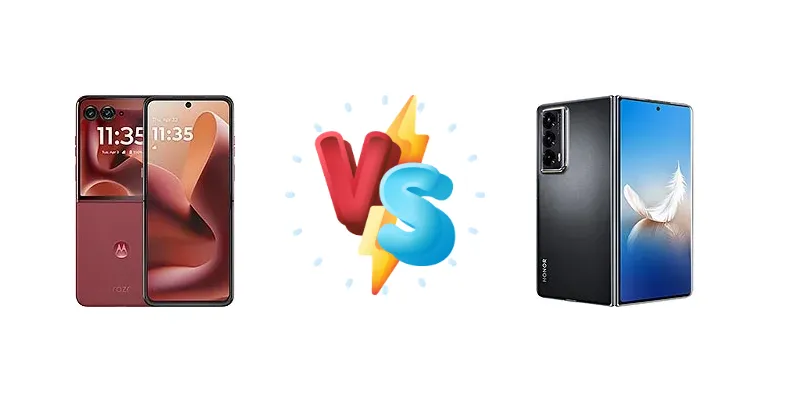
|
🏆 Quick Verdict
For users prioritizing raw performance and future-proofing, the Motorola Razr 60 Ultra emerges as the winner. Its Snapdragon 8 Elite chipset, built on a 3nm process, offers a significant leap in processing power and efficiency. However, the Honor Magic Vs2 remains a strong contender, offering a balanced experience at potentially a lower cost.
| PHONES | ||
|---|---|---|
| Phone Names | Motorola Razr 60 Ultra | Honor Magic Vs2 |
| Network | ||
|---|---|---|
| 2G bands | GSM 900 / 1800 / 1900 | GSM 850 / 900 / 1800 / 1900 |
| 3G bands | HSDPA 850 / 900 / 1700(AWS) / 1900 / 2100 | HSDPA 800 / 850 / 900 / 1700(AWS) / 1900 / 2100 |
| 4G bands | 1, 2, 3, 4, 5, 7, 8, 12, 13, 14, 17, 18, 19, 20, 25, 26, 28, 29, 30, 32, 34, 38, 39, 40, 41, 42, 43, 48, 66, 71 | LTE |
| 5G bands | 1, 2, 3, 5, 7, 8, 12, 14, 20, 25, 26, 28, 29, 30, 38, 40, 41, 48, 66, 70, 71, 75, 77, 78 SA/NSA/Sub6 | SA/NSA |
| Speed | HSPA, LTE, 5G | HSPA, LTE, 5G |
| Technology | GSM / CDMA / HSPA / EVDO / LTE / 5G | GSM / CDMA / HSPA / CDMA2000 / LTE / 5G |
| Launch | ||
|---|---|---|
| Announced | 2025, April 24 | 2023, October 12 |
| Status | Available. Released 2025, April 25 | Available. Released 2023, October 17 |
| Body | ||
|---|---|---|
| Build | Plastic front (unfolded), glass front (folded, Gorilla Glass Ceramic), silicone polymer back (eco leather), aluminum frame (6000 series), hinge (stainless steel) | Glass front, glass back or eco leather back, magnesium alloy frame, titanium alloy folding mechanism |
| Dimensions | Unfolded: 171.5 x 74 x 7.2 mmFolded: 88.1 x 74 x 15.7 mm | Unfolded: 157.5 x 146.2 x 5.1 mmFolded: 157.5 x 74.4 x 10.7 mm |
| SIM | · Nano-SIM + eSIM· Nano-SIM + Nano-SIM | Nano-SIM + Nano-SIM |
| Weight | 199 g (7.02 oz) | 229 g (8.08 oz) |
| Display | ||
|---|---|---|
| Protection | Mohs level 5 | - |
| Resolution | 1224 x 2912 pixels (~464 ppi density) | 2156 x 2344 pixels (~402 ppi density) |
| Size | 7.0 inches, 106.7 cm2 (~84.1% screen-to-body ratio) | 7.92 inches, 201.6 cm2 (~87.6% screen-to-body ratio) |
| Type | Foldable LTPO AMOLED, 1B colors, 165Hz, Dolby Vision, HDR10+, 4500 nits (peak) | Foldable LTPO OLED, 1B colors, 120Hz, HDR10+, Dolby Vision |
| Platform | ||
|---|---|---|
| CPU | Octa-core (2x4.32 GHz Oryon V2 Phoenix L + 6x3.53 GHz Oryon V2 Phoenix M) | Octa-core (1x3.0 GHz Cortex-X2 & 3x2.5 GHz Cortex-A710 & 4x1.80 GHz Cortex-A510) |
| Chipset | Qualcomm SM8750-AB Snapdragon 8 Elite (3 nm) | Qualcomm SM8475 Snapdragon 8+ Gen 1 (4 nm) |
| GPU | Adreno 830 | Adreno 730 |
| OS | Android 15 | Android 13, MagicOS 7.2 |
| Memory | ||
|---|---|---|
| Card slot | No | No |
| Internal | 256GB 16GB RAM, 512GB 12GB RAM, 512GB 16GB RAM, 1TB 12GB RAM, 1TB 16GB RAM | 256GB 12GB RAM, 512GB 16GB RAM |
| Main Camera | ||
|---|---|---|
| Dual | 50 MP, f/1.8, 24mm (wide), 1/1.56", 1.0µm, multi-directional PDAF, OIS 50 MP, f/2.0, 12mm, 122˚ (ultrawide), 0.6µm, PDAF | - |
| Features | LED flash, panorama, HDR, Pantone Validated Colour and Skin Tones | LED flash, HDR, panorama |
| Triple | - | 50 MP, f/1.9, 25mm (wide), PDAF 20 MP, f/2.4, 62mm (telephoto), PDAF, 2.5x optical zoom, OIS 12 MP, f/2.2, 16mm (ultrawide), AF |
| Video | 8K@30fps, 4K@30/60/120fps, 1080p@30/60/120/240fps, Dolby Vision HDR, gyro-EIS | 4K@30/60fps (10-bit), 1080p@30/60fps, gyro-EIS, HDR10+ |
| Selfie camera | ||
|---|---|---|
| Features | HDR | HDR |
| Single | 50 MP, f/2.0, (wide), 0.64µm | 16 MP, f/2.2, (wide) |
| Video | 4K@30/60fps, 1080p@30/60fps | 4K@30fps, 1080p@30fps, gyro-EIS |
| Sound | ||
|---|---|---|
| 35mm jack | No | No |
| Loudspeaker | Yes, with stereo speakers (with Dolby Atmos) | Yes, with stereo speakers |
| Comms | ||
|---|---|---|
| Bluetooth | 5.4, A2DP, LE, aptX HD, aptX Adaptive, aptX Lossless | 5.2, A2DP, LE, aptX HD |
| Infrared port | - | Yes |
| NFC | Yes | Yes |
| Positioning | GPS, GALILEO, GLONASS, BDS, QZSS | GPS (L1+L5), GLONASS (L1), BDS (B1I+B1c+B2a), GALILEO (E1+E5a), QZSS (L1+L5) |
| Radio | No | No |
| USB | USB Type-C, OTG | USB Type-C 3.1, OTG, Display Port 1.2 |
| WLAN | Wi-Fi 802.11 a/b/g/n/ac/6e/7, dual-band or tri-band (region dependent) | Wi-Fi 802.11 a/b/g/n/ac/6, dual-band, Wi-Fi Direct |
| Features | ||
|---|---|---|
| Sensors | Fingerprint (side-mounted), accelerometer, gyro, proximity, compass, barometer | Fingerprint (side-mounted), accelerometer, gyro, proximity, compass |
| Battery | ||
|---|---|---|
| Charging | 68W wired 30W wireless 5W reverse wired | 66W wired 5W reverse wired |
| Type | 4700 mAh | Li-Po 5000 mAh |
| Misc | ||
|---|---|---|
| Colors | Pantone: Rio Red, Scarab, Mountain Trail, Cabaret | Black, Blue, Purple |
| Models | XT2551-6 | VER-AN00 |
| Price | € 725.00 / $ 849.99 / £ 763.91 / ₹ 89,998 | About 910 EUR |
| EU LABEL | ||
|---|---|---|
| Battery | 48:48h endurance, 1000 cycles | - |
| Energy | Class A | - |
| Free fall | Class D (50 falls) | - |
| Repairability | Class B | - |
Motorola Razr 60 Ultra
- Superior performance with Snapdragon 8 Elite
- Excellent battery life and fast charging
- High peak display brightness
- Potentially higher price point
- Foldable design may be less durable than traditional phones
Honor Magic Vs2
- Proven Snapdragon 8+ Gen 1 performance
- Potentially more affordable price
- Refined foldable design
- Older chipset architecture
- May exhibit more thermal throttling under heavy load
Display Comparison
The Motorola Razr 60 Ultra features a display capable of reaching a measured peak brightness of 1489 nits, ensuring excellent visibility even in direct sunlight. While the Magic Vs2’s display specs aren’t provided, Honor typically prioritizes color accuracy in its displays. The Snapdragon 8 Elite’s display engine likely supports advanced features like variable refresh rates and HDR10+ for a superior viewing experience. The Razr’s brightness advantage is particularly beneficial for outdoor use, a common scenario for foldable phones.
Camera Comparison
Without detailed camera specifications for either device, a direct comparison is difficult. However, given the market positioning, we can infer that both phones will feature multi-camera systems. The Snapdragon 8 Elite’s ISP (Image Signal Processor) is significantly more advanced, offering improved noise reduction, dynamic range, and computational photography capabilities. This translates to better image quality, especially in challenging lighting conditions. The Razr 60 Ultra is likely to benefit from the newer ISP in capturing more detail and producing more vibrant photos. The Magic Vs2 will likely rely on software optimization to compete.
Performance
The core difference lies in the chipsets. The Motorola Razr 60 Ultra’s Snapdragon 8 Elite (3nm) utilizes Oryon V2 Phoenix cores, offering a substantial performance uplift over the Honor Magic Vs2’s Snapdragon 8+ Gen 1 (4nm). The 3nm process node of the Snapdragon 8 Elite translates to improved thermal efficiency, reducing the likelihood of throttling during sustained workloads. The Razr 60 Ultra’s CPU configuration – 2x4.32 GHz Oryon V2 Phoenix L + 6x3.53 GHz Oryon V2 Phoenix M – is geared towards both peak performance and sustained multi-core tasks, giving it an edge in demanding applications. The Magic Vs2’s Cortex-X2 core provides strong single-core performance, but the overall architecture is a generation behind.
Battery Life
The Motorola Razr 60 Ultra boasts an impressive 48:48h endurance rating, suggesting excellent battery life. Its active use score of 15:10h further reinforces this claim. While the Magic Vs2’s battery capacity isn’t specified, both phones offer 66W/68W wired charging, enabling relatively quick top-ups. The Razr 60 Ultra also supports 30W wireless charging and 5W reverse wired charging, offering greater versatility. The 1000 cycle battery life claim for the Razr 60 Ultra indicates a focus on long-term battery health.
Buying Guide
Buy the Motorola Razr 60 Ultra if you demand the absolute best performance for demanding tasks like gaming and video editing, and value the latest processor technology. Buy the Honor Magic Vs2 if you prioritize a refined foldable experience with a proven chipset and potentially a more competitive price, and aren't necessarily chasing the bleeding edge of performance.