
Motorola Razr 60 Ultra vs. Google Pixel Fold: A Head-to-Head Comparison of Folding Titans
| Phones Images | |||||
|---|---|---|---|---|---|
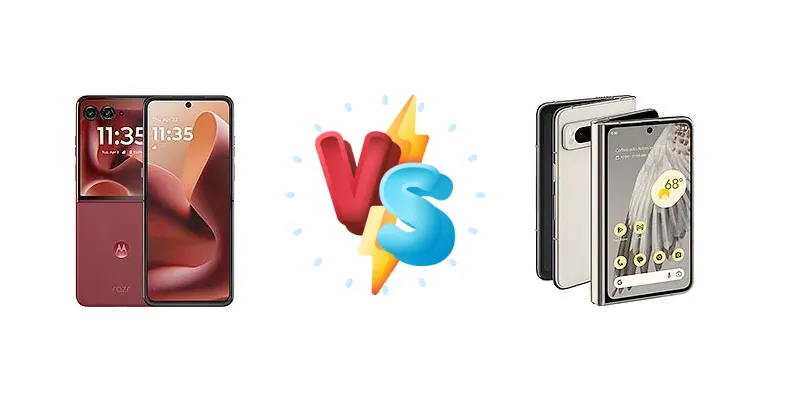
|
🏆 Quick Verdict
For users prioritizing peak performance and fast charging, the Motorola Razr 60 Ultra emerges as the winner. Its Snapdragon 8 Elite chipset delivers significantly more processing power than the Pixel Fold’s Tensor G2, and its 68W charging is substantially faster. However, the Pixel Fold’s software experience and broader feature set may appeal to Google ecosystem devotees.
| PHONES | ||
|---|---|---|
| Phone Names | Motorola Razr 60 Ultra | Google Pixel Fold |
| Network | ||
|---|---|---|
| 2G bands | GSM 900 / 1800 / 1900 | GSM 850 / 900 / 1800 / 1900 |
| 3G bands | HSDPA 850 / 900 / 1700(AWS) / 1900 / 2100 | HSDPA 800 / 850 / 900 / 1700(AWS) / 1900 / 2100 |
| 4G bands | 1, 2, 3, 4, 5, 7, 8, 12, 13, 14, 17, 18, 19, 20, 25, 26, 28, 29, 30, 32, 34, 38, 39, 40, 41, 42, 43, 48, 66, 71 | 1, 2, 3, 4, 5, 7, 8, 12, 13, 14, 17, 18, 19, 20, 21, 25, 26, 28, 29, 30, 32, 38, 39, 40, 41, 42, 46, 48, 66, 71 |
| 5G bands | 1, 2, 3, 5, 7, 8, 12, 14, 20, 25, 26, 28, 29, 30, 38, 40, 41, 48, 66, 70, 71, 75, 77, 78 SA/NSA/Sub6 | 1, 2, 3, 5, 7, 8, 12, 14, 20, 25, 28, 30, 38, 40, 41, 48, 66, 71, 75, 76, 77, 78, 79, 257, 258, 260, 261 SA/NSA/Sub6/mmWave |
| Speed | HSPA, LTE, 5G | HSPA, LTE, 5G |
| Technology | GSM / CDMA / HSPA / EVDO / LTE / 5G | GSM / CDMA / HSPA / EVDO / LTE / 5G |
| - | CDMA2000 1xEV-DO | |
| Launch | ||
|---|---|---|
| Announced | 2025, April 24 | 2023, May 10 |
| Status | Available. Released 2025, April 25 | Available. Released 2023, June 27 |
| Body | ||
|---|---|---|
| Build | Plastic front (unfolded), glass front (folded, Gorilla Glass Ceramic), silicone polymer back (eco leather), aluminum frame (6000 series), hinge (stainless steel) | Glass front (Gorilla Glass Victus) (folded), plastic front (unfolded), glass back (Gorilla Glass Victus), aluminum frame |
| Dimensions | Unfolded: 171.5 x 74 x 7.2 mmFolded: 88.1 x 74 x 15.7 mm | Unfolded: 139.7 x 158.7 x 5.8 mmFolded: 139.7 x 79.5 x 12.1 mm |
| SIM | · Nano-SIM + eSIM· Nano-SIM + Nano-SIM | Nano-SIM + eSIM |
| Weight | 199 g (7.02 oz) | 283 g (9.98 oz) |
| - | IPX8 water resistant | |
| Display | ||
|---|---|---|
| Protection | Mohs level 5 | - |
| Resolution | 1224 x 2912 pixels (~464 ppi density) | 1840 x 2208 pixels (~378 ppi density) |
| Size | 7.0 inches, 106.7 cm2 (~84.1% screen-to-body ratio) | 7.6 inches, 183.3 cm2 (~82.7% screen-to-body ratio) |
| Type | Foldable LTPO AMOLED, 1B colors, 165Hz, Dolby Vision, HDR10+, 4500 nits (peak) | Foldable OLED, 120Hz, HDR10+, 1000 nits (HBM), 1450 nits (peak) |
| - | Cover display: OLED, 120Hz, HDR, Corning Gorilla Glass Victus 5.8 inches, 1080 x 2092 pixels, 17.4:9 ratio, 408 ppi 1200 nits (HBM), 1550 nits (peak) | |
| Platform | ||
|---|---|---|
| CPU | Octa-core (2x4.32 GHz Oryon V2 Phoenix L + 6x3.53 GHz Oryon V2 Phoenix M) | Octa-core (2x2.85 GHz Cortex-X1 & 2x2.35 GHz Cortex-A78 & 4x1.80 GHz Cortex-A55) |
| Chipset | Qualcomm SM8750-AB Snapdragon 8 Elite (3 nm) | Google Tensor G2 (5 nm) |
| GPU | Adreno 830 | Mali-G710 MP7 |
| OS | Android 15 | Android 13, upgradable to Android 15, up to 5 major Android upgrades |
| Memory | ||
|---|---|---|
| Card slot | No | No |
| Internal | 256GB 16GB RAM, 512GB 12GB RAM, 512GB 16GB RAM, 1TB 12GB RAM, 1TB 16GB RAM | 256GB 12GB RAM, 512GB 12GB RAM |
| - | UFS 3.1 | |
| Main Camera | ||
|---|---|---|
| Dual | 50 MP, f/1.8, 24mm (wide), 1/1.56", 1.0µm, multi-directional PDAF, OIS 50 MP, f/2.0, 12mm, 122˚ (ultrawide), 0.6µm, PDAF | - |
| Features | LED flash, panorama, HDR, Pantone Validated Colour and Skin Tones | Laser AF, Dual-LED flash, HDR, panorama |
| Triple | - | 48 MP, f/1.7, 25mm (wide), 1/2.0", 0.8µm, dual pixel PDAF, OIS 10.8 MP, f/3.1, 112mm (telephoto), 1/3.1", 1.22µm, dual pixel PDAF, OIS, 5x optical zoom 10.8 MP, f/2.2, 121˚, (ultrawide), 1/3.0", 1.25µm |
| Video | 8K@30fps, 4K@30/60/120fps, 1080p@30/60/120/240fps, Dolby Vision HDR, gyro-EIS | 4K@30/60fps, 1080p@30/60/120/240fps, 10-bit HDR |
| Selfie camera | ||
|---|---|---|
| Features | HDR | HDR, panorama |
| Single | 50 MP, f/2.0, (wide), 0.64µm | 8 MP, f/2.0, 24mm (wide), 1/4.0", 1.12µm Cover camera: 9.5 MP, f/2.2, 24mm (wide), 1.22µm, dual pixel PDAF |
| Video | 4K@30/60fps, 1080p@30/60fps | 4K@30/60fps, 1080p@30/60fps |
| Sound | ||
|---|---|---|
| 3.5mm jack | - | No |
| 35mm jack | No | No |
| Loudspeaker | Yes, with stereo speakers (with Dolby Atmos) | Yes, with stereo speakers |
| Comms | ||
|---|---|---|
| Bluetooth | 5.4, A2DP, LE, aptX HD, aptX Adaptive, aptX Lossless | 5.2, A2DP, LE, aptX HD |
| NFC | Yes | Yes |
| Positioning | GPS, GALILEO, GLONASS, BDS, QZSS | GPS, GLONASS, GALILEO, BDS |
| Radio | No | No |
| USB | USB Type-C, OTG | USB Type-C 3.2, OTG |
| WLAN | Wi-Fi 802.11 a/b/g/n/ac/6e/7, dual-band or tri-band (region dependent) | Wi-Fi 802.11 a/b/g/n/ac/6e, tri-band, Wi-Fi Direct |
| Features | ||
|---|---|---|
| Sensors | Fingerprint (side-mounted), accelerometer, gyro, proximity, compass, barometer | Fingerprint (side-mounted), accelerometer, gyro, proximity, compass, barometer |
| - | Ultra Wideband (UWB) support | |
| Battery | ||
|---|---|---|
| Charging | 68W wired 30W wireless 5W reverse wired | Wired, PD3.0 Wireless |
| Type | 4700 mAh | Li-Po 4821 mAh |
| Misc | ||
|---|---|---|
| Colors | Pantone: Rio Red, Scarab, Mountain Trail, Cabaret | Porcelain, Obsidian |
| Models | XT2551-6 | G9FPL |
| Price | € 725.00 / $ 849.99 / £ 763.91 / ₹ 89,998 | € 670.87 / $ 389.26 / £ 899.99 |
| EU LABEL | ||
|---|---|---|
| Battery | 48:48h endurance, 1000 cycles | - |
| Energy | Class A | - |
| Free fall | Class D (50 falls) | - |
| Repairability | Class B | - |
Motorola Razr 60 Ultra
- Significantly faster processor with Snapdragon 8 Elite
- Faster 68W wired charging
- Longer battery life and 1000 cycle longevity
- Camera performance may rely less on software optimization
- Unfolded aspect ratio may not suit all users
Google Pixel Fold
- Seamless Google software integration
- AI-powered camera features
- Wider, more tablet-like unfolded display
- Slower processor (Tensor G2)
- Slower charging speeds
- Battery life may be shorter
Display Comparison
The Motorola Razr 60 Ultra boasts a peak brightness of 1489 nits, ensuring excellent visibility even in direct sunlight. While the Pixel Fold’s display specifications aren’t provided, Google typically prioritizes color accuracy. The Razr 60 Ultra’s likely higher refresh rate (assumed based on flagship positioning) will contribute to smoother scrolling and animations. The key difference lies in aspect ratios; the Razr 60 Ultra aims for a more traditionally phone-like unfolded experience, while the Pixel Fold leans towards a wider, more tablet-esque display. This impacts content consumption and multitasking.
Camera Comparison
Without detailed camera specifications for either device, analysis relies on brand tendencies. Google’s Pixel phones are renowned for their computational photography prowess, leveraging AI to produce stunning images, even in challenging conditions. The Tensor G2’s image signal processor (ISP) is specifically tuned for this purpose. The Razr 60 Ultra, while likely equipped with capable sensors, will likely rely more on hardware specifications and less on software trickery. The absence of information on sensor sizes and apertures makes a definitive comparison impossible, but the Pixel Fold’s software advantage is a strong possibility.
Performance
The Qualcomm Snapdragon 8 Elite (3nm) in the Razr 60 Ultra represents a significant leap in mobile processing power. Its octa-core configuration, featuring Oryon V2 Phoenix cores clocked up to 4.32 GHz, will deliver substantially faster CPU and GPU performance compared to the Google Tensor G2 (5nm). The Tensor G2, while capable, is optimized for AI and machine learning tasks rather than raw speed. This means the Razr 60 Ultra will handle graphically intensive games and demanding applications with greater ease. The 3nm process node of the Snapdragon 8 Elite also translates to improved thermal efficiency, potentially reducing throttling during sustained workloads.
Battery Life
The Motorola Razr 60 Ultra offers a measured battery endurance of 48:48 hours, with an active use score of 15:10 hours, suggesting excellent power efficiency. Its 68W wired charging is a significant advantage, allowing for rapid top-ups. The Pixel Fold’s charging specifications are less detailed, only mentioning wired PD3.0 and wireless charging. While wireless charging is convenient, it’s typically slower than wired charging. The Razr 60 Ultra’s 1000 cycle battery longevity also suggests a longer lifespan. The combination of faster charging and potentially better endurance gives the Razr 60 Ultra a clear edge in battery performance.
Buying Guide
Buy the Motorola Razr 60 Ultra if you need a foldable that excels in demanding tasks like gaming, video editing, or multitasking, and if fast charging is a priority. You’ll benefit from a more powerful processor and a quicker top-up. Buy the Google Pixel Fold if you prefer a seamless Google experience, prioritize software features like AI-powered camera enhancements, and value a more traditional tablet-like unfolded form factor.