
Motorola Razr 50 vs. Xiaomi 14T Pro: A Deep Dive into Foldable Innovation and Flagship Power
| Phones Images | |||||
|---|---|---|---|---|---|
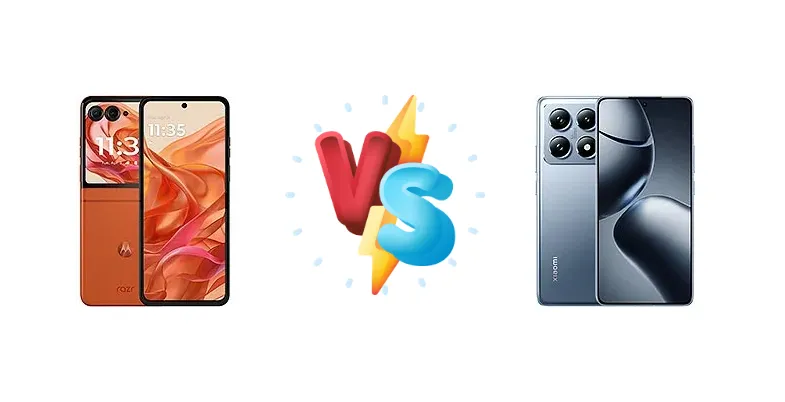
|
🏆 Quick Verdict
For the average user prioritizing all-day battery life and blazing-fast charging, the Xiaomi 14T Pro emerges as the winner. Its Dimensity 9300+ chipset and 120W charging significantly outperform the Razr 50, despite the Razr's innovative foldable form factor. However, the Razr 50 is the clear choice for those captivated by the foldable experience.
| PHONES | ||
|---|---|---|
| Phone Names | Motorola Razr 50 | Xiaomi 14T Pro |
| Network | ||
|---|---|---|
| 2G bands | GSM 900 / 1800 / 1900 | GSM 850 / 900 / 1800 / 1900 |
| 3G bands | HSDPA 850 / 900 / 1700(AWS) / 1900 / 2100 | HSDPA 800 / 850 / 900 / 1700(AWS) / 1900 / 2100 |
| 4G bands | 1, 2, 3, 4, 5, 7, 8, 12, 13, 17, 18, 19, 20, 25, 26, 28, 32, 38, 39, 40, 41, 42, 43, 66, 71 | 1, 2, 3, 4, 5, 7, 8, 12, 13, 17, 18, 19, 20, 25, 26, 28, 32, 38, 39, 40, 41, 42, 48, 66 |
| 5G bands | 1, 2, 3, 5, 7, 8, 20, 26, 28, 38, 40, 41, 66, 71, 77, 78 SA/NSA/Sub6 | 1, 2, 3, 5, 7, 8, 12, 20, 25, 26, 28, 38, 40, 41, 48, 66, 75, 77, 78 SA/NSA |
| Speed | HSPA, LTE, 5G | HSPA, LTE, 5G |
| Technology | GSM / CDMA / HSPA / EVDO / LTE / 5G | GSM / HSPA / LTE / 5G |
| Launch | ||
|---|---|---|
| Announced | 2024, June 25 | 2024, September 26 |
| Status | Available. Released 2024, June 25 | Available. Released 2024, September 26 |
| Body | ||
|---|---|---|
| Build | Plastic front (unfolded), glass front (folded, Gorilla Glass Victus), silicone polymer back (eco leather), aluminum frame (6000 series), hinge (stainless steel) | Glass front (Gorilla Glass 5), aluminum frame, glass back (Panda X) |
| Dimensions | Unfolded: 171.3 x 74 x 7.3 mm Folded: 88.1 x 74 x 15.9 mm | 160.4 x 75.1 x 8.4 mm (6.31 x 2.96 x 0.33 in) |
| SIM | · Nano-SIM + eSIM· Nano-SIM + Nano-SIM | · Nano-SIM + eSIM· eSIM + eSIM· Nano-SIM + Nano-SIM |
| Weight | 188.4 g (6.63 oz) | 209 g (7.37 oz) |
| Display | ||
|---|---|---|
| Protection | - | Corning Gorilla Glass 5 |
| Resolution | 1080 x 2640 pixels (~413 ppi density) | 1220 x 2712 pixels, 20:9 ratio (~446 ppi density) |
| Size | 6.9 inches, 107.6 cm2 (~84.9% screen-to-body ratio) | 6.67 inches, 107.4 cm2 (~89.1% screen-to-body ratio) |
| Type | Foldable LTPO AMOLED, 1B colors, 120Hz, HDR10+, 3000 nits (peak) | AMOLED, 68B colors, 144Hz, 3840Hz PWM, Dolby Vision, HDR10+, 1600 nits (HBM), 4000 nits (peak) |
| Platform | ||
|---|---|---|
| CPU | Octa-core (4x2.5 GHz Cortex-A78 & 4x2.0 GHz Cortex-A55) | Octa-core (1x3.4 GHz Cortex-X4 & 3x2.85 GHz Cortex-X4 & 4x2.0 GHz Cortex-A720) |
| Chipset | Mediatek Dimensity 7300X (4 nm) | Mediatek Dimensity 9300+ (4 nm) |
| GPU | Mali-G615 MC2 | Immortalis-G720 MC12 |
| OS | Android 14 | Android 14, HyperOS |
| Memory | ||
|---|---|---|
| Card slot | No | No |
| Internal | 256GB 8GB RAM, 512GB 12GB RAM | 256GB 12GB RAM, 512GB 12GB RAM, 512GB 16GB RAM, 1TB 12GB RAM |
| Main Camera | ||
|---|---|---|
| Dual | 50 MP, f/1.7, 25mm (wide), 1/1.95", 0.8µm, dual pixel PDAF, OIS 13 MP, f/2.2, 120˚ (ultrawide), 1/3.0", 1.12µm, AF | - |
| Features | LED flash, panorama, HDR | Leica lens, Ultra HDR, LED flash, HDR, panorama |
| Triple | - | 50 MP, f/1.6, 23mm (wide), 1/1.31", 1.2µm, PDAF, OIS 50 MP, f/2.0, 60mm (telephoto), 1/2.88", 0.61µm, PDAF, 2.6x optical zoom 12 MP, f/2.2, 15mm (ultrawide), 1/3.06", 1.12µm |
| Video | 4K@30fps, 1080p@30/60fps, gyro-EIS | 8K@24/30fps, 4K@24/30/60fps, 1080p@30/60/120/240/960fps, gyro-EIS, 10-bit Rec. 2020, HDR10+ |
| Selfie camera | ||
|---|---|---|
| Features | HDR | HDR |
| Single | 32 MP, f/2.4, 25mm (wide), 1/3.14", 0.7µm | 32 MP, f/2.0, 25mm (wide), 1/3.44", 0.64µm |
| Video | 4K@30fps, 1080p@30/60fps | 4K@30fps, 1080p@30/60fps, HDR10+ |
| Sound | ||
|---|---|---|
| 35mm jack | No | No |
| Loudspeaker | Yes, with stereo speakers | Yes, with stereo speakers |
| Comms | ||
|---|---|---|
| Bluetooth | 5.4, A2DP, LE | 5.4, A2DP, LE, LHDC |
| Infrared port | - | Yes |
| NFC | Yes | Yes (market/region dependent) |
| Positioning | GPS, GLONASS, BDS, GALILEO, QZSS | GPS (L1+L5), BDS (B1I+B1C+B2a+B2b), GALILEO (E1+E5a+E5b), QZSS (L1+L5), NavIC (L5), GLONASS |
| Radio | No | No |
| USB | USB Type-C 2.0 | USB Type-C 2.0, OTG |
| WLAN | Wi-Fi 802.11 a/b/g/n/ac/6e, dual-band or tri-band (region dependent) | Wi-Fi 802.11 a/b/g/n/ac/6e/7, dual-band, Wi-Fi Direct |
| Features | ||
|---|---|---|
| Sensors | Fingerprint (side-mounted), gyro, accelerometer, proximity, compass, barometer | Fingerprint (under display, optical), accelerometer, gyro, proximity, compass |
| Battery | ||
|---|---|---|
| Charging | 30W wired 15W wireless | 120W wired, PD3.0, QC4, 100% in 19 min 50W wireless, 100% in 45 min |
| Type | 4200 mAh | Li-Po 5000 mAh |
| Misc | ||
|---|---|---|
| Colors | Koala Grey (Steel Wool), Beach Sand (Pumice Stone), Spritz Orange (Arabesque) | Titan Gray, Titan Blue, Titan Black |
| Models | XT2453-1 | 2407FPN8EG |
| Price | € 479.00 / £ 541.99 / ₹ 40,488 | $ 550.00 / £ 498.00 / € 539.99 |
| SAR EU | - | 0.99 W/kg (head) 1.00 W/kg (body) |
Motorola Razr 50
- Innovative foldable design offers unique portability.
- High peak display brightness (1289 nits).
- Compact form factor when folded.
- Slower charging speeds (30W wired, 15W wireless).
- Less powerful chipset (Dimensity 7300X) compared to the competition.
- Potentially lower battery life (11:46h active use).
Xiaomi 14T Pro
- Blazing-fast 120W wired charging (0-100% in 19 minutes).
- Powerful Dimensity 9300+ chipset for demanding tasks.
- Longer battery life (12:32h active use).
- Traditional flagship design lacks the novelty of a foldable.
- May be larger and less pocketable than the Razr 50.
- No foldable display.
Display Comparison
Both the Razr 50 and Xiaomi 14T Pro boast impressive displays, achieving peak brightness levels of 1289 nits and 1228 nits respectively. While the difference is minimal, the Razr 50’s foldable nature is its defining characteristic. The 14T Pro likely benefits from a more traditional, optimized panel structure, potentially offering slightly better color accuracy. The Razr 50’s folding display, while visually striking, introduces inherent complexities in manufacturing that can impact long-term durability and crease visibility – factors not directly quantifiable from these specs.
Camera Comparison
Without detailed camera specifications, a direct comparison is limited. However, the chipset difference suggests the 14T Pro will have a more powerful ISP (Image Signal Processor), enabling faster image processing and potentially better low-light performance. The Dimensity 9300+’s superior processing capabilities will likely translate to more sophisticated computational photography features. While both phones likely feature multi-camera systems, the 14T Pro’s processing power will be crucial for maximizing image quality and detail.
Performance
The Xiaomi 14T Pro’s Mediatek Dimensity 9300+ chipset represents a significant leap in performance over the Razr 50’s Dimensity 7300X. The 9300+ features a 1x3.4 GHz Cortex-X4 prime core alongside 3x2.85 GHz Cortex-X4 cores, a configuration designed for sustained peak performance. The Razr 50’s 4x2.5 GHz Cortex-A78 cores, while capable, are architecturally older and less efficient. This translates to a noticeable advantage for the 14T Pro in demanding applications like gaming and video editing. The 4nm fabrication process is shared between both chipsets, but the architectural differences within the 9300+ provide a clear performance edge.
Battery Life
The Xiaomi 14T Pro’s 12:32h active use score surpasses the Razr 50’s 11:46h, indicating superior battery endurance. This advantage is further amplified by the 14T Pro’s revolutionary 120W wired charging, capable of a full charge in just 19 minutes. The Razr 50’s 30W wired and 15W wireless charging are comparatively slow. The 14T Pro’s charging speed is a game-changer for users who prioritize minimizing downtime, while the Razr 50 requires significantly longer to replenish its battery.
Buying Guide
Buy the Motorola Razr 50 if you prioritize portability, a unique user experience, and are willing to trade some battery life and raw processing power for the convenience of a foldable display. Buy the Xiaomi 14T Pro if you demand maximum performance for gaming and demanding tasks, require exceptionally fast charging, and value longer battery endurance for all-day use.