
Motorola Razr 50 vs. Huawei Pura 70: A Detailed Comparison of Foldable Innovation and Flagship Power
| Phones Images | |||||
|---|---|---|---|---|---|
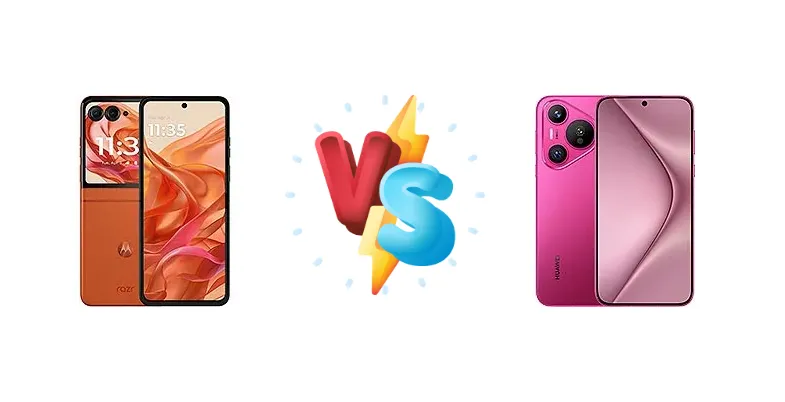
|
🏆 Quick Verdict
For the average user prioritizing all-day battery life and faster charging, the Huawei Pura 70 emerges as the stronger choice. Its 66W wired and 50W wireless charging significantly outperform the Razr 50’s 30W and 15W respectively, while the Kirin 9000S1 offers competitive performance. However, the Razr 50’s foldable form factor remains a unique draw for those seeking a compact, innovative design.
| PHONES | ||
|---|---|---|
| Phone Names | Motorola Razr 50 | Huawei Pura 70 |
| Network | ||
|---|---|---|
| 2G bands | GSM 900 / 1800 / 1900 | GSM 850 / 900 / 1800 / 1900 |
| 3G bands | HSDPA 850 / 900 / 1700(AWS) / 1900 / 2100 | HSDPA 800 / 850 / 900 / 1700(AWS) / 1900 / 2100 |
| 4G bands | 1, 2, 3, 4, 5, 7, 8, 12, 13, 17, 18, 19, 20, 25, 26, 28, 32, 38, 39, 40, 41, 42, 43, 66, 71 | 1, 2, 3, 4, 5, 6, 7, 8, 9, 12, 17, 18, 19, 20, 26, 28, 34, 38, 39, 40, 41, 42 |
| 5G bands | 1, 2, 3, 5, 7, 8, 20, 26, 28, 38, 40, 41, 66, 71, 77, 78 SA/NSA/Sub6 | SA/NSA - China only |
| Speed | HSPA, LTE, 5G | HSPA, LTE, 5G |
| Technology | GSM / CDMA / HSPA / EVDO / LTE / 5G | GSM / CDMA / HSPA / CDMA2000 / LTE / 5G |
| Launch | ||
|---|---|---|
| Announced | 2024, June 25 | 2024, April 18 |
| Status | Available. Released 2024, June 25 | Available. Released 2024, May 06 |
| Body | ||
|---|---|---|
| Build | Plastic front (unfolded), glass front (folded, Gorilla Glass Victus), silicone polymer back (eco leather), aluminum frame (6000 series), hinge (stainless steel) | Glass front, aluminum frame |
| Dimensions | Unfolded: 171.3 x 74 x 7.3 mm Folded: 88.1 x 74 x 15.9 mm | 157.6 x 74.3 x 8 mm (6.20 x 2.93 x 0.31 in) |
| SIM | · Nano-SIM + eSIM· Nano-SIM + Nano-SIM | Nano-SIM + Nano-SIM |
| Weight | 188.4 g (6.63 oz) | 207 g (7.30 oz) |
| Display | ||
|---|---|---|
| Protection | - | Kunlun Glass 2 |
| Resolution | 1080 x 2640 pixels (~413 ppi density) | 1256 x 2760 pixels (~460 ppi density) |
| Size | 6.9 inches, 107.6 cm2 (~84.9% screen-to-body ratio) | 6.6 inches, 105.5 cm2 (~90.1% screen-to-body ratio) |
| Type | Foldable LTPO AMOLED, 1B colors, 120Hz, HDR10+, 3000 nits (peak) | LTPO OLED, 1B colors, HDR, 120Hz, 1440Hz PWM, 2500 nits (peak) |
| Platform | ||
|---|---|---|
| CPU | Octa-core (4x2.5 GHz Cortex-A78 & 4x2.0 GHz Cortex-A55) | Octa-core |
| Chipset | Mediatek Dimensity 7300X (4 nm) | Kirin 9000S1 |
| GPU | Mali-G615 MC2 | - |
| OS | Android 14 | EMUI 14.2 (International), HarmonyOS 4.2 (China) |
| Memory | ||
|---|---|---|
| Card slot | No | No |
| Internal | 256GB 8GB RAM, 512GB 12GB RAM | 256GB 12GB RAM, 512GB 12GB RAM, 1TB 12GB RAM |
| Main Camera | ||
|---|---|---|
| Dual | 50 MP, f/1.7, 25mm (wide), 1/1.95", 0.8µm, dual pixel PDAF, OIS 13 MP, f/2.2, 120˚ (ultrawide), 1/3.0", 1.12µm, AF | - |
| Features | LED flash, panorama, HDR | Laser AF, color spectrum sensor, LED flash, panorama, HDR |
| Triple | - | 50 MP, f/1.4-4.0, 25mm (wide), 1/1.3", PDAF, OIS 12 MP, f/3.4, 125mm (periscope telephoto), PDAF, OIS, 5x optical zoom 13 MP, f/2.2, 13mm (ultrawide) |
| Video | 4K@30fps, 1080p@30/60fps, gyro-EIS | 4K, 1080p, HDR, gyro-EIS, OIS |
| Selfie camera | ||
|---|---|---|
| Features | HDR | HDR, panorama |
| Single | 32 MP, f/2.4, 25mm (wide), 1/3.14", 0.7µm | 13 MP, f/2.4, (ultrawide) |
| Video | 4K@30fps, 1080p@30/60fps | Yes, HDR |
| Sound | ||
|---|---|---|
| 35mm jack | No | No |
| Loudspeaker | Yes, with stereo speakers | Yes, with stereo speakers |
| Comms | ||
|---|---|---|
| Bluetooth | 5.4, A2DP, LE | 5.2, A2DP, LE, L2HC |
| NFC | Yes | Yes |
| Positioning | GPS, GLONASS, BDS, GALILEO, QZSS | GPS (L1+L5), GLONASS (L1), BDS (B1I+B1c+B2a+B2b), GALILEO (E1+E5a+E5b), QZSS (L1+L5), NavIC |
| Radio | No | No |
| USB | USB Type-C 2.0 | USB Type-C 3.1, OTG, DisplayPort 1.2 |
| WLAN | Wi-Fi 802.11 a/b/g/n/ac/6e, dual-band or tri-band (region dependent) | Wi-Fi 802.11 a/b/g/n/ac/6, dual-band, Wi-Fi Direct |
| Features | ||
|---|---|---|
| Sensors | Fingerprint (side-mounted), gyro, accelerometer, proximity, compass, barometer | Fingerprint (under display, optical), accelerometer, proximity, gyro, compass |
| Battery | ||
|---|---|---|
| Charging | 30W wired 15W wireless | 66W wired 50W wireless 7.5W reverse wireless 5W reverse wired |
| Type | 4200 mAh | Li-Po 4900 mAh |
| Misc | ||
|---|---|---|
| Colors | Koala Grey (Steel Wool), Beach Sand (Pumice Stone), Spritz Orange (Arabesque) | Black, White, Blue, Pink |
| Models | XT2453-1 | ADY-LX9, ADY-AL00, ADY-AL10 |
| Price | € 479.00 / £ 541.99 / ₹ 40,488 | € 699.95 |
Motorola Razr 50
- Unique foldable design for portability
- Solid mid-range performance with Dimensity 7300X
- Respectable display brightness (1289 nits)
- Slower charging speeds (30W wired, 15W wireless)
- Potentially lower battery life compared to Pura 70
- Foldable display durability concerns
Huawei Pura 70
- Faster charging (66W wired, 50W wireless)
- Potentially superior performance with Kirin 9000S1
- Reverse wireless and wired charging capabilities
- Traditional flagship design – lacks the novelty of a foldable
- Display specifications currently unknown
- Potential software restrictions due to geopolitical factors
Display Comparison
The Motorola Razr 50 boasts a foldable display, a key differentiator, but its peak brightness of 1289 nits, while respectable, is a focal point for comparison. The Pura 70’s display specifications are currently unavailable, but Huawei typically employs high-quality OLED panels. The Razr 50’s foldable nature introduces potential concerns regarding crease visibility and durability, areas where the Pura 70, with its standard flat display, inherently excels. The Razr 50’s foldable design prioritizes portability, while the Pura 70 likely focuses on color accuracy and viewing angles.
Camera Comparison
Camera details for the Pura 70 are currently limited, but Huawei has a strong history of camera innovation. The Razr 50’s camera specifications are also unavailable, making a direct sensor comparison impossible. However, given the Razr’s focus on design, it’s likely the camera system prioritizes versatility over outright image quality. The Kirin 9000S1’s image signal processor (ISP) in the Pura 70 likely offers advanced computational photography capabilities, potentially resulting in superior image processing and low-light performance. Without specific sensor details, it’s reasonable to assume the Pura 70 will offer a more comprehensive and refined camera experience.
Performance
The Motorola Razr 50 is powered by the Mediatek Dimensity 7300X (4nm), featuring an octa-core CPU configuration (4x2.5 GHz Cortex-A78 & 4x2.0 GHz Cortex-A55). This chipset offers a solid mid-range to upper-mid-range performance profile. The Huawei Pura 70, however, utilizes the Kirin 9000S1. While detailed specifications are limited, Kirin chips are known for their strong performance and efficiency. The 4nm process node shared by both chipsets suggests comparable thermal efficiency, but the Kirin 9000S1’s architecture likely provides a performance edge, particularly in demanding tasks. The Razr 50’s performance is geared towards smooth daily use and moderate gaming, while the Pura 70 aims for a more premium, flagship-level experience.
Battery Life
The Motorola Razr 50 achieves an active use battery score of 11:46h, indicating solid, but not exceptional, battery life. This is a crucial metric for foldable phones, as the form factor often necessitates a smaller battery capacity. The Huawei Pura 70’s battery capacity is unknown, but its charging capabilities are a significant advantage. With 66W wired charging, the Pura 70 can rapidly replenish its battery, significantly faster than the Razr 50’s 30W charging. Furthermore, the Pura 70 offers 50W wireless charging and even reverse wireless/wired charging (7.5W/5W), providing added convenience. The Pura 70’s faster charging offsets any potential capacity disadvantage, making it the more practical choice for users who frequently need to top up their battery.
Buying Guide
Buy the Motorola Razr 50 if you prioritize a truly unique, pocketable form factor and are willing to compromise slightly on battery life and charging speed for the novelty of a foldable display. Buy the Huawei Pura 70 if you value a traditional flagship experience with a powerful processor, exceptional charging capabilities, and a potentially superior camera system, even if it means foregoing the foldable design.