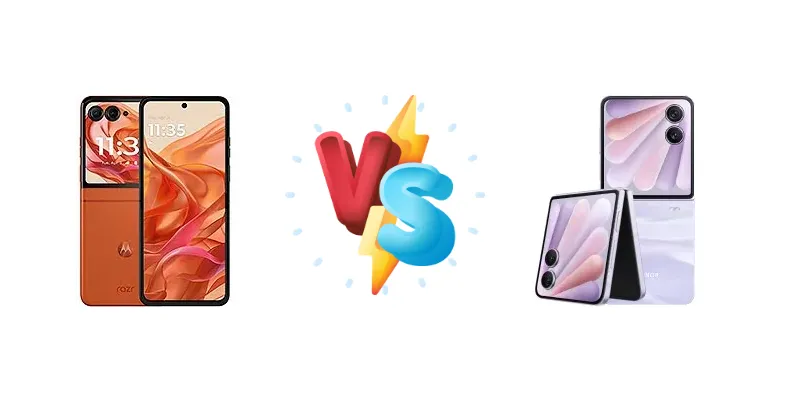
The foldable flip phone market is heating up, with Motorola and Honor delivering compelling options. The Motorola Razr 50 aims to deliver a refined experience at a competitive price, while the Honor Magic V Flip 2 throws down the gauntlet with flagship-level processing and rapid charging. This comparison breaks down the key differences to help you choose the right foldable for your needs.
🏆 Quick Verdict
For the average user prioritizing raw performance and fast charging, the Honor Magic V Flip 2 is the clear winner. Its Snapdragon 8 Gen 3 chipset and 80W charging significantly outperform the Razr 50’s Dimensity 7300X and 30W charging. However, the Razr 50 offers respectable battery life and a more accessible price point.
| Network |
|---|
| 2G bands | GSM 900 / 1800 / 1900 | GSM 850 / 900 / 1800 / 1900 |
| 3G bands | HSDPA 850 / 900 / 1700(AWS) / 1900 / 2100 | HSDPA 800 / 850 / 900 / 1700(AWS) / 1900 / 2100 |
| 4G bands | 1, 2, 3, 4, 5, 7, 8, 12, 13, 17, 18, 19, 20, 25, 26, 28, 32, 38, 39, 40, 41, 42, 43, 66, 71 | LTE |
| 5G bands | 1, 2, 3, 5, 7, 8, 20, 26, 28, 38, 40, 41, 66, 71, 77, 78 SA/NSA/Sub6 | SA/NSA |
| Speed | HSPA, LTE, 5G | HSPA, LTE, 5G |
| Technology | GSM / CDMA / HSPA / EVDO / LTE / 5G | GSM / CDMA / HSPA / CDMA2000 / LTE / 5G |
| Launch |
|---|
| Announced | 2024, June 25 | 2025, August 21 |
| Status | Available. Released 2024, June 25 | Available. Released 2025, August 21 |
| Body |
|---|
| Build | Plastic front (unfolded), glass front (folded, Gorilla Glass Victus), silicone polymer back (eco leather), aluminum frame (6000 series), hinge (stainless steel) | Aluminum frame |
| Dimensions | Unfolded: 171.3 x 74 x 7.3 mm Folded: 88.1 x 74 x 15.9 mm | Unfolded: 167.1 x 75.6 x 6.9 mm Folded: 86.2 x 75.6 x 15.5 mm |
| SIM | · Nano-SIM + eSIM· Nano-SIM + Nano-SIM | Nano-SIM + Nano-SIM |
| Weight | 188.4 g (6.63 oz) | 204 g (7.20 oz) |
| Display |
|---|
| Resolution | 1080 x 2640 pixels (~413 ppi density) | 1232 x 2868 pixels, 21:9 ratio (~458 ppi density) |
| Size | 6.9 inches, 107.6 cm2 (~84.9% screen-to-body ratio) | 6.82 inches, 108.8 cm2 (~86.1% screen-to-body ratio) |
| Type | Foldable LTPO AMOLED, 1B colors, 120Hz, HDR10+, 3000 nits (peak) | Foldable LTPO OLED, 1B colors, 120Hz, 4320Hz PWM, HDR, Dolby Vision, BT.2020, 5000 nits (peak) |
| Platform |
|---|
| CPU | Octa-core (4x2.5 GHz Cortex-A78 & 4x2.0 GHz Cortex-A55) | Octa-core (1x3.3 GHz Cortex-X4 & 3x3.2 GHz Cortex-A720 & 2x3.0 GHz Cortex-A720 & 2x2.3 GHz Cortex-A520) |
| Chipset | Mediatek Dimensity 7300X (4 nm) | Qualcomm SM8650-AB Snapdragon 8 Gen 3 (4 nm) |
| GPU | Mali-G615 MC2 | Adreno 750 |
| OS | Android 14 | Android 15, MagicOS 9 |
| Memory |
|---|
| Card slot | No | No |
| Internal | 256GB 8GB RAM, 512GB 12GB RAM | 256GB 12GB RAM, 512GB 12GB RAM, 1TB 12GB RAM, 1TB 16GB RAM |
| Main Camera |
|---|
| Dual | 50 MP, f/1.7, 25mm (wide), 1/1.95", 0.8µm, dual pixel PDAF, OIS
13 MP, f/2.2, 120˚ (ultrawide), 1/3.0", 1.12µm, AF | 200 MP, f/1.9, (wide), 1/1.3", 0.6µm, multi-directional PDAF, OIS
50 MP, f/2.0, 120˚ (ultrawide), AF |
| Features | LED flash, panorama, HDR | LED flash, HDR, panorama |
| Video | 4K@30fps, 1080p@30/60fps, gyro-EIS | 4K, 1080p, gyro-EIS |
| Selfie camera |
|---|
| Features | HDR | - |
| Single | 32 MP, f/2.4, 25mm (wide), 1/3.14", 0.7µm | 50 MP, f/2.0, (wide), AF |
| Video | 4K@30fps, 1080p@30/60fps | 4K, 1080p |
| Sound |
|---|
| 35mm jack | No | No |
| Loudspeaker | Yes, with stereo speakers | Yes, with stereo speakers |
| Comms |
|---|
| Bluetooth | 5.4, A2DP, LE | 5.4, A2DP, LE, aptX HD, aptX Adaptive, ASHA |
| Infrared port | - | Yes |
| NFC | Yes | Yes |
| Positioning | GPS, GLONASS, BDS, GALILEO, QZSS | GPS (L1+L5), BDS (B1I+B1C+B2a+B2b), GALILEO (E1+E5a+E5b), QZSS (L1+L5), NavIC (L5), GLONASS |
| Radio | No | No |
| USB | USB Type-C 2.0 | USB Type-C 2.0, OTG |
| WLAN | Wi-Fi 802.11 a/b/g/n/ac/6e, dual-band or tri-band (region dependent) | Wi-Fi 802.11 a/b/g/n/ac/6, dual-band, Wi-Fi Direct |
| Features |
|---|
| Sensors | Fingerprint (side-mounted), gyro, accelerometer, proximity, compass, barometer | Fingerprint (side-mounted), gyro, accelerometer, proximity (ultrasonic), compass |
| Battery |
|---|
| Charging | 30W wired
15W wireless | 80W wired, 100% in 42 min
50W wireless
5W reverse wired
Reverse wireless |
| Type | 4200 mAh | Si/C Li-Po 5500 mAh |
| Misc |
|---|
| Colors | Koala Grey (Steel Wool), Beach Sand (Pumice Stone), Spritz Orange (Arabesque) | Purple, Silver, Gray, Blue |
| Models | XT2453-1 | CLE-AN00 |
| Price | € 479.00 / £ 541.99 / ₹ 40,488 | - |
Motorola Razr 50
- More affordable price point
- Respectable battery life for a flip phone
- Stylish and compact design
- Less powerful processor
- Slower charging speeds
- Lower display brightness
Honor Magic V Flip 2
- Flagship-level Snapdragon 8 Gen 3 performance
- Ultra-fast 80W wired charging
- Significantly brighter display
- Higher price tag
- Potentially shorter battery life under heavy load (despite longer active use score)
- Larger file sizes for apps and games due to higher processing power
Display Comparison
The Honor Magic V Flip 2 boasts a significantly brighter display, reaching a measured 1786 nits compared to the Razr 50’s 1289 nits. This translates to superior visibility outdoors under direct sunlight. While both utilize foldable OLED panels, the higher brightness of the Magic V Flip 2 provides a more vibrant and immersive viewing experience. Details regarding panel technology (LTPO or not) are missing, but the brightness difference is a key differentiator. Bezels appear comparable based on available imagery, but color accuracy testing would be needed for a definitive assessment.
Camera Comparison
Without detailed camera specs beyond sensor size, a direct comparison is limited. However, the chipset difference indirectly impacts camera performance. The Snapdragon 8 Gen 3’s superior ISP (Image Signal Processor) in the Magic V Flip 2 will likely result in better image processing, noise reduction, and dynamic range. The Razr 50 will still produce acceptable images, but the Magic V Flip 2 has the potential for higher-quality photos and videos, especially in challenging lighting conditions. We'd need to see sample images to confirm.
Performance
The performance gap is substantial. The Honor Magic V Flip 2’s Qualcomm Snapdragon 8 Gen 3 (4nm) is a flagship-tier chipset, featuring a Cortex-X4 prime core clocked at 3.3 GHz, vastly exceeding the Motorola Razr 50’s Mediatek Dimensity 7300X (4nm). The Snapdragon 8 Gen 3’s architecture – with its mix of Cortex-A720 and A520 cores – is designed for sustained performance and efficiency. This means the Magic V Flip 2 will handle demanding tasks like gaming and video editing with ease, while the Razr 50 may exhibit some throttling under prolonged load. The Razr 50’s Cortex-A78 cores, while capable, are a generation behind and less efficient.
Battery Life
The Honor Magic V Flip 2 edges out the Motorola Razr 50 in battery life, achieving 12:43 hours of active use compared to the Razr 50’s 11:46 hours. While the difference isn’t massive, it’s noticeable. More importantly, the charging speeds are worlds apart. The Magic V Flip 2’s 80W wired charging can fully charge the device in just 42 minutes, while the Razr 50’s 30W charging is considerably slower. The Magic V Flip 2 also offers 50W wireless charging and even reverse wired/wireless charging, features absent on the Razr 50.
Buying Guide
Buy the Motorola Razr 50 if you need a stylish, well-rounded flip phone with solid battery life and aren't demanding the absolute highest performance. It’s ideal for social media users and those who appreciate a refined, compact design. Buy the Honor Magic V Flip 2 if you prioritize speed, gaming, and quick top-ups. This is the phone for power users who want a foldable that can handle anything they throw at it, and don't mind paying a premium.
Frequently Asked Questions
❓ Does the Dimensity 7300X in the Razr 50 struggle with graphically intensive games like Genshin Impact?
While the Dimensity 7300X is a capable chip, it's not in the same league as the Snapdragon 8 Gen 3. Expect to play Genshin Impact at medium settings to maintain a stable frame rate. Prolonged gaming sessions may result in some thermal throttling, reducing performance over time.
❓ How much faster is the 80W charging on the Magic V Flip 2 compared to the 30W charging on the Razr 50 in real-world use?
The 80W charging on the Magic V Flip 2 can take a phone from 0% to 100% in approximately 42 minutes. The Razr 50’s 30W charging will likely take over 90 minutes to achieve the same result. This difference is significant for users who frequently need to quickly top up their battery.
❓ Is the reverse wireless charging on the Magic V Flip 2 useful for charging accessories like earbuds?
Yes, the 5W reverse wireless charging is convenient for topping up accessories like wireless earbuds or smartwatches. While it's not a fast charging solution, it can provide a small boost when you're away from a power outlet.