
Motorola Razr 50 vs. Google Pixel 8a: A Deep Dive into Foldable vs. Flagship
| Phones Images | |||||
|---|---|---|---|---|---|
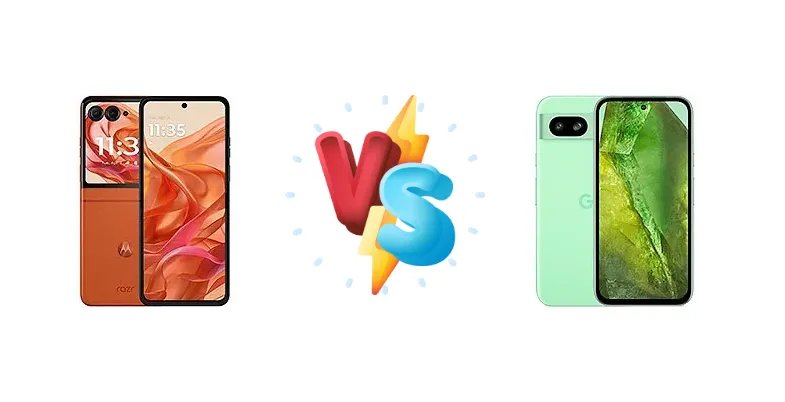
|
🏆 Quick Verdict
For the average user prioritizing longevity and a consistently smooth experience, the Google Pixel 8a emerges as the stronger choice. Its Tensor G3 chipset, coupled with exceptional battery life (40:06h endurance), and Google’s software support outweigh the Razr 50’s novelty foldable form factor.
| PHONES | ||
|---|---|---|
| Phone Names | Motorola Razr 50 | Google Pixel 8a |
| Network | ||
|---|---|---|
| 2G bands | GSM 900 / 1800 / 1900 | GSM 850 / 900 / 1800 / 1900 |
| 3G bands | HSDPA 850 / 900 / 1700(AWS) / 1900 / 2100 | HSDPA 800 / 850 / 900 / 1700(AWS) / 1900 / 2100 |
| 4G bands | 1, 2, 3, 4, 5, 7, 8, 12, 13, 17, 18, 19, 20, 25, 26, 28, 32, 38, 39, 40, 41, 42, 43, 66, 71 | 1, 2, 3, 4, 5, 7, 8, 12, 17, 18, 19, 20, 26, 28, 32, 38, 40, 41, 42, 66 - G6GPR (International) |
| 5G bands | 1, 2, 3, 5, 7, 8, 20, 26, 28, 38, 40, 41, 66, 71, 77, 78 SA/NSA/Sub6 | 1, 2, 3, 5, 7, 8, 12, 20, 26, 28, 38, 40, 41, 66, 75, 76, 77, 78 SA/NSA/Sub6 - G6GPR (International) |
| Speed | HSPA, LTE, 5G | HSPA, LTE, 5G |
| Technology | GSM / CDMA / HSPA / EVDO / LTE / 5G | GSM / HSPA / LTE / 5G |
| Launch | ||
|---|---|---|
| Announced | 2024, June 25 | 2024, May 07 |
| Status | Available. Released 2024, June 25 | Available. Released 2024, May 14 |
| Body | ||
|---|---|---|
| Build | Plastic front (unfolded), glass front (folded, Gorilla Glass Victus), silicone polymer back (eco leather), aluminum frame (6000 series), hinge (stainless steel) | Glass front (Gorilla Glass 3), aluminum frame, plastic back |
| Dimensions | Unfolded: 171.3 x 74 x 7.3 mm Folded: 88.1 x 74 x 15.9 mm | 152.1 x 72.7 x 8.9 mm (5.99 x 2.86 x 0.35 in) |
| SIM | · Nano-SIM + eSIM· Nano-SIM + Nano-SIM | Nano-SIM + eSIM |
| Weight | 188.4 g (6.63 oz) | 188 g (6.63 oz) |
| Display | ||
|---|---|---|
| Protection | - | Corning Gorilla Glass 3, Mohs level 5 |
| Resolution | 1080 x 2640 pixels (~413 ppi density) | 1080 x 2400 pixels, 20:9 ratio (~430 ppi density) |
| Size | 6.9 inches, 107.6 cm2 (~84.9% screen-to-body ratio) | 6.1 inches, 90.3 cm2 (~81.6% screen-to-body ratio) |
| Type | Foldable LTPO AMOLED, 1B colors, 120Hz, HDR10+, 3000 nits (peak) | OLED, HDR, 120Hz, 2000 nits (peak) |
| Platform | ||
|---|---|---|
| CPU | Octa-core (4x2.5 GHz Cortex-A78 & 4x2.0 GHz Cortex-A55) | Nona-core (1x3.0 GHz Cortex-X3 & 4x2.45 GHz Cortex-A715 & 4x2.15 GHz Cortex-A510) |
| Chipset | Mediatek Dimensity 7300X (4 nm) | Google Tensor G3 (4 nm) |
| GPU | Mali-G615 MC2 | Immortalis-G715s MC10 |
| OS | Android 14 | Android 14, upgradable to Android 16, up to 7 major Android upgrades |
| Memory | ||
|---|---|---|
| Card slot | No | No |
| Internal | 256GB 8GB RAM, 512GB 12GB RAM | 128GB 8GB RAM, 256GB 8GB RAM |
| Main Camera | ||
|---|---|---|
| Dual | 50 MP, f/1.7, 25mm (wide), 1/1.95", 0.8µm, dual pixel PDAF, OIS 13 MP, f/2.2, 120˚ (ultrawide), 1/3.0", 1.12µm, AF | 64 MP (16 MP eff.), f/1.9, 26mm (wide), 1/1.73", 0.8µm, dual pixel PDAF, OIS 13 MP, f/2.2, 120˚ (ultrawide), 1.12µm |
| Features | LED flash, panorama, HDR | Dual-LED flash, Pixel Shift, Ultra HDR, panorama, Best Take |
| Video | 4K@30fps, 1080p@30/60fps, gyro-EIS | 4K@30/60fps, 1080p@30/60/120/240fps, OIS |
| Selfie camera | ||
|---|---|---|
| Features | HDR | HDR, panorama |
| Single | 32 MP, f/2.4, 25mm (wide), 1/3.14", 0.7µm | 13 MP, f/2.2, 20mm (ultrawide), 1.12µm |
| Video | 4K@30fps, 1080p@30/60fps | 4K@30fps, 1080p@30/60fps |
| Sound | ||
|---|---|---|
| 35mm jack | No | No |
| Loudspeaker | Yes, with stereo speakers | Yes, with stereo speakers |
| Comms | ||
|---|---|---|
| Bluetooth | 5.4, A2DP, LE | 5.3, A2DP, LE |
| NFC | Yes | Yes |
| Positioning | GPS, GLONASS, BDS, GALILEO, QZSS | GPS, GLONASS, GALILEO, BDS, QZSS, NavIC |
| Radio | No | No |
| USB | USB Type-C 2.0 | USB Type-C 3.2 |
| WLAN | Wi-Fi 802.11 a/b/g/n/ac/6e, dual-band or tri-band (region dependent) | Wi-Fi 802.11 a/b/g/n/ac/6e, dual/tri-band (market/region dependent) |
| Features | ||
|---|---|---|
| Sensors | Fingerprint (side-mounted), gyro, accelerometer, proximity, compass, barometer | Fingerprint (under display, optical), accelerometer, gyro, proximity, compass, barometer |
| Battery | ||
|---|---|---|
| Charging | 30W wired 15W wireless | 18W wired, PD3.0 7.5W wireless Bypass charging |
| Type | 4200 mAh | Li-Po 4492 mAh |
| Misc | ||
|---|---|---|
| Colors | Koala Grey (Steel Wool), Beach Sand (Pumice Stone), Spritz Orange (Arabesque) | Obsidian, Porcelain, Bay, Aloe |
| Models | XT2453-1 | GKV4X, G6GPR, G8HHN, G576D |
| Price | € 479.00 / £ 541.99 / ₹ 40,488 | $ 229.98 / C$ 417.99 / £ 279.00 / € 299.99 / ₹ 33,300 |
| EU LABEL | ||
|---|---|---|
| Battery | - | 40:06h endurance, 1000 cycles |
| Energy | - | Class B |
| Free fall | - | Class A (270 falls) |
| Repairability | - | Class B |
Motorola Razr 50
- Unique foldable form factor
- Relatively affordable foldable option
- Decent peak display brightness (1289 nits)
- Significantly shorter battery life (11:46h)
- Less powerful chipset compared to Tensor G3
- Foldable display may be less durable
Google Pixel 8a
- Exceptional battery life (40:06h endurance)
- Powerful Google Tensor G3 chipset
- Superior camera performance and software optimization
- Traditional smartphone form factor
- Slower charging speed (18W) than Razr 50 (30W)
- No foldable display novelty
Display Comparison
The Razr 50 boasts a foldable display, but its peak brightness of 1289 nits is noticeably lower than the Pixel 8a’s 1508 nits. This translates to better outdoor visibility on the Pixel 8a. While the Razr 50’s foldable nature is a key differentiator, the Pixel 8a’s potentially more durable and brighter display offers a more practical viewing experience for everyday use. We lack data on panel technology (LTPO vs standard OLED) for the Razr 50, but the Pixel 8a’s display is known for its color accuracy and smoothness.
Camera Comparison
The Pixel 8a is expected to excel in camera performance, leveraging Google’s renowned computational photography. While specific sensor details for the Razr 50 are unavailable, the Pixel 8a’s image processing capabilities, powered by the Tensor G3, will likely deliver superior dynamic range and low-light performance. The Pixel 8a’s focus on software optimization and AI-driven features will likely result in more consistently pleasing images, even without a massive megapixel count. We can assume the Razr 50 will have a competent camera, but it won't match the Pixel's software advantage.
Performance
The Google Pixel 8a’s Google Tensor G3 (4nm) chipset, with its nona-core CPU configuration (1x3.0 GHz Cortex-X3, 4x2.45 GHz Cortex-A715, 4x2.15 GHz Cortex-A510), offers a more complex and potentially powerful architecture than the Motorola Razr 50’s Mediatek Dimensity 7300X (4nm) and its octa-core setup (4x2.5 GHz Cortex-A78 & 4x2.0 GHz Cortex-A55). The Cortex-X3 core in the Tensor G3 provides a significant performance boost for demanding tasks. While both chips are built on a 4nm process, the Tensor G3’s architecture is geared towards AI and machine learning tasks, enhancing features like image processing and voice recognition. The Pixel 8a also benefits from faster RAM, likely LPDDR5x, further improving responsiveness.
Battery Life
The Google Pixel 8a dominates in battery endurance, achieving an impressive 40:06h of endurance based on testing, and a remarkable 1000 cycle lifespan. This is significantly better than the Razr 50’s 11:46h active use score. While the Razr 50 offers 30W wired and 15W wireless charging, the Pixel 8a’s 18W wired charging with PD3.0 and 7.5W wireless charging, coupled with its bypass charging feature (allowing charging while in use), provides a more versatile and efficient charging experience. The Pixel 8a’s superior battery life is a major advantage for users who rely heavily on their smartphones throughout the day.
Buying Guide
Buy the Motorola Razr 50 if you crave the unique experience of a foldable display and are willing to accept compromises in battery life and raw processing power for the sake of innovation. Buy the Google Pixel 8a if you prioritize a reliable, long-lasting device with a fantastic camera, smooth performance, and guaranteed software updates – a true all-rounder.