
Motorola Razr 50 vs. Google Pixel 7a: A Deep Dive into Foldable Innovation and Google's Value Proposition
| Phones Images | |||||
|---|---|---|---|---|---|
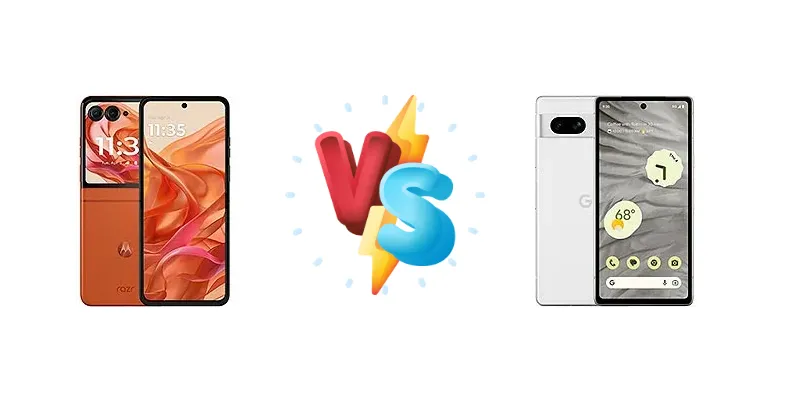
|
🏆 Quick Verdict
For the average user prioritizing a unique form factor and solid all-day battery life, the Motorola Razr 50 emerges as the winner. While the Pixel 7a boasts a superior camera system and Google’s software polish, the Razr 50’s foldable display and respectable performance offer a compelling alternative.
| PHONES | ||
|---|---|---|
| Phone Names | Motorola Razr 50 | Google Pixel 7a |
| Network | ||
|---|---|---|
| 2G bands | GSM 900 / 1800 / 1900 | GSM 850 / 900 / 1800 / 1900 |
| 3G bands | HSDPA 850 / 900 / 1700(AWS) / 1900 / 2100 | HSDPA 800 / 850 / 900 / 1700(AWS) / 1900 / 2100 |
| 4G bands | 1, 2, 3, 4, 5, 7, 8, 12, 13, 17, 18, 19, 20, 25, 26, 28, 32, 38, 39, 40, 41, 42, 43, 66, 71 | 1, 2, 3, 4, 5, 7, 8, 12, 13, 14, 17, 20, 25, 26, 28, 29, 30, 38, 40, 41, 48, 66, 71 - GWKK3, G0DZQ |
| 5G bands | 1, 2, 3, 5, 7, 8, 20, 26, 28, 38, 40, 41, 66, 71, 77, 78 SA/NSA/Sub6 | 1, 2, 3, 5, 7, 8, 12, 14, 20, 25, 28, 30, 38, 41, 48, 66, 71, 77, 78 SA/NSA/Sub6 - GWKK3 |
| Speed | HSPA, LTE, 5G | HSPA, LTE, 5G |
| Technology | GSM / CDMA / HSPA / EVDO / LTE / 5G | GSM / HSPA / LTE / 5G |
| - | 1, 2, 3, 5, 7, 8, 12, 20, 25, 28, 38, 40, 41, 66, 75, 76, 77, 78, 79 SA/NSA/Sub6 - GHL1X, G82U8 | |
| Launch | ||
|---|---|---|
| Announced | 2024, June 25 | 2023, May 10 |
| Status | Available. Released 2024, June 25 | Available. Released 2023, May 10 |
| Body | ||
|---|---|---|
| Build | Plastic front (unfolded), glass front (folded, Gorilla Glass Victus), silicone polymer back (eco leather), aluminum frame (6000 series), hinge (stainless steel) | Glass front (Gorilla Glass 3), aluminum frame, plastic back |
| Dimensions | Unfolded: 171.3 x 74 x 7.3 mm Folded: 88.1 x 74 x 15.9 mm | 152 x 72.9 x 9 mm (5.98 x 2.87 x 0.35 in) |
| SIM | · Nano-SIM + eSIM· Nano-SIM + Nano-SIM | Nano-SIM + eSIM |
| Weight | 188.4 g (6.63 oz) | 193.5 g (6.84 oz) |
| - | IP67 dust/water resistant (up to 1m for 30 min) | |
| Display | ||
|---|---|---|
| Protection | - | Corning Gorilla Glass 3 |
| Resolution | 1080 x 2640 pixels (~413 ppi density) | 1080 x 2400 pixels, 20:9 ratio (~429 ppi density) |
| Size | 6.9 inches, 107.6 cm2 (~84.9% screen-to-body ratio) | 6.1 inches, 90.7 cm2 (~81.8% screen-to-body ratio) |
| Type | Foldable LTPO AMOLED, 1B colors, 120Hz, HDR10+, 3000 nits (peak) | OLED, HDR, 90Hz |
| - | Always-on display | |
| Platform | ||
|---|---|---|
| CPU | Octa-core (4x2.5 GHz Cortex-A78 & 4x2.0 GHz Cortex-A55) | Octa-core (2x2.85 GHz Cortex-X1 & 2x2.35 GHz Cortex-A78 & 4x1.80 GHz Cortex-A55) |
| Chipset | Mediatek Dimensity 7300X (4 nm) | Google Tensor G2 (5 nm) |
| GPU | Mali-G615 MC2 | Mali-G710 MP7 |
| OS | Android 14 | Android 13, upgradable to Android 15, up to 5 major Android upgrades |
| Memory | ||
|---|---|---|
| Card slot | No | No |
| Internal | 256GB 8GB RAM, 512GB 12GB RAM | 128GB 8GB RAM |
| - | UFS 3.1 | |
| Main Camera | ||
|---|---|---|
| Dual | 50 MP, f/1.7, 25mm (wide), 1/1.95", 0.8µm, dual pixel PDAF, OIS 13 MP, f/2.2, 120˚ (ultrawide), 1/3.0", 1.12µm, AF | 64 MP, f/1.9, 26mm (wide), 1/1.73", 0.8µm, dual pixel PDAF, OIS 13 MP, f/2.2, 120˚ (ultrawide), 1.12µm |
| Features | LED flash, panorama, HDR | Dual-LED flash, Pixel Shift, Auto-HDR, panorama |
| Video | 4K@30fps, 1080p@30/60fps, gyro-EIS | 4K@30/60fps, 1080p@30/60/120/240fps, OIS |
| Selfie camera | ||
|---|---|---|
| Features | HDR | HDR, panorama |
| Single | 32 MP, f/2.4, 25mm (wide), 1/3.14", 0.7µm | 13 MP, f/2.2, 20mm (ultrawide), 1.12µm |
| Video | 4K@30fps, 1080p@30/60fps | 4K@30fps, 1080p@30fps |
| Sound | ||
|---|---|---|
| 3.5mm jack | - | No |
| 35mm jack | No | No |
| Loudspeaker | Yes, with stereo speakers | Yes, with stereo speakers |
| Comms | ||
|---|---|---|
| Bluetooth | 5.4, A2DP, LE | 5.3, A2DP, LE |
| NFC | Yes | Yes |
| Positioning | GPS, GLONASS, BDS, GALILEO, QZSS | GPS, GLONASS, GALILEO, BDS, QZSS, NavIC |
| Radio | No | No |
| USB | USB Type-C 2.0 | USB Type-C 3.2 |
| WLAN | Wi-Fi 802.11 a/b/g/n/ac/6e, dual-band or tri-band (region dependent) | Wi-Fi 802.11 a/b/g/n/ac/6e, tri-band |
| Features | ||
|---|---|---|
| Sensors | Fingerprint (side-mounted), gyro, accelerometer, proximity, compass, barometer | Fingerprint (under display, optical), accelerometer, gyro, proximity, compass, barometer |
| Battery | ||
|---|---|---|
| Charging | 30W wired 15W wireless | 18W wired, PD3.0 7.5W wireless |
| Type | 4200 mAh | Li-Po 4385 mAh |
| Misc | ||
|---|---|---|
| Colors | Koala Grey (Steel Wool), Beach Sand (Pumice Stone), Spritz Orange (Arabesque) | Charcoal, Snow, Sea, Coral |
| Models | XT2453-1 | GWKK3, GHL1X, G0DZQ, G82U8 |
| Price | € 479.00 / £ 541.99 / ₹ 40,488 | € 179.90 / $ 150.00 / £ 170.00 / ₹ 25,980 |
Motorola Razr 50
- Innovative foldable design
- Bright and vibrant display
- Faster 30W wired charging
- Strong battery life (11:46h active use)
- Camera specs are unknown
- Potential durability concerns with foldable screen
Google Pixel 7a
- Exceptional camera quality and image processing
- Smooth and optimized software experience
- Powerful Tensor G2 chip for AI tasks
- Reliable performance and updates
- Slower 18W wired charging
- Less bright display compared to Razr 50
Display Comparison
The Razr 50 boasts a significantly brighter display at 1289 nits, compared to the Pixel 7a’s 1070 nits, making it more usable outdoors under direct sunlight. While both utilize OLED technology, the Razr 50’s foldable nature is its defining feature. The Pixel 7a’s display, though less bright, benefits from Google’s excellent color calibration. The impact of the Razr 50’s folding crease on viewing experience is a key consideration, while the Pixel 7a offers a more traditional, uninterrupted viewing area.
Camera Comparison
The Pixel 7a is the clear winner in camera capabilities. While the Razr 50’s camera specs aren’t detailed, the Pixel 7a’s renowned computational photography, powered by the Tensor G2, delivers consistently excellent photos and videos. Google’s image processing excels in dynamic range and low-light performance. The Pixel 7a’s video stabilization is also a strong point. Without detailed Razr 50 camera specs, it’s difficult to assess its capabilities beyond basic smartphone photography.
Performance
The Google Pixel 7a’s Tensor G2 (5nm) chip, with its Cortex-X1 prime cores, theoretically offers higher peak CPU performance (2.85 GHz) than the Razr 50’s Dimensity 7300X (4nm) (2.5 GHz). However, the Dimensity 7300X’s more efficient 4nm process could translate to better sustained performance and thermal management during extended gaming sessions. The Pixel 7a’s Tensor G2 excels in AI-driven tasks, while the Razr 50 aims for a balanced approach to performance and efficiency. Both devices are likely to handle everyday tasks with ease, but the Razr 50’s architecture may prove more consistent under load.
Battery Life
The Motorola Razr 50 demonstrates a strong battery performance with 11:46h of active use, suggesting a well-optimized power management system. The Pixel 7a, with an older endurance rating of 76h, doesn’t directly translate to active use time, but indicates reasonable longevity. The Razr 50’s 30W wired charging is faster than the Pixel 7a’s 18W, while both support wireless charging, though at different wattages (15W vs 7.5W). The Razr 50’s faster charging is a significant convenience factor.
Buying Guide
Buy the Motorola Razr 50 if you crave a head-turning design, enjoy the novelty of a foldable screen, and value a battery that comfortably lasts through a full day of active use. Buy the Google Pixel 7a if you prioritize exceptional camera quality, seamless software updates, and a proven track record of reliable performance within the Google ecosystem.