
Motorola Razr 2025 vs. Honor Magic V3: A Deep Dive into Foldable Power and Efficiency
| Phones Images | |||||
|---|---|---|---|---|---|
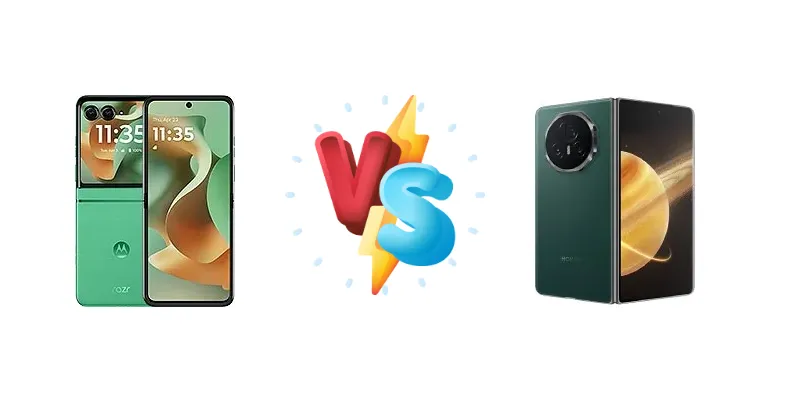
|
🏆 Quick Verdict
For the average user prioritizing longevity and a smooth experience, the Honor Magic V3 takes the lead. Its Snapdragon 8 Gen 3 chipset and faster charging outweigh the Razr 2025’s slightly better battery score, offering a more future-proof and powerful foldable experience.
| PHONES | ||
|---|---|---|
| Phone Names | Motorola Razr 2025 | Honor Magic V3 |
| Network | ||
|---|---|---|
| 2G bands | GSM 900 / 1800 / 1900 | GSM 850 / 900 / 1800 / 1900 |
| 3G bands | HSDPA 850 / 900 / 1700(AWS) / 1900 / 2100 | HSDPA 800 / 850 / 900 / 1700(AWS) / 1900 / 2100 |
| 4G bands | 1, 2, 3, 4, 5, 7, 8, 12, 13, 14, 17, 18, 19, 20, 25, 26, 28, 29, 30, 38, 39, 40, 41, 48, 66, 71 | 1, 2, 3, 4, 5, 7, 8, 12, 17, 18, 19, 20, 26, 28, 34, 38, 39, 40, 41, 66 |
| 5G bands | 1, 2, 3, 5, 7, 12, 14, 20, 25, 26, 28, 29, 30, 38, 40, 41, 48, 66, 70, 71, 77, 78 SA/NSA/Sub6 | 1, 3, 5, 8, 28, 38, 41, 77, 78 SA/NSA |
| Speed | HSPA, LTE, 5G | HSPA, LTE, 5G |
| Technology | GSM / HSPA / LTE / 5G | GSM / CDMA / HSPA / CDMA2000 / LTE / 5G |
| Launch | ||
|---|---|---|
| Announced | 2025, April 24 | 2024, July 12 |
| Status | Available. Released 2025, May 15 | Available. Released 2024, July 19 |
| Body | ||
|---|---|---|
| Build | Plastic front (unfolded), glass front (folded, Gorilla Glass Victus), silicone polymer back (eco leather), aluminum frame (6000 series), hinge (stainless steel) | Glass front, fiber-reinforced plastic back, aluminum frame |
| Dimensions | Unfolded: 171.3 x 74 x 7.3 mmFolded: 88.1 x 74 x 15.9 mm | Unfolded: 156.6 x 145.3 x 4.35 mm or 4.4 mmFolded: 156.6 x 74.0 x 9.2 mm or 9.3 mm |
| SIM | Nano-SIM + eSIM | · Nano-SIM + eSIM· Nano-SIM + Nano-SIM |
| Weight | 188 g (6.63 oz) | 226 g or 230 g (7.97 oz) |
| Display | ||
|---|---|---|
| Protection | - | King Kong Rhinoceros |
| Resolution | 1080 x 2640 pixels (~413 ppi density) | 2156 x 2344 pixels (~402 ppi density) |
| Size | 6.9 inches, 107.6 cm2 (~84.9% screen-to-body ratio) | 7.92 inches, 201.6 cm2 (~88.6% screen-to-body ratio) |
| Type | Foldable LTPO AMOLED, 1B colors, 120Hz, HDR10+, 3000 nits (peak) | Foldable LTPO AMOLED, 1B colors, HDR10+, Dolby Vision, 120Hz, 1800 nits (peak) |
| Platform | ||
|---|---|---|
| CPU | Octa-core (4x2.6 GHz Cortex-A78 & 4x2.0 GHz Cortex-A55) | Octa-core (1x3.3 GHz Cortex-X4 & 3x3.2 GHz Cortex-A720 & 2x3.0 GHz Cortex-A720 & 2x2.3 GHz Cortex-A520) |
| Chipset | Mediatek Dimensity 7400X (4 nm) | Qualcomm SM8650-AB Snapdragon 8 Gen 3 (4 nm) |
| GPU | Mali-G615 MC2 | Adreno 750 |
| OS | Android 15 | Android 14, upgradable to Android 15, MagicOS 9 |
| Memory | ||
|---|---|---|
| Card slot | No | No |
| Internal | 256GB 8GB RAM | 256GB 12GB RAM, 512GB 12GB RAM, 512GB 16GB RAM, 1TB 16GB RAM |
| Main Camera | ||
|---|---|---|
| Dual | 50 MP, f/1.7, 25mm (wide), 1/1.95", 0.8µm, dual pixel PDAF, OIS 13 MP, f/2.2, 120˚ (ultrawide), 1/3.0", 1.12µm, AF | - |
| Features | LED flash, panorama, HDR, Pantone Validated Colour and Skin Tones | Laser AF, LED flash, HDR, panorama |
| Triple | - | 50 MP, f/1.6, 23mm (wide), 1/1.56", 1.0µm, PDAF, OIS 50 MP, f/3.0, 90mm (periscope telephoto), 1/2.51", 0.7µm, PDAF, OIS, 3.5x optical zoom 40 MP, f/2.2, 16mm, 112˚ (ultrawide), AF |
| Video | 4K@30fps, 1080p@30/60/120fps, gyro-EIS | 4K@30/60fps (10-bit), 1080p@30/60fps, gyro-EIS, OIS |
| Selfie camera | ||
|---|---|---|
| Features | HDR | HDR |
| Single | 32 MP, f/2.4, 25mm (wide), 1/3.14", 0.7µm | 20 MP, f/2.2, 90˚, 21mm (wide), 0.61µm Cover camera: 20 MP, f/2.2, 90˚, 21mm (wide), 0.61µm |
| Video | 4K@30fps, 1080p@30/60fps | 4K@30fps, 1080p@30fps, gyro-EIS |
| Sound | ||
|---|---|---|
| 35mm jack | No | No |
| Loudspeaker | Yes, with stereo speakers (with Dolby Atmos) | Yes, with stereo speakers |
| Comms | ||
|---|---|---|
| Bluetooth | 5.4, A2DP, LE | 5.3, A2DP, LE, aptX HD, LDAC |
| Infrared port | - | Yes |
| NFC | Yes | Yes |
| Positioning | GPS, GLONASS, BDS, GALILEO, QZSS | GPS (L1+L5), GLONASS (L1), BDS (B1I+B1c+B2a), GALILEO (E1+E5a) |
| Radio | No | No |
| USB | USB Type-C 2.0 | USB Type-C 3.1, OTG, Display Port 1.2 |
| WLAN | Wi-Fi 802.11 a/b/g/n/ac/6 or 6e, dual-band or tri-band (region dependent) | Wi-Fi 802.11 a/b/g/n/ac/6e/7, dual-band, Wi-Fi Direct |
| Features | ||
|---|---|---|
| Sensors | Fingerprint (side-mounted), gyro, accelerometer, proximity, compass, barometer (NA only) | Fingerprint (side-mounted), accelerometer, gyro, proximity, compass, barometer |
| Battery | ||
|---|---|---|
| Charging | 30W wired 15W wireless | 66W wired 50W wireless 5W reverse wired |
| Type | Si/C Li-Ion 4500 mAh | Si/C Li-Ion 5150 mAh |
| Misc | ||
|---|---|---|
| Colors | Pantone: Gibraltar Sea, Spring Bud, Lightest Sky, Parfait Pink | Velvet Black, Snow, Tundra Green, Red |
| Models | - | FCP-AN10, FCP-N49 |
| Price | $ 599.99 | € 838.00 / $ 1,229.00 / £ 832.00 |
Motorola Razr 2025
- Higher peak display brightness for better outdoor visibility
- More efficient processor for everyday tasks
- Slightly longer battery life score
- Significantly less powerful chipset compared to the Snapdragon 8 Gen 3
- Slower charging speeds (both wired and wireless)
Honor Magic V3
- Flagship Snapdragon 8 Gen 3 processor for unmatched performance
- Much faster charging speeds (66W wired, 50W wireless)
- Advanced ISP for superior image processing
- Slightly lower peak display brightness
- Slightly shorter battery life score
Display Comparison
Both foldables feature 4nm chipsets, but their displays differ. The Motorola Razr 2025 achieves a measured peak brightness of 1189 nits, exceeding the Honor Magic V3’s 1076 nits. This translates to better outdoor visibility for the Razr. While both likely employ OLED technology, the Razr’s higher brightness suggests a potentially more vibrant image. However, without knowing refresh rates or panel technology (LTPO is expected on both), it’s difficult to assess power efficiency differences. The Razr’s brightness advantage is noticeable, but the Magic V3’s color accuracy and panel quality will be crucial in real-world use.
Camera Comparison
Without detailed camera specs, a direct comparison is limited. However, the chipset difference indirectly impacts camera performance. The Snapdragon 8 Gen 3’s ISP (Image Signal Processor) is significantly more advanced, enabling faster image processing, better noise reduction, and improved dynamic range. While both phones likely feature multi-camera systems, the Magic V3 will benefit from the Snapdragon’s superior image processing capabilities. We can assume both will have capable main sensors, but the Magic V3’s processing power will likely result in more refined and detailed images.
Performance
The performance gap is significant. The Honor Magic V3’s Qualcomm Snapdragon 8 Gen 3 (SM8650-AB) is a flagship powerhouse, boasting a 1x3.3 GHz Cortex-X4 prime core alongside 3x3.2 GHz Cortex-A720 and 2x3.0 GHz Cortex-A720 cores, and 2x2.3 GHz Cortex-A520 cores. This architecture dwarfs the Motorola Razr 2025’s Mediatek Dimensity 7400X, which utilizes a 4x2.6 GHz Cortex-A78 and 4x2.0 GHz Cortex-A55 configuration. The Snapdragon 8 Gen 3’s superior core design and Adreno GPU will deliver substantially faster processing speeds and smoother graphics performance, particularly in demanding games and applications. The 4nm process node is shared, but the Snapdragon’s architecture is more efficient at handling sustained workloads.
Battery Life
The Honor Magic V3 edges out the Motorola Razr 2025 in battery endurance, achieving an active use score of 10:05h compared to the Razr’s 9:28h. While the difference isn’t massive, it’s noticeable. Crucially, the Magic V3 supports 66W wired charging and 50W wireless charging, significantly faster than the Razr’s 30W wired and 15W wireless. This means the Magic V3 can replenish its battery much quicker, mitigating the slight difference in overall capacity. The 5W reverse wired charging on the Magic V3 is a bonus for topping up accessories.
Buying Guide
Buy the Motorola Razr 2025 if you prioritize maximizing battery life and prefer a more efficient processor for everyday tasks. It’s ideal for users who don’t heavily game or run demanding applications. Buy the Honor Magic V3 if you demand the absolute best performance, need the fastest charging speeds, and anticipate using your foldable for intensive tasks like gaming, video editing, or running multiple apps simultaneously.