
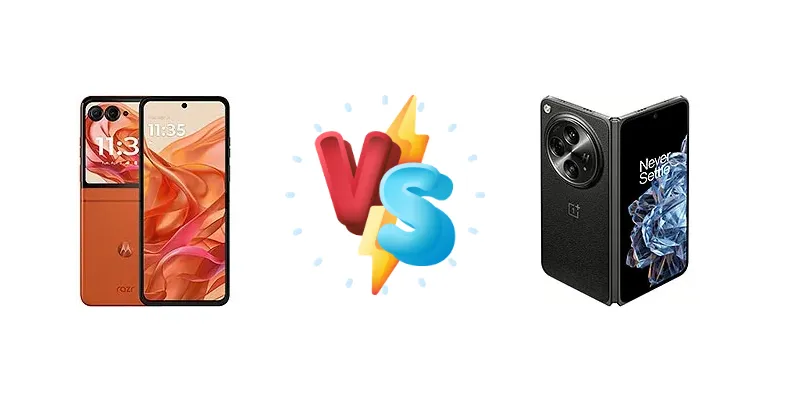
Motorola Razr 2024 vs. OnePlus Open: A Deep Dive into Foldable Performance and Value
| Phones Images | |||||
|---|---|---|---|---|---|
|
🏆 Quick Verdict
For the average user prioritizing raw performance and battery endurance, the OnePlus Open emerges as the clear winner. Its Snapdragon 8 Gen 2 chipset and impressive 11:59-hour active use battery life significantly outperform the Razr 2024’s Dimensity 7300X. However, the Razr 2024 offers a compelling alternative for those seeking a more compact and potentially more affordable foldable.
| PHONES | ||
|---|---|---|
| Phone Names | Motorola Razr 2024 | OnePlus Open |
| Network | ||
|---|---|---|
| 2G bands | GSM 900 / 1800 / 1900 | GSM 850 / 900 / 1800 / 1900 |
| 3G bands | HSDPA 850 / 900 / 1700(AWS) / 1900 / 2100 | HSDPA 800 / 850 / 900 / 1700(AWS) / 1900 / 2100 |
| 4G bands | 1, 2, 3, 4, 5, , 7, 8, 12, 13, 14, 17, 18, 19, 20, 25, 26, 28, 29, 30, 38, 39, 40, 41, 48, 66, 71 | 1, 2, 3, 4, 5, 7, 8, 12, 13, 17, 18, 19, 20, 25, 26, 28, 30, 32, 38, 39, 40, 41, 46, 48, 66, 71 |
| 5G bands | 1, 2, 3, 5, 7, 12, 14, 20, 25, 26, 28, 29, 30, 38, 40, 41, 48, 66, 70, 71, 77, 78 SA/NSA/Sub6 | 1, 2, 3, 5, 7, 8, 12, 20, 25, 28, 30, 38, 40, 41, 66, 71, 75, 77, 78 SA/NSA |
| Speed | HSPA, LTE, 5G | HSPA, LTE, 5G |
| Technology | GSM / HSPA / LTE / 5G | GSM / HSPA / LTE / 5G |
| Launch | ||
|---|---|---|
| Announced | 2024, June 25 | 2023, October 19 |
| Status | Available. Released 2024, July 17 | Available. Released 2023, October 26 |
| Body | ||
|---|---|---|
| Build | Plastic front (unfolded), glass front (folded, Gorilla Glass Victus), silicone polymer back (eco leather), aluminum frame (6000 series), hinge (stainless steel) | Glass front (Ceramic Guard) (folded), plastic front (unfolded), glass back or eco leather back, aluminum frame |
| Dimensions | Unfolded: 171.3 x 74 x 7.3 mm Folded: 88.1 x 74 x 15.9 mm | Unfolded: 153.4 x 143.1 x 5.8 mmFolded: 153.4 x 73.3 x 11.7 mm |
| SIM | Nano-SIM + eSIM | Nano-SIM + Nano-SIM + eSIM (max 2 at a time) |
| Weight | 188.4 g (6.63 oz) | 239 g or 245 g (8.43 oz) |
| Display | ||
|---|---|---|
| Resolution | 1080 x 2640 pixels (~413 ppi density) | 2268 x 2440 pixels (~426 ppi density) |
| Size | 6.9 inches, 107.6 cm2 (~84.9% screen-to-body ratio) | 7.82 inches, 196.7 cm2 (~89.6% screen-to-body ratio) |
| Type | Foldable LTPO AMOLED, 1B colors, 120Hz, HDR10+, 3000 nits (peak) | Foldable LTPO3 Flexi-fluid AMOLED, 1B colors, Dolby Vision, 120Hz, 2800 nits (peak) |
| Platform | ||
|---|---|---|
| CPU | Octa-core (4x2.5 GHz Cortex-A78 & 4x2.0 GHz Cortex-A55) | Octa-core (1x3.2 GHz Cortex-X3 & 2x2.8 GHz Cortex-A715 & 2x2.8 GHz Cortex-A710 & 3x2.0 GHz Cortex-A510) |
| Chipset | Mediatek Dimensity 7300X (4 nm) | Qualcomm SM8550-AB Snapdragon 8 Gen 2 (4 nm) |
| GPU | Mali-G615 MC2 | Adreno 740 |
| OS | Android 14 | Android 13, upgradable to Android 15, OxygenOS 15 |
| Memory | ||
|---|---|---|
| Card slot | No | No |
| Internal | 256GB 8GB RAM | 512GB 16GB RAM, 1TB 16GB RAM |
| Main Camera | ||
|---|---|---|
| Dual | 50 MP, f/1.7, 25mm (wide), 1/1.95", 0.8µm, dual pixel PDAF, OIS 13 MP, f/2.2, 120˚ (ultrawide), 1/3.0", 1.12µm, AF | - |
| Features | LED flash, panorama, HDR | Hasselblad Color Calibration, LED flash, HDR, panorama |
| Triple | - | 48 MP, f/1.7, 24mm (wide), 1/1.43", 1.12µm, multi-directional PDAF, OIS 64 MP, f/2.6, 70mm (telephoto), 1/2.0", 0.7µm, PDAF, OIS, 3x optical zoom 48 MP, f/2.2, 14mm, 114˚ (ultrawide), 1/2.0", 0.8µm, PDAF |
| Video | 4K@30fps, 1080p@30/60fps, gyro-EIS | 4K@30/60fps, 1080p@30/60/120/240/480fps gyro-EIS, HDR10+, Dolby Vision |
| Selfie camera | ||
|---|---|---|
| Features | HDR | HDR |
| Single | 32 MP, f/2.4, 25mm (wide), 1/3.14", 0.7µm | 20MP, f/2.2, 20mm (ultrawide), 1/4.0", 0.7µm Cover camera: 32MP, f/2.4, 22mm (ultrawide), 1/3.14", 0.7µm |
| Video | 4K@30fps, 1080p@30/60fps | 4K@30fps, 1080p@30fps, gyro-EIS |
| Sound | ||
|---|---|---|
| 35mm jack | No | No |
| Loudspeaker | Yes, with stereo speakers | Yes, with stereo speakers (Dolby Atmos enhanced) |
| Comms | ||
|---|---|---|
| Bluetooth | 5.4, A2DP, LE | 5.3, A2DP, LE, aptX HD |
| Infrared port | - | Yes |
| NFC | Yes | Yes |
| Positioning | GPS, GLONASS, BDS, GALILEO, QZSS | GPS (L1+L5), GLONASS, BDS, GALILEO (E1+E5a), QZSS |
| Radio | No | No |
| USB | USB Type-C 2.0 | USB Type-C 3.1, OTG |
| WLAN | Wi-Fi 802.11 a/b/g/n/ac/6e, dual-band or tri-band (region dependent) | Wi-Fi 802.11 a/b/g/n/ac/6e/7, tri-band |
| Features | ||
|---|---|---|
| Sensors | Fingerprint (side-mounted), gyro, accelerometer, proximity, compass, barometer | Fingerprint (side-mounted), accelerometer, gyro, proximity, compass |
| Battery | ||
|---|---|---|
| Charging | 30W wired 15W wireless | 67W wired, PD, 100% in 42 min Reverse wired |
| Type | 4200 mAh | Li-Po 4805 mAh |
| Misc | ||
|---|---|---|
| Colors | Koala Grey, Beach Sand, Spritz Orange | Emerald Dusk, Voyager Black, Apex Edition |
| Models | - | CPH2551 |
| Price | $ 324.90 | $ 1,059.99 / € 926.54 |
| SAR | - | 0.98 W/kg (head) 0.76 W/kg (body) |
Motorola Razr 2024
- Potentially more affordable price point
- More compact and pocketable design
- Modern foldable form factor
- Less powerful processor (Dimensity 7300X)
- Slower charging speed (30W)
- Limited battery life data
OnePlus Open
- Flagship Snapdragon 8 Gen 2 performance
- Excellent battery life (11:59h active use)
- Fast 67W wired charging
- Higher price tag
- Larger and heavier design
- May be less pocketable
Display Comparison
The OnePlus Open boasts a significantly brighter display, reaching a measured 1238 nits, which translates to superior visibility in direct sunlight compared to the Razr 2024 (brightness data unavailable). While both utilize foldable OLED technology, the OnePlus Open’s panel likely benefits from more advanced calibration and potentially a higher-quality panel, contributing to a more immersive viewing experience. The absence of detailed display specs for the Razr 2024 makes a direct comparison of color accuracy and refresh rate difficult, but the OnePlus Open’s brightness advantage is a clear win.
Camera Comparison
Detailed camera specs are limited for both devices, but the OnePlus Open’s camera system is expected to be more comprehensive, leveraging the Snapdragon 8 Gen 2’s advanced image signal processor (ISP). While the Razr 2024 likely offers a capable camera for everyday use, the OnePlus Open’s superior processing power and potentially larger sensors (speculation based on OnePlus’s flagship history) will result in better low-light performance, dynamic range, and overall image quality. The absence of specific sensor details for the Razr 2024 hinders a precise comparison, but the OnePlus Open’s flagship positioning suggests a more refined camera experience.
Performance
The core difference lies in the chipsets. The OnePlus Open’s Qualcomm Snapdragon 8 Gen 2 (4nm) is a substantial upgrade over the Motorola Razr 2024’s MediaTek Dimensity 7300X (4nm). The Snapdragon 8 Gen 2 features a more powerful CPU configuration – a 1x3.2 GHz Cortex-X3 prime core versus the Razr’s 4x2.5 GHz Cortex-A78 cores – resulting in significantly faster processing speeds and improved multitasking capabilities. While both are built on a 4nm process, the Snapdragon 8 Gen 2’s architectural advantages and higher clock speeds deliver superior performance, particularly in graphically intensive tasks like gaming. The OnePlus Open will handle demanding applications and sustained workloads with greater ease.
Battery Life
The OnePlus Open’s battery life is a standout feature, achieving an impressive 11:59 hours of active use. This is a significant advantage over the Razr 2024, for which active use data is unavailable. Furthermore, the OnePlus Open supports 67W wired charging, reaching 100% in just 42 minutes, while the Razr 2024 is limited to 30W wired charging. The OnePlus Open also offers 15W wireless charging and reverse wired charging, adding to its versatility. The faster charging speed and longer endurance of the OnePlus Open make it the better choice for users who rely heavily on their phones throughout the day.
Buying Guide
Buy the Motorola Razr 2024 if you prioritize a more pocketable foldable design and are willing to trade some performance for a potentially lower price point. It’s ideal for users who primarily use their phones for social media, communication, and light tasks. Buy the OnePlus Open if you demand flagship-level performance for gaming and demanding applications, require all-day battery life, and appreciate a brighter, more vibrant display. This is the choice for power users and content creators.