
Motorola Razr 2024 vs. Honor Magic V2 RSR Porsche Design: A Deep Dive
| Phones Images | |||||
|---|---|---|---|---|---|
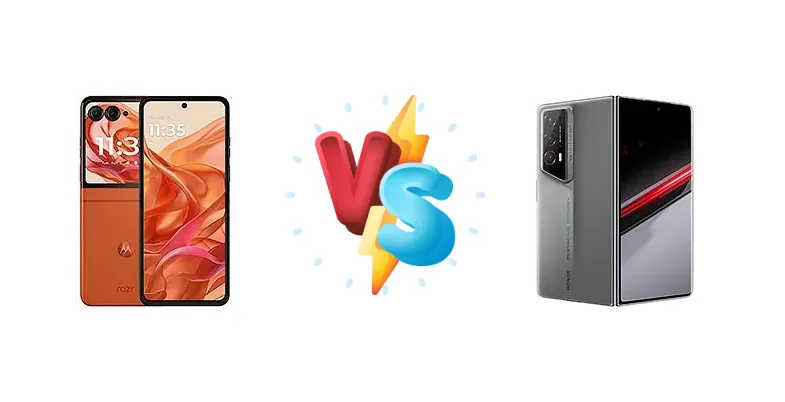
|
🏆 Quick Verdict
For the average user prioritizing value and a more compact form factor, the Motorola Razr 2024 offers a compelling experience. However, the Honor Magic V2 RSR Porsche Design’s Snapdragon 8 Gen 2 chipset and significantly faster 66W charging make it the clear winner for power users and those demanding top-tier performance.
| PHONES | ||
|---|---|---|
| Phone Names | Motorola Razr 2024 | Honor Magic V2 RSR Porsche Design |
| Network | ||
|---|---|---|
| 2G bands | GSM 900 / 1800 / 1900 | GSM 850 / 900 / 1800 / 1900 |
| 3G bands | HSDPA 850 / 900 / 1700(AWS) / 1900 / 2100 | HSDPA 800 / 850 / 900 / 1700(AWS) / 1900 / 2100 |
| 4G bands | 1, 2, 3, 4, 5, , 7, 8, 12, 13, 14, 17, 18, 19, 20, 25, 26, 28, 29, 30, 38, 39, 40, 41, 48, 66, 71 | 1, 2, 3, 4, 5, 7, 8, 12, 17, 18, 19, 20, 26, 28, 34, 38, 39, 40, 41, 66 |
| 5G bands | 1, 2, 3, 5, 7, 12, 14, 20, 25, 26, 28, 29, 30, 38, 40, 41, 48, 66, 70, 71, 77, 78 SA/NSA/Sub6 | 1, 3, 5, 8, 28, 38, 41, 77, 78 SA/NSA |
| Speed | HSPA, LTE, 5G | HSPA, LTE, 5G |
| Technology | GSM / HSPA / LTE / 5G | GSM / CDMA / HSPA / CDMA2000 / LTE / 5G |
| Launch | ||
|---|---|---|
| Announced | 2024, June 25 | 2024, January 11 |
| Status | Available. Released 2024, July 17 | Available. Released 2024, January 12 |
| Body | ||
|---|---|---|
| Build | Plastic front (unfolded), glass front (folded, Gorilla Glass Victus), silicone polymer back (eco leather), aluminum frame (6000 series), hinge (stainless steel) | Glass front, glass back, magnesium alloy frame, titanium alloy folding mechanism |
| Dimensions | Unfolded: 171.3 x 74 x 7.3 mm Folded: 88.1 x 74 x 15.9 mm | Unfolded: 156.7 x 145.4 x 4.7 mm or 4.8 mmFolded: 156.7 x 74 x 9.9 mm or 10.1 mm |
| SIM | Nano-SIM + eSIM | · Nano-SIM + eSIM· Nano-SIM + Nano-SIM |
| Weight | 188.4 g (6.63 oz) | 234 g (8.25 oz) |
| Display | ||
|---|---|---|
| Resolution | 1080 x 2640 pixels (~413 ppi density) | 2156 x 2344 pixels (~402 ppi density) |
| Size | 6.9 inches, 107.6 cm2 (~84.9% screen-to-body ratio) | 7.92 inches, 201.6 cm2 (~88.5% screen-to-body ratio) |
| Type | Foldable LTPO AMOLED, 1B colors, 120Hz, HDR10+, 3000 nits (peak) | Foldable LTPO OLED, 1B colors, 120Hz, HDR10+, 1600 nits (peak) |
| Platform | ||
|---|---|---|
| CPU | Octa-core (4x2.5 GHz Cortex-A78 & 4x2.0 GHz Cortex-A55) | Octa-core (1x3.36 GHz Cortex-X3 & 2x2.8 GHz Cortex-A715 & 2x2.8 GHz Cortex-A710 & 3x2.0 GHz Cortex-A510) |
| Chipset | Mediatek Dimensity 7300X (4 nm) | Qualcomm SM8550-AC Snapdragon 8 Gen 2 (4 nm) |
| GPU | Mali-G615 MC2 | Adreno 740 |
| OS | Android 14 | Android 13, upgradable to Android 14, MagicOS 8 |
| Memory | ||
|---|---|---|
| Card slot | No | No |
| Internal | 256GB 8GB RAM | 1TB 16GB RAM |
| Main Camera | ||
|---|---|---|
| Dual | 50 MP, f/1.7, 25mm (wide), 1/1.95", 0.8µm, dual pixel PDAF, OIS 13 MP, f/2.2, 120˚ (ultrawide), 1/3.0", 1.12µm, AF | - |
| Features | LED flash, panorama, HDR | Multi-zone Laser AF (8x8 dToF), color spectrum sensor, LED flash, HDR, panorama |
| Triple | - | 50 MP, f/1.9, (wide), PDAF, OIS 20 MP, f/2.4, 62mm (telephoto), PDAF, 2.5x optical zoom, OIS 50 MP, f/2.0, 13mm (ultrawide), AF |
| Video | 4K@30fps, 1080p@30/60fps, gyro-EIS | 4K@30/60fps (10-bit), 1080p@30/60fps, gyro-EIS, HDR10+, OIS |
| Selfie camera | ||
|---|---|---|
| Features | HDR | HDR |
| Single | 32 MP, f/2.4, 25mm (wide), 1/3.14", 0.7µm | 16 MP, f/2.2, (wide) |
| Video | 4K@30fps, 1080p@30/60fps | 4K@30fps, 1080p@30fps, gyro-EIS |
| Sound | ||
|---|---|---|
| 35mm jack | No | No |
| Loudspeaker | Yes, with stereo speakers | Yes, with stereo speakers |
| Comms | ||
|---|---|---|
| Bluetooth | 5.4, A2DP, LE | 5.3, A2DP, LE, aptX HD |
| Infrared port | - | Yes |
| NFC | Yes | Yes |
| Positioning | GPS, GLONASS, BDS, GALILEO, QZSS | GPS (L1+L5), GLONASS (L1), BDS (B1I+B1c+B2a), GALILEO (E1+E5a), QZSS (L1+L5) |
| Radio | No | No |
| USB | USB Type-C 2.0 | USB Type-C 3.1, OTG, Display Port 1.2 |
| WLAN | Wi-Fi 802.11 a/b/g/n/ac/6e, dual-band or tri-band (region dependent) | Wi-Fi 802.11 a/b/g/n/ac/6e/7, dual-band, Wi-Fi Direct |
| Features | ||
|---|---|---|
| Sensors | Fingerprint (side-mounted), gyro, accelerometer, proximity, compass, barometer | Fingerprint (side-mounted), accelerometer, gyro, proximity, compass |
| Battery | ||
|---|---|---|
| Charging | 30W wired 15W wireless | 66W wired 5W reverse wired |
| Type | 4200 mAh | Si/C Li-Ion 5000 mAh |
| Misc | ||
|---|---|---|
| Colors | Koala Grey, Beach Sand, Spritz Orange | Agate Gray |
| Models | - | VER-AN10 |
| Price | $ 324.90 | About 2700 EUR |
Motorola Razr 2024
- More affordable price point
- Potentially more compact and pocketable design
- Stylish and recognizable Razr branding
- Less powerful processor
- Significantly slower charging speed
- Likely a less advanced camera system
Honor Magic V2 RSR Porsche Design
- Flagship-level performance with Snapdragon 8 Gen 2
- Ultra-fast 66W wired charging
- Premium Porsche Design aesthetic and build quality
- Significantly higher price
- Larger and potentially less pocketable form factor
- May be overkill for casual users
Display Comparison
While both devices feature foldable displays, specifics are missing. However, given the Razr’s positioning, it likely prioritizes a more compact external display. The Magic V2 RSR, with its Porsche Design branding, likely boasts a larger, higher-resolution internal display with LTPO technology for adaptive refresh rates, maximizing battery efficiency. The Snapdragon 8 Gen 2’s image signal processor (ISP) will also contribute to superior display calibration and color accuracy on the Honor device.
Camera Comparison
Without detailed camera specs, analysis is limited. However, the Honor Magic V2 RSR, positioned as a flagship, likely incorporates a more sophisticated camera system with larger sensors and advanced image processing capabilities leveraging the Snapdragon 8 Gen 2’s ISP. Expect features like enhanced low-light performance and improved dynamic range. The Razr 2024 will likely focus on providing a competent camera experience for social media and casual photography, but won’t match the Magic V2 RSR’s potential for professional-quality images.
Performance
The core difference lies in the chipsets. The Honor Magic V2 RSR’s Qualcomm Snapdragon 8 Gen 2 (4nm) is a significant leap ahead of the Motorola Razr 2024’s MediaTek Dimensity 7300X (4nm). The Snapdragon 8 Gen 2’s Cortex-X3 prime core, clocked at 3.36 GHz, provides substantially more single-core performance, crucial for responsive UI and demanding applications. The Adreno 740 GPU in the Snapdragon 8 Gen 2 also offers a considerable advantage in graphics processing, translating to smoother gaming and faster video editing. While both are 4nm, the architectural differences and higher clock speeds give the Snapdragon a clear edge. The Razr’s Dimensity 7300X is still capable, but geared towards efficient everyday tasks rather than sustained peak performance.
Battery Life
The Honor Magic V2 RSR’s 66W wired charging is a game-changer, allowing for a full charge in under 40 minutes. The Motorola Razr 2024’s 30W charging is considerably slower, requiring significantly longer to reach 100%. While battery capacity isn’t specified, the faster charging speed of the Honor device mitigates any potential disadvantage in mAh. The Magic V2 RSR also offers 5W reverse wired charging, a convenient feature for topping up accessories, absent on the Razr.
Buying Guide
Buy the Motorola Razr 2024 if you need a stylish, pocketable foldable that balances price and features, and aren't a heavy gamer or power user. Buy the Honor Magic V2 RSR Porsche Design if you prioritize uncompromising performance, rapid charging, and a premium, luxury experience, and are willing to pay a substantial premium.