
Motorola Razr 2024 vs. Google Pixel Fold: A Deep Dive into Foldable Futures
| Phones Images | |||||
|---|---|---|---|---|---|
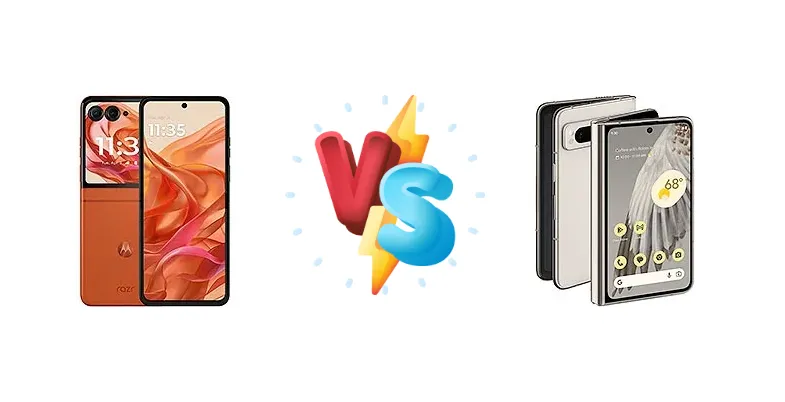
|
🏆 Quick Verdict
For the average user prioritizing software integration and a polished experience, the Google Pixel Fold is the superior choice. However, the Motorola Razr 2024 offers compelling value, delivering solid performance and a stylish design at a significantly lower price point, making it ideal for budget-conscious foldable enthusiasts.
| PHONES | ||
|---|---|---|
| Phone Names | Motorola Razr 2024 | Google Pixel Fold |
| Network | ||
|---|---|---|
| 2G bands | GSM 900 / 1800 / 1900 | GSM 850 / 900 / 1800 / 1900 |
| 3G bands | HSDPA 850 / 900 / 1700(AWS) / 1900 / 2100 | HSDPA 800 / 850 / 900 / 1700(AWS) / 1900 / 2100 |
| 4G bands | 1, 2, 3, 4, 5, , 7, 8, 12, 13, 14, 17, 18, 19, 20, 25, 26, 28, 29, 30, 38, 39, 40, 41, 48, 66, 71 | 1, 2, 3, 4, 5, 7, 8, 12, 13, 14, 17, 18, 19, 20, 21, 25, 26, 28, 29, 30, 32, 38, 39, 40, 41, 42, 46, 48, 66, 71 |
| 5G bands | 1, 2, 3, 5, 7, 12, 14, 20, 25, 26, 28, 29, 30, 38, 40, 41, 48, 66, 70, 71, 77, 78 SA/NSA/Sub6 | 1, 2, 3, 5, 7, 8, 12, 14, 20, 25, 28, 30, 38, 40, 41, 48, 66, 71, 75, 76, 77, 78, 79, 257, 258, 260, 261 SA/NSA/Sub6/mmWave |
| Speed | HSPA, LTE, 5G | HSPA, LTE, 5G |
| Technology | GSM / HSPA / LTE / 5G | GSM / CDMA / HSPA / EVDO / LTE / 5G |
| - | CDMA2000 1xEV-DO | |
| Launch | ||
|---|---|---|
| Announced | 2024, June 25 | 2023, May 10 |
| Status | Available. Released 2024, July 17 | Available. Released 2023, June 27 |
| Body | ||
|---|---|---|
| Build | Plastic front (unfolded), glass front (folded, Gorilla Glass Victus), silicone polymer back (eco leather), aluminum frame (6000 series), hinge (stainless steel) | Glass front (Gorilla Glass Victus) (folded), plastic front (unfolded), glass back (Gorilla Glass Victus), aluminum frame |
| Dimensions | Unfolded: 171.3 x 74 x 7.3 mm Folded: 88.1 x 74 x 15.9 mm | Unfolded: 139.7 x 158.7 x 5.8 mmFolded: 139.7 x 79.5 x 12.1 mm |
| SIM | Nano-SIM + eSIM | Nano-SIM + eSIM |
| Weight | 188.4 g (6.63 oz) | 283 g (9.98 oz) |
| - | IPX8 water resistant | |
| Display | ||
|---|---|---|
| Resolution | 1080 x 2640 pixels (~413 ppi density) | 1840 x 2208 pixels (~378 ppi density) |
| Size | 6.9 inches, 107.6 cm2 (~84.9% screen-to-body ratio) | 7.6 inches, 183.3 cm2 (~82.7% screen-to-body ratio) |
| Type | Foldable LTPO AMOLED, 1B colors, 120Hz, HDR10+, 3000 nits (peak) | Foldable OLED, 120Hz, HDR10+, 1000 nits (HBM), 1450 nits (peak) |
| - | Cover display: OLED, 120Hz, HDR, Corning Gorilla Glass Victus 5.8 inches, 1080 x 2092 pixels, 17.4:9 ratio, 408 ppi 1200 nits (HBM), 1550 nits (peak) | |
| Platform | ||
|---|---|---|
| CPU | Octa-core (4x2.5 GHz Cortex-A78 & 4x2.0 GHz Cortex-A55) | Octa-core (2x2.85 GHz Cortex-X1 & 2x2.35 GHz Cortex-A78 & 4x1.80 GHz Cortex-A55) |
| Chipset | Mediatek Dimensity 7300X (4 nm) | Google Tensor G2 (5 nm) |
| GPU | Mali-G615 MC2 | Mali-G710 MP7 |
| OS | Android 14 | Android 13, upgradable to Android 15, up to 5 major Android upgrades |
| Memory | ||
|---|---|---|
| Card slot | No | No |
| Internal | 256GB 8GB RAM | 256GB 12GB RAM, 512GB 12GB RAM |
| - | UFS 3.1 | |
| Main Camera | ||
|---|---|---|
| Dual | 50 MP, f/1.7, 25mm (wide), 1/1.95", 0.8µm, dual pixel PDAF, OIS 13 MP, f/2.2, 120˚ (ultrawide), 1/3.0", 1.12µm, AF | - |
| Features | LED flash, panorama, HDR | Laser AF, Dual-LED flash, HDR, panorama |
| Triple | - | 48 MP, f/1.7, 25mm (wide), 1/2.0", 0.8µm, dual pixel PDAF, OIS 10.8 MP, f/3.1, 112mm (telephoto), 1/3.1", 1.22µm, dual pixel PDAF, OIS, 5x optical zoom 10.8 MP, f/2.2, 121˚, (ultrawide), 1/3.0", 1.25µm |
| Video | 4K@30fps, 1080p@30/60fps, gyro-EIS | 4K@30/60fps, 1080p@30/60/120/240fps, 10-bit HDR |
| Selfie camera | ||
|---|---|---|
| Features | HDR | HDR, panorama |
| Single | 32 MP, f/2.4, 25mm (wide), 1/3.14", 0.7µm | 8 MP, f/2.0, 24mm (wide), 1/4.0", 1.12µm Cover camera: 9.5 MP, f/2.2, 24mm (wide), 1.22µm, dual pixel PDAF |
| Video | 4K@30fps, 1080p@30/60fps | 4K@30/60fps, 1080p@30/60fps |
| Sound | ||
|---|---|---|
| 3.5mm jack | - | No |
| 35mm jack | No | No |
| Loudspeaker | Yes, with stereo speakers | Yes, with stereo speakers |
| Comms | ||
|---|---|---|
| Bluetooth | 5.4, A2DP, LE | 5.2, A2DP, LE, aptX HD |
| NFC | Yes | Yes |
| Positioning | GPS, GLONASS, BDS, GALILEO, QZSS | GPS, GLONASS, GALILEO, BDS |
| Radio | No | No |
| USB | USB Type-C 2.0 | USB Type-C 3.2, OTG |
| WLAN | Wi-Fi 802.11 a/b/g/n/ac/6e, dual-band or tri-band (region dependent) | Wi-Fi 802.11 a/b/g/n/ac/6e, tri-band, Wi-Fi Direct |
| Features | ||
|---|---|---|
| Sensors | Fingerprint (side-mounted), gyro, accelerometer, proximity, compass, barometer | Fingerprint (side-mounted), accelerometer, gyro, proximity, compass, barometer |
| - | Ultra Wideband (UWB) support | |
| Battery | ||
|---|---|---|
| Charging | 30W wired 15W wireless | Wired, PD3.0 Wireless |
| Type | 4200 mAh | Li-Po 4821 mAh |
| Misc | ||
|---|---|---|
| Colors | Koala Grey, Beach Sand, Spritz Orange | Porcelain, Obsidian |
| Models | - | G9FPL |
| Price | $ 324.90 | € 670.87 / $ 389.26 / £ 899.99 |
Motorola Razr 2024
- More affordable price point
- Compact and stylish design
- Efficient 4nm Dimensity 7300X chipset
- Likely inferior camera performance
- Potentially slower charging speeds
- Less refined software experience
Google Pixel Fold
- Superior camera system with Google’s image processing
- Faster performance with Tensor G2
- Seamless software integration with Google ecosystem
- Significantly higher price
- Larger and heavier form factor
- Potentially higher power consumption
Display Comparison
While specific display specs (resolution, refresh rate) are missing for the Razr 2024, the Pixel Fold boasts a high-quality foldable display. The Pixel Fold’s panel benefits from Google’s color calibration expertise, ensuring accurate and vibrant visuals. The Dimensity 7300X in the Razr 2024 will likely drive a 120Hz panel, but the Pixel Fold’s potentially higher peak brightness and LTPO technology (allowing for variable refresh rates down to 1Hz for power saving) give it an edge. Bezels are a key area; the Pixel Fold generally has narrower bezels, contributing to a more immersive experience.
Camera Comparison
The Pixel Fold is expected to excel in camera performance, leveraging Google’s computational photography prowess. While specific sensor details are missing for both, the Pixel Fold’s image processing pipeline is renowned for its dynamic range and accurate color reproduction. The Tensor G2’s dedicated image signal processor (ISP) plays a crucial role here. The Razr 2024 will likely offer a competent camera system, but it won’t match the Pixel Fold’s consistency and detail, especially in challenging lighting conditions. We anticipate the Pixel Fold to have superior video recording capabilities as well.
Performance
The Google Tensor G2 (5nm) in the Pixel Fold and the Mediatek Dimensity 7300X (4nm) in the Razr 2024 represent different philosophies. The Tensor G2 prioritizes AI and machine learning tasks, enhancing features like voice recognition and image processing. Its Cortex-X1 prime core (2.85 GHz) offers peak performance advantages over the Razr’s Cortex-A78 cores (2.5 GHz). However, the 4nm process of the Dimensity 7300X should offer better power efficiency. The Pixel Fold’s LPDDR5x RAM likely provides faster memory bandwidth, further aiding multitasking. While the Razr 2024 is capable, the Pixel Fold holds a performance advantage, particularly in demanding applications.
Battery Life
Battery capacity is unspecified for both devices. However, the Pixel Fold’s larger size allows for a potentially larger battery. The Razr 2024 offers 30W wired charging and 15W wireless charging, while the Pixel Fold supports wired PD3.0 and wireless charging. The Pixel Fold’s faster wired charging and potentially larger battery capacity will translate to quicker top-ups and potentially longer battery life, despite the Tensor G2’s higher power draw. Real-world usage will determine the ultimate winner, but the Pixel Fold has the potential for superior endurance.
Buying Guide
Buy the Motorola Razr 2024 if you need a stylish, relatively affordable entry point into the foldable world and prioritize a compact form factor. You'll appreciate its design and acceptable performance for everyday tasks. Buy the Google Pixel Fold if you prefer a seamless software experience, a more robust camera system, and are willing to pay a premium for Google’s ecosystem and refined foldable implementation.