
Motorola Razr 2022 vs. Razr 5G: The Ultimate Foldable Showdown
| Phones Images | |||||
|---|---|---|---|---|---|
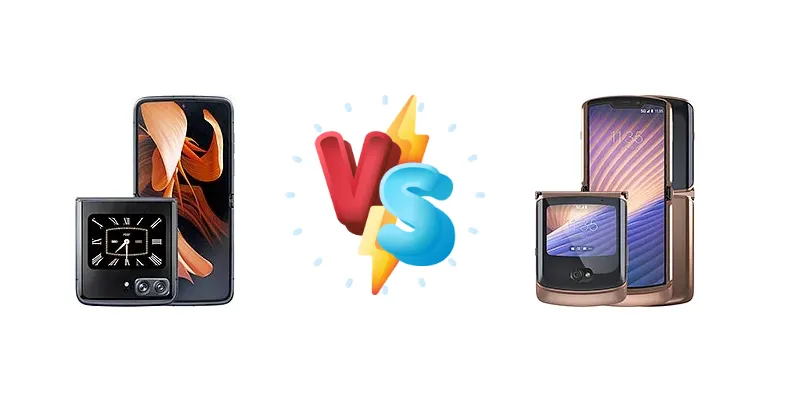
|
🏆 Quick Verdict
The Razr 2022 is the clear winner, boasting a significantly faster processor, brighter display, and vastly improved battery life. However, its higher price tag might make the Razr 5G a more appealing option for budget-conscious buyers seeking a stylish foldable.
| PHONES | ||
|---|---|---|
| Phone Names | Motorola Razr 2022 | Motorola Razr 5G |
| Network | ||
|---|---|---|
| 2G bands | GSM 900 / 1800 / 1900 | GSM 900 / 1800 / 1900 |
| 3G bands | HSDPA 850 / 900 / 1700(AWS) / 1900 / 2100 | HSDPA 850 / 900 / 1700(AWS) / 1900 / 2100 |
| 4G bands | 1, 2, 3, 4, 5, 7, 8, 12, 13, 14, 17, 18, 19, 20, 25, 26, 28, 34, 38, 39, 40, 41, 42, 43, 48, 66 | 1, 2, 3, 4, 5, 7, 8, 12, 13, 14, 17, 18, 19, 20, 25, 26, 28, 29, 30, 38, 39, 40, 41, 46, 48, 66, 71 |
| 5G bands | 1, 2, 3, 5, 7, 8, 12, 20, 25, 26, 28, 38, 40, 41, 66, 77, 78, 79 SA/NSA/Sub6 | 2, 5, 25, 41, 66, 71, 78 SA/NSA/Sub6 |
| Speed | HSPA, LTE, 5G | HSPA 42.2/5.76 Mbps, LTE Cat18 1200/150 Mbps, 5G |
| Technology | GSM / CDMA / HSPA / EVDO / LTE / 5G | GSM / CDMA / HSPA / EVDO / LTE / 5G |
| CDMA2000 1xEV-DO | CDMA2000 1xEV-DO | |
| Launch | ||
|---|---|---|
| Announced | 2022, August 11 | 2020, September 09. Released 2020, September 15 |
| Status | Available. Released 2022, August 18 | Discontinued |
| Body | ||
|---|---|---|
| Build | Plastic front (unfolded), glass front (folded, Gorilla Glass 5), glass back (Gorilla Glass 5), aluminum frame (7000 series), hinge (stainless steel) | Plastic front (unfolded), glass front (folded, Gorilla Glass 5), glass back (Gorilla Glass 5), aluminum frame (7000 series), hinge (stainless steel) |
| Dimensions | Unfolded: 167.0 x 79.8 x 7.6 mm Folded: 86.5 x 79.8 x 17 mm | Unfolded: 169.2 x 72.6 x 7.9 mmFolded: 91.7 x 72.6 x 16 mm |
| SIM | Nano-SIM + eSIM | Nano-SIM + eSIM |
| Weight | 200 g (7.05 oz) | 192 g (6.77 oz) |
| Water-repellent coating | Water-repellent coating | |
| Display | ||
|---|---|---|
| Resolution | 1080 x 2400 pixels, 20:9 ratio (~393 ppi density) | 876 x 2142 pixels (~373 ppi density) |
| Size | 6.7 inches, 108.4 cm2 (~81.3% screen-to-body ratio) | 6.2 inches, 86.9 cm2 (~70.7% screen-to-body ratio) |
| Type | Foldable AMOLED, 1B colors, 144Hz, HDR10+ | Foldable P-OLED |
| Second external AMOLED display, 2.7 inches, 573 x 800 pixels | Second external G-OLED display, 2.7 inches, 600 x 800 pixels | |
| Platform | ||
|---|---|---|
| CPU | Octa-core (1x3.19 GHz Cortex-X2 & 3x2.75 GHz Cortex-A710 & 4x1.80 GHz Cortex-A510) | Octa-core (1x2.4 GHz Kryo 475 Prime & 1x2.2 GHz Kryo 475 Gold & 6x1.8 GHz Kryo 475 Silver) |
| Chipset | Qualcomm SM8475 Snapdragon 8+ Gen 1 (4 nm) | Qualcomm SM7250 Snapdragon 765G 5G (7 nm) |
| GPU | Adreno 730 | Adreno 620 |
| OS | Android 13, upgradable to Android 14 | Android 10, upgradable to Android 11 |
| Memory | ||
|---|---|---|
| Card slot | No | No |
| Internal | 128GB 8GB RAM, 256GB 8GB RAM, 512GB 12GB RAM | 256GB 8GB RAM |
| UFS 3.1 | - | |
| Main Camera | ||
|---|---|---|
| Dual | 50 MP, f/1.8, (wide), 1/1.55", 1.0µm, PDAF, OIS 13 MP, f/2.2, 120˚ (ultrawide), 1/3.0", 1.12µm, AF | - |
| Features | LED flash, panorama, auto HDR | Dual-LED dual-tone flash, auto HDR, panorama |
| Single | - | 48 MP, f/1.7, 26mm (wide), 1/2.0", 0.8µm, PDAF, OIS |
| Video | 8K@30fps, 4K@30/60fps, 1080p@30/60/120fps, gyro-EIS | 4K@30fps, 1080p@30/60/120fps, gyro-EIS |
| Selfie camera | ||
|---|---|---|
| Features | Auto HDR | Auto HDR |
| Single | 32 MP, f/2.4, 25mm (wide), 1/3.2", 0.7µm | 20 MP, f/2.2, (wide), 0.8µm |
| Video | 1080p@30/60fps | 1080p@30/60fps |
| Sound | ||
|---|---|---|
| 3.5mm jack | No | No |
| 35mm jack | No | No |
| Loudspeaker | Yes, with stereo speakers | Yes |
| Comms | ||
|---|---|---|
| Bluetooth | 5.2, A2DP, LE, aptX HD, aptX Adaptive | 5.1, A2DP, LE |
| NFC | Yes | Yes |
| Positioning | GPS (L1+L5), GLONASS (L1), BDS (B1I+B1c+B2a), GALILEO (E1+E5a), QZSS (L1+L5) | GPS, GLONASS, GALILEO |
| Radio | No | No |
| USB | USB Type-C 3.1 | USB Type-C 3.1 |
| WLAN | Wi-Fi 802.11 a/b/g/n/ac/6e, dual-band, Wi-Fi Direct | Wi-Fi 802.11 a/b/g/n/ac, dual-band, Wi-Fi Direct |
| Features | ||
|---|---|---|
| Sensors | Fingerprint (side-mounted), accelerometer, gyro, proximity, compass | Fingerprint (rear-mounted), accelerometer, gyro, proximity, compass, barometer |
| Battery | ||
|---|---|---|
| Charging | 30W wired | 15W wired |
| Type | Li-Po 3500 mAh | Li-Po 2800 mAh |
| Misc | ||
|---|---|---|
| Colors | Satin Black | Polished Graphite, Blush Gold, Liquid Mercury |
| Models | XT2251-1 | XT2071-4, XT2071-3 |
| Price | About 670 EUR | About 490 EUR |
| Tests | ||
|---|---|---|
| Battery life | Endurance rating 64h | - |
| Camera | Photo / Video | - |
| Display | Contrast ratio: Infinite (nominal) | - |
| Loudspeaker | -25.4 LUFS (Very good) | - |
| Performance | AnTuTu: 965260 (v9) GeekBench: 3944 (v5.1) GFXBench: 76fps (ES 3.1 onscreen) | - |
Motorola Razr 2022
- Significantly faster performance
- Brighter and more vibrant display
- Much better battery life
- Faster charging (30W)
- Modern chipset (Snapdragon 8+ Gen 1)
- Higher price
- Potential for crease visibility
Motorola Razr 5G
- More affordable
- Iconic Razr design
- 5G connectivity
- Slower performance
- Less bright display
- Shorter battery life
- Slower charging (15W)
- Older chipset (Snapdragon 765G)
Display Comparison
The Razr 2022 features a significantly brighter display, peaking at 1033 nits compared to the Razr 5G's unspecified brightness. Both offer a similar foldable OLED panel with a 6.2-inch external display and a 7.3-inch internal display. The Razr 2022's improved brightness makes it more usable outdoors. Contrast ratio is excellent on both, with the Razr 2022 having a nominal 'infinite' contrast.
Camera Comparison
While both phones offer decent camera capabilities, the Razr 2022 is expected to have improvements in image processing and low-light performance due to the more powerful chipset. Specific camera specs are not fully detailed in the provided data, but the 2022's processor allows for more advanced computational photography features. Both have a dual-camera setup.
Performance
The Razr 2022's Snapdragon 8+ Gen 1 is a powerhouse, offering a substantial performance boost over the Razr 5G's Snapdragon 765G. Expect smoother multitasking, faster app loading, and better gaming performance on the 2022 model. The 2022 also benefits from a more modern 4nm process, improving efficiency.
Battery Life
The Razr 2022 boasts a significantly better battery life, with an endurance rating of 64 hours, compared to the Razr 5G's unspecified battery life (likely considerably lower). The 2022's more efficient chipset and potentially larger battery contribute to this advantage. The Razr 5G's 15W charging is also slower than the Razr 2022's 30W wired charging.
Buying Guide
The Motorola Razr 2022 is ideal for users who prioritize performance, a vibrant display, and longer battery life. It's perfect for power users and those wanting the latest tech. The Motorola Razr 5G is a good choice for those on a tighter budget who still want the unique foldable experience and iconic Razr design, accepting compromises in performance and battery.