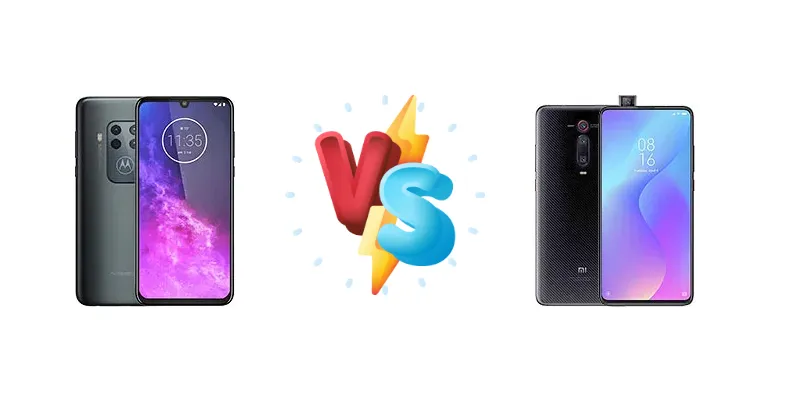
Released around the same timeframe, the Motorola One Zoom and Xiaomi Mi 9T Pro represent compelling options in the mid-range smartphone market. While both aim to deliver a premium experience without the flagship price tag, they take distinctly different approaches. The Motorola One Zoom prioritizes a versatile camera system, while the Mi 9T Pro focuses on raw processing power and faster charging.
🏆 Quick Verdict
For the average user prioritizing performance and future-proofing, the Xiaomi Mi 9T Pro is the clear winner. Its Snapdragon 855 chipset provides a substantial leap in processing power and gaming capabilities compared to the Motorola One Zoom’s Snapdragon 675. However, the One Zoom remains a viable option for those prioritizing camera versatility and longer endurance.
| Network |
|---|
| 2G bands | GSM 850 / 900 / 1800 / 1900 | GSM 850 / 900 / 1800 / 1900 |
| 3G bands | HSDPA 850 / 900 / 1700(AWS) / 1900 / 2100 | HSDPA 850 / 900 / 1700(AWS) / 1900 / 2100 |
| 4G bands | 1, 2, 3, 4, 5, 7, 8, 12, 17, 20, 28, 38, 40, 41, 66 | 1, 2, 3, 4, 5, 7, 8, 20, 28, 38, 40 |
| EDGE | No | - |
| GPRS | No | - |
| Speed | HSPA 42.2/5.76 Mbps, LTE (2CA) Cat12 600/100 Mbps | HSPA, LTE |
| Technology | GSM / HSPA / LTE | GSM / HSPA / LTE |
| Launch |
|---|
| Announced | 2019, September 05. Released 2019, September 05 | 2019, August 21. Released 2019, August 21 |
| Status | Discontinued | Discontinued |
| Body |
|---|
| Build | Glass front (Panda King), glass back (Gorilla Glass 3), aluminum frame | Glass front (Gorilla Glass 5), glass back (Gorilla Glass 5), aluminum frame |
| Dimensions | 158 x 75 x 8.8 mm (6.22 x 2.95 x 0.35 in) | 156.7 x 74.3 x 8.8 mm (6.17 x 2.93 x 0.35 in) |
| SIM | · Nano-SIM· Nano-SIM + Nano-SIM | Nano-SIM + Nano-SIM |
| Weight | 190 g (6.70 oz) | 191 g (6.74 oz) |
| | Splash and dust resistant | - |
| Display |
|---|
| Protection | Panda King glass | Corning Gorilla Glass 5 |
| Resolution | 1080 x 2340 pixels, 19.5:9 ratio (~403 ppi density) | 1080 x 2340 pixels, 19.5:9 ratio (~403 ppi density) |
| Size | 6.39 inches, 100.2 cm2 (~84.6% screen-to-body ratio) | 6.39 inches, 100.2 cm2 (~86.1% screen-to-body ratio) |
| Type | Super AMOLED | Super AMOLED, HDR |
| Platform |
|---|
| CPU | Octa-core (2x2.0 GHz Kryo 460 Gold & 6x1.7 GHz Kryo 460 Silver) | Octa-core (1x2.84 GHz Kryo 485 & 3x2.42 GHz Kryo 485 & 4x1.78 GHz Kryo 485) |
| Chipset | Qualcomm SDM675 Snapdragon 675 (11 nm) | Qualcomm SM8150 Snapdragon 855 (7 nm) |
| GPU | Adreno 612 | Adreno 640 |
| OS | Android 9.0 (Pie) | Android 9.0 (Pie), upgradable to Android 11, MIUI 12.5 |
| Memory |
|---|
| Call records | 20 dialed, 20 received, 20 missed calls | - |
| Card slot | microSDXC (uses shared SIM slot) | No |
| Internal | 128GB 4GB RAM | 64GB 6GB RAM, 128GB 6GB RAM, 256GB 8GB RAM |
| Phonebook | 1000 entries, Photocall | - |
| | UFS 2.0 | UFS 2.1 |
| Main Camera |
|---|
| Features | Dual-LED dual-tone flash, panorama, HDR | Laser AF, Dual-LED flash, HDR, panorama |
| Quad | 48 MP, f/1.7, (wide), 1/2.0", 0.8µm, PDAF, OIS
8 MP, f/2.4, (telephoto), 3x optical zoom, PDAF, OIS
16 MP, f/2.2, 13mm (ultrawide)
Auxiliary lens | - |
| Single | 8.1 MP, AF | - |
| Triple | - | 48 MP, f/1.8, 26mm (wide), 1/2.0", 0.8µm, PDAF
8 MP, f/2.4, 53mm (telephoto), 1/4.0", 1.12µm, PDAF, 2x optical zoom
13 MP, f/2.4, 12mm (ultrawide), 1/3.1", 1.12µm |
| Video | 4K@30fps, 1080p@30/60fps | 4K@30/60fps, 1080p@30/120/240fps, 1080p@960fps |
| Selfie camera |
|---|
| Features | HDR | HDR |
| Single | 25 MP, f/2.0, 0.9µm | Motorized pop-up 20 MP, f/2.2, (wide), 1/3.4", 0.8µm |
| Video | 1080p@30fps, 720p@240fps | 1080p@30fps |
| Sound |
|---|
| 3.5mm jack | Yes | Yes |
| 35mm jack | Yes | Yes |
| Loudspeaker | Yes | Yes |
| | - | 24-bit/192kHz audio
|
| Comms |
|---|
| Bluetooth | 5.0, A2DP, LE, EDR | 5.0, A2DP, LE, aptX HD |
| NFC | Yes | Yes |
| Positioning | GPS, GLONASS, GALILEO, BDS | GPS (L1+L5), GLONASS (G1), BDS (B1), GALILEO (E1+E5a) |
| Radio | FM radio | Yes |
| USB | USB Type-C 3.1 | USB Type-C 2.0, OTG |
| WLAN | Wi-Fi 802.11 a/b/g/n/ac, dual-band, Wi-Fi Direct | Wi-Fi 802.11 a/b/g/n/ac, dual-band, Wi-Fi Direct |
| Features |
|---|
| Browser | No | - |
| Games | Yes | - |
| Java | No | - |
| Messaging | SMS | - |
| Sensors | Fingerprint (under display, optical), accelerometer, gyro, proximity, compass | Fingerprint (under display, optical), accelerometer, gyro, proximity, compass |
| Battery |
|---|
| Charging | 15W wired | 27W wired, QC4 |
| Stand-by | Up to 625 h | - |
| Talk time | Up to 11 h | - |
| Type | Li-Po 4000 mAh, non-removable | Li-Po 4000 mAh, non-removable |
| Misc |
|---|
| Colors | Electric Gray, Cosmic Purple, Brushed Bronze | Carbon black, Red flame, Glacier blue |
| Models | SGP771 | M1903F11G |
| Price | About 140 EUR | About 150 EUR |
| SAR | 1.26 W/kg (head) 1.39 W/kg (body) | 1.03 W/kg (head) 0.72 W/kg (body) |
| SAR EU | 0.71 W/kg (head) 1.54 W/kg (body) | 1.30 W/kg (head) 1.51 W/kg (body) |
| Tests |
|---|
| Audio quality |
Noise -91.6dB / Crosstalk -91.8dB |
Noise -93.9dB / Crosstalk -94.2dB |
| Battery life |
Endurance rating 90h
| Endurance rating 103h |
| Camera |
Photo / Video | - |
| Display |
Contrast ratio: Infinite (nominal) |
Contrast ratio: Infinite (nominal) |
| Loudspeaker |
Voice 66dB / Noise 72dB / Ring 85dB
|
-26.9 LUFS (Good) |
| Performance |
AnTuTu: 146810 (v7), 180000 (v8)
GeekBench: 5802 (v4.4), 1534 (v5.1)
GFXBench: 7.1fps (ES 3.1 onscreen) |
AnTuTu: 368846 (v7), 437823 (v8)
GeekBench: 10684 (v4.4), 2732 (v5.1)
GFXBench: 36fps (ES 3.1 onscreen) |
Motorola One Zoom
- Potentially better camera versatility (details limited)
- Solid battery life (90h endurance)
- Higher measured peak display brightness (690 nits)
- Significantly weaker processor (Snapdragon 675)
- Slower charging speed (15W)
Xiaomi Mi 9T Pro
- Flagship-level performance (Snapdragon 855)
- Faster charging (27W with QC4)
- Longer battery life (103h endurance)
- Display brightness data unavailable
- Camera details are limited
Display Comparison
Both the Motorola One Zoom and Xiaomi Mi 9T Pro feature displays with an 'Infinite' (nominal) contrast ratio, suggesting deep blacks typical of OLED panels. However, the Motorola One Zoom boasts a measured peak brightness of 690 nits, which will provide better visibility in direct sunlight compared to the Mi 9T Pro (brightness data unavailable). While both likely utilize similar OLED technology, the One Zoom’s higher measured brightness gives it a slight edge for outdoor usability. The lack of high refresh rate panels on either device is a common trait for this price point.
Camera Comparison
Both devices advertise photo and video capabilities, but details are limited. The Motorola One Zoom’s strength likely lies in its camera versatility, potentially offering a wider range of focal lengths and shooting modes. However, without specific sensor size or aperture information, it’s difficult to assess image quality definitively. The Mi 9T Pro, benefiting from the Snapdragon 855’s superior image signal processor (ISP), likely delivers better dynamic range and low-light performance. The absence of detailed camera specs necessitates a focus on the processing power advantage of the Mi 9T Pro, which will contribute to faster image processing and potentially better video stabilization.
Performance
The core difference between these two phones lies in their chipsets. The Xiaomi Mi 9T Pro is equipped with the Qualcomm Snapdragon 855 (7nm), a flagship-level processor featuring an octa-core CPU configuration with a prime Kryo 485 core clocked at 2.84 GHz. This is a significant upgrade over the Motorola One Zoom’s Snapdragon 675 (11nm). The 855’s smaller 7nm process node translates to improved power efficiency and thermal performance, allowing for sustained peak performance during demanding tasks. The Mi 9T Pro’s CPU configuration – 1x2.84 GHz, 3x2.42 GHz, and 4x1.78 GHz – demonstrates a more aggressive core clocking strategy, directly impacting responsiveness and gaming frame rates.
Battery Life
The Xiaomi Mi 9T Pro edges out the Motorola One Zoom in battery endurance, achieving a rating of 103 hours compared to the One Zoom’s 90 hours. This difference is partially attributable to the more efficient Snapdragon 855 chipset. Crucially, the Mi 9T Pro supports 27W wired charging with Quick Charge 4 (QC4) technology, allowing for significantly faster charging speeds than the Motorola One Zoom’s 15W charging. This means the Mi 9T Pro can replenish its battery from 0-100% much quicker, minimizing downtime.
Buying Guide
Buy the Motorola One Zoom if you need a phone with a strong emphasis on photography and a consistently reliable battery life, even if it means sacrificing some processing speed. It’s ideal for casual users and photography enthusiasts. Buy the Xiaomi Mi 9T Pro if you prefer a phone capable of handling demanding games, multitasking, and future software updates with ease. It’s the better choice for power users and gamers.
Frequently Asked Questions
❓ Does the Snapdragon 855 in the Mi 9T Pro get hot during extended gaming sessions?
While the Snapdragon 855 can generate heat under sustained load, its 7nm process node and the Mi 9T Pro’s thermal management system are generally effective at preventing significant throttling. Users report playable frame rates even after prolonged gaming, though some heat dissipation is expected.
❓ Is the 15W charging on the Motorola One Zoom slow compared to modern standards?
Yes, 15W charging is relatively slow compared to the 27W charging offered by the Mi 9T Pro and many other contemporary smartphones. Expect a significantly longer time to fully charge the Motorola One Zoom from 0 to 100%.
❓ How does the Snapdragon 675 in the Motorola One Zoom handle everyday tasks like browsing and social media?
The Snapdragon 675 is perfectly capable of handling everyday tasks smoothly. Users will experience responsive performance for browsing, social media, and basic app usage. However, it will struggle with more demanding applications and games.
❓ Which phone is likely to receive more software updates and security patches?
Xiaomi generally provides more frequent software updates and security patches for its devices compared to Motorola. The Mi 9T Pro is likely to receive updates for a longer period, offering better long-term software support.