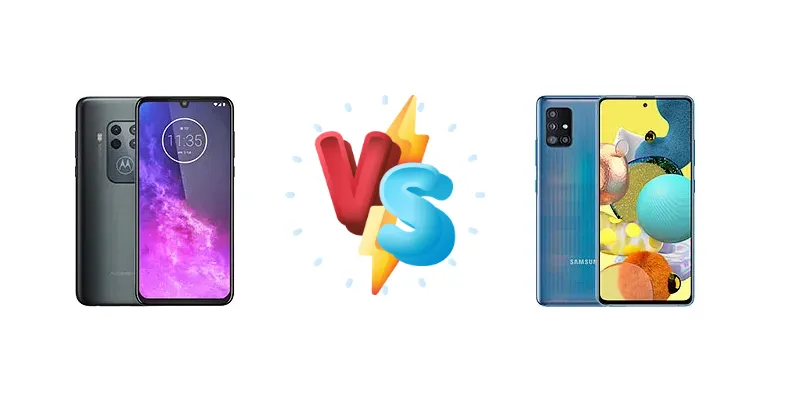
The Motorola One Zoom and Samsung Galaxy A51 5G UW represent different approaches to the mid-range smartphone market. The One Zoom, while older, prioritized a strong camera experience and endurance. The A51 5G UW, leveraging 5G connectivity and a newer chipset, aims for a balance of performance and modern features. This comparison dissects their key differences to determine which device delivers the best value.
🏆 Quick Verdict
For the average user prioritizing future-proofing and smoother performance, the Samsung Galaxy A51 5G UW is the better choice. Its Snapdragon 765G chipset provides a noticeable performance uplift over the One Zoom’s Snapdragon 675, and 5G connectivity adds long-term value. However, the One Zoom remains a viable option for those prioritizing battery endurance and a potentially more refined camera experience.
| Network |
|---|
| 2G bands | GSM 850 / 900 / 1800 / 1900 | GSM 850 / 900 / 1800 / 1900 |
| 3G bands | HSDPA 850 / 900 / 1700(AWS) / 1900 / 2100 | HSDPA 850 / 900 / 1900 / 2100 |
| 4G bands | 1, 2, 3, 4, 5, 7, 8, 12, 17, 20, 28, 38, 40, 41, 66 | 2, 4, 5, 13, 66 |
| 5G bands | - | 260, 261 mmWave |
| EDGE | No | - |
| GPRS | No | - |
| Speed | HSPA 42.2/5.76 Mbps, LTE (2CA) Cat12 600/100 Mbps | HSPA, LTE, 5G |
| Technology | GSM / HSPA / LTE | GSM / HSPA / LTE / 5G |
| Launch |
|---|
| Announced | 2019, September 05. Released 2019, September 05 | 2020, August 14 |
| Status | Discontinued | Available. Released 2020, August 14 |
| Body |
|---|
| Build | Glass front (Panda King), glass back (Gorilla Glass 3), aluminum frame | Glass front (Gorilla Glass 3), plastic back, aluminum frame |
| Dimensions | 158 x 75 x 8.8 mm (6.22 x 2.95 x 0.35 in) | 158.8 x 73.4 x 8.6 mm (6.25 x 2.89 x 0.34 in) |
| SIM | · Nano-SIM· Nano-SIM + Nano-SIM | Nano-SIM (pre-installed) |
| Weight | 190 g (6.70 oz) | 188.8 g (6.67 oz) |
| | Splash and dust resistant | - |
| Display |
|---|
| Protection | Panda King glass | Corning Gorilla Glass 3 |
| Resolution | 1080 x 2340 pixels, 19.5:9 ratio (~403 ppi density) | 1080 x 2400 pixels, 20:9 ratio (~405 ppi density) |
| Size | 6.39 inches, 100.2 cm2 (~84.6% screen-to-body ratio) | 6.5 inches, 102.0 cm2 (~87.5% screen-to-body ratio) |
| Type | Super AMOLED | Super AMOLED |
| Platform |
|---|
| CPU | Octa-core (2x2.0 GHz Kryo 460 Gold & 6x1.7 GHz Kryo 460 Silver) | Octa-core (1x2.4 GHz Kryo 475 Prime & 1x2.2 GHz Kryo 475 Gold & 6x1.8 GHz Kryo 475 Silver) |
| Chipset | Qualcomm SDM675 Snapdragon 675 (11 nm) | Qualcomm SM7250 Snapdragon 765G 5G (7 nm) |
| GPU | Adreno 612 | Adreno 620 |
| OS | Android 9.0 (Pie) | Android 10, One UI 2 |
| Memory |
|---|
| Call records | 20 dialed, 20 received, 20 missed calls | - |
| Card slot | microSDXC (uses shared SIM slot) | microSDXC (uses shared SIM slot) |
| Internal | 128GB 4GB RAM | 128GB 6GB RAM |
| Phonebook | 1000 entries, Photocall | - |
| | UFS 2.0 | UFS 2.1 |
| Main Camera |
|---|
| Features | Dual-LED dual-tone flash, panorama, HDR | LED flash, panorama, HDR |
| Quad | 48 MP, f/1.7, (wide), 1/2.0", 0.8µm, PDAF, OIS
8 MP, f/2.4, (telephoto), 3x optical zoom, PDAF, OIS
16 MP, f/2.2, 13mm (ultrawide)
Auxiliary lens | 48 MP, f/2.0, 26mm (wide), 1/2.0", 0.8µm, PDAF
12 MP, f/2.2, 123˚ (ultrawide)
5 MP (macro)
Auxiliary lens |
| Single | 8.1 MP, AF | 5 MP, AF |
| Video | 4K@30fps, 1080p@30/60fps | 4K@30fps, 1080p@30/120fps; gyro-EIS |
| Selfie camera |
|---|
| Features | HDR | HDR |
| Single | 25 MP, f/2.0, 0.9µm | 32 MP, f/2.2, 26mm (wide), 1/2.8", 0.8µm |
| Video | 1080p@30fps, 720p@240fps | 4K@30fps, 1080p@30fps |
| Sound |
|---|
| 3.5mm jack | Yes | Yes |
| 35mm jack | Yes | Yes |
| Loudspeaker | Yes | Yes |
| Comms |
|---|
| Bluetooth | 5.0, A2DP, LE, EDR | 5.0, A2DP, LE |
| NFC | Yes | Yes |
| Positioning | GPS, GLONASS, GALILEO, BDS | GPS, GLONASS, GALILEO, BDS |
| Radio | FM radio | FM radio, RDS, recording |
| USB | USB Type-C 3.1 | USB Type-C 2.0, OTG |
| WLAN | Wi-Fi 802.11 a/b/g/n/ac, dual-band, Wi-Fi Direct | Wi-Fi 802.11 a/b/g/n/ac, dual-band, Wi-Fi Direct |
| Features |
|---|
| Browser | No | - |
| Games | Yes | - |
| Java | No | - |
| Messaging | SMS | - |
| Sensors | Fingerprint (under display, optical), accelerometer, gyro, proximity, compass | Fingerprint (under display, optical), accelerometer, gyro, proximity, compass |
| | - | ANT+ |
| Battery |
|---|
| Charging | 15W wired | 15W wired |
| Stand-by | Up to 625 h | Up to 672 h |
| Talk time | Up to 11 h | Up to 5 h |
| Type | Li-Po 4000 mAh, non-removable | Li-Po 4500 mAh |
| Misc |
|---|
| Colors | Electric Gray, Cosmic Purple, Brushed Bronze | Prism Bricks Blue |
| Models | SGP771 | SM-A516V |
| Price | About 140 EUR | About 470 EUR |
| SAR | 1.26 W/kg (head) 1.39 W/kg (body) | 0.70 W/kg (head) 1.25 W/kg (body) |
| SAR EU | 0.71 W/kg (head) 1.54 W/kg (body) | 0.59 W/kg (head) 1.32 W/kg (body) |
| Tests |
|---|
| Audio quality |
Noise -91.6dB / Crosstalk -91.8dB | - |
| Battery life |
Endurance rating 90h
| - |
| Camera |
Photo / Video | - |
| Display |
Contrast ratio: Infinite (nominal) | - |
| Loudspeaker |
Voice 66dB / Noise 72dB / Ring 85dB
| - |
| Performance |
AnTuTu: 146810 (v7), 180000 (v8)
GeekBench: 5802 (v4.4), 1534 (v5.1)
GFXBench: 7.1fps (ES 3.1 onscreen) | - |
Motorola One Zoom
- Exceptional 90-hour battery endurance
- Potentially refined camera image processing
- Good peak display brightness (690 nits)
- Older Snapdragon 675 chipset
- Lacks 5G connectivity
- Slower charging (15W)
Samsung Galaxy A51 5G UW
- Faster Snapdragon 765G chipset
- 5G connectivity for future-proofing
- Likely vibrant AMOLED display (based on Samsung's history)
- Potentially lower battery endurance
- Slower charging (15W)
- May include a low-resolution macro lens
Display Comparison
The Motorola One Zoom boasts a display capable of reaching 690 nits of peak brightness, ensuring good visibility even outdoors. While the A51 5G UW’s display specifications aren’t provided, Samsung typically employs vibrant AMOLED panels. The One Zoom’s ‘Infinite’ contrast ratio suggests a standard LCD panel, lacking the deep blacks of AMOLED. This difference impacts visual pop and overall viewing experience, favoring the A51 5G UW if it utilizes a typical Samsung AMOLED. The lack of refresh rate information for both devices means neither offers the smoothness of a 90Hz or 120Hz panel.
Camera Comparison
Both devices are marketed with a focus on photography and video, but specifics are limited. Without sensor size or aperture data, a direct comparison is difficult. However, the One Zoom’s emphasis on camera capabilities suggests a potentially more refined image processing pipeline. The A51 5G UW benefits from the Snapdragon 765G’s image signal processor (ISP), which offers improved noise reduction and dynamic range. The absence of details regarding optical image stabilization (OIS) on either device makes it impossible to assess low-light performance definitively. The inclusion of a 2MP macro lens on the A51 5G UW is likely a marketing gimmick, offering limited practical benefit.
Performance
The core difference lies in the chipsets. The Samsung Galaxy A51 5G UW’s Snapdragon 765G (7nm) is a significant upgrade over the Motorola One Zoom’s Snapdragon 675 (11nm). The 7nm process node allows for greater transistor density and improved power efficiency, translating to better sustained performance and reduced thermal throttling. The A51 5G UW’s CPU configuration – a 2.4 GHz Kryo 475 Prime core alongside a 2.2 GHz Kryo 475 Gold core and six 1.8 GHz Kryo 475 Silver cores – offers a clear advantage over the One Zoom’s 2.0 GHz Kryo 460 Gold and 1.7 GHz Kryo 460 Silver setup. This translates to faster app loading times, smoother multitasking, and a more responsive user experience, particularly for gaming.
Battery Life
The Motorola One Zoom shines with an impressive 90-hour endurance rating, indicating exceptional battery life. The A51 5G UW’s battery capacity isn’t specified, but its more powerful chipset and 5G connectivity likely result in lower endurance. Both phones support 15W wired charging, which is relatively slow by today’s standards. The One Zoom’s superior endurance rating suggests it can comfortably last a full day of heavy use, while the A51 5G UW may require a mid-day top-up depending on usage patterns. The efficiency gains of the 7nm process on the A51 5G UW may partially offset the power draw of the 5G modem.
Buying Guide
Buy the Motorola One Zoom if you need exceptional battery life (90h endurance rating) and a reliable camera for everyday photography. It’s ideal for users who prioritize longevity and aren’t heavily invested in demanding mobile gaming or 5G connectivity. Buy the Samsung Galaxy A51 5G UW if you prefer faster performance for multitasking and gaming, and want access to 5G networks for quicker data speeds. This phone is best suited for users who want a more modern smartphone experience and anticipate using data-intensive applications.
Frequently Asked Questions
❓ Will the Snapdragon 765G in the A51 5G UW handle demanding games like PUBG or Call of Duty Mobile smoothly?
Yes, the Snapdragon 765G is capable of running PUBG and Call of Duty Mobile at medium to high settings with stable frame rates. While not a flagship-level gaming chip, it provides a significant performance boost over the Snapdragon 675, resulting in a smoother and more enjoyable gaming experience.
❓ How much faster is 5G on the A51 5G UW compared to 4G LTE, and is it worth the extra cost?
5G speeds can be significantly faster than 4G LTE, potentially offering download speeds several times higher. However, actual 5G performance depends on network availability and coverage in your area. If you live in an area with robust 5G infrastructure and frequently download large files or stream high-resolution video, the A51 5G UW’s 5G connectivity is a worthwhile investment. Otherwise, the benefit may be minimal.
❓ Is the 15W charging speed on both phones sufficient, or will I need to purchase a faster charger?
15W charging is relatively slow compared to modern standards. Expect a full charge to take around 2-3 hours. While functional, a faster charger (25W or higher) would significantly reduce charging times. However, ensure any third-party charger is compatible with the phone's charging protocol.