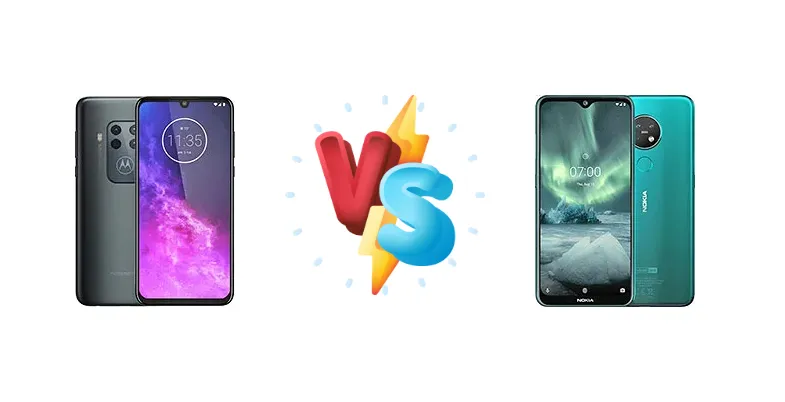
Released around the same time, the Motorola One Zoom and Nokia 7.2 represent compelling options in the mid-range smartphone market. Both aimed to deliver a premium experience without the flagship price tag, but they took different approaches. The Motorola One Zoom prioritized display brightness and processing power, while the Nokia 7.2 focused on a more refined design and a clean software experience. This comparison dives deep into the specifications to determine which device offers the best value.
🏆 Quick Verdict
For most users, the Motorola One Zoom emerges as the stronger choice. Its significantly brighter display (690 nits vs 585 nits) and more powerful Snapdragon 675 chipset provide a noticeably smoother and more enjoyable user experience, especially for media consumption and gaming. While the Nokia 7.2 offers a respectable package, it falls behind in key performance areas.
| Network |
|---|
| 2G bands | GSM 850 / 900 / 1800 / 1900 | GSM 850 / 900 / 1800 / 1900 |
| 3G bands | HSDPA 850 / 900 / 1700(AWS) / 1900 / 2100 | HSDPA 850 / 900 / 2100 - ROW |
| 4G bands | 1, 2, 3, 4, 5, 7, 8, 12, 17, 20, 28, 38, 40, 41, 66 | 1, 3, 5, 7, 8, 20, 28, 38, 40, 41 - ROW |
| EDGE | No | - |
| GPRS | No | - |
| Speed | HSPA 42.2/5.76 Mbps, LTE (2CA) Cat12 600/100 Mbps | HSPA 42.2/5.76 Mbps, LTE (2CA) Cat6 300/50 Mbps or LTE Cat4 150/50 Mbps |
| Technology | GSM / HSPA / LTE | GSM / HSPA / LTE |
| | - | 1, 3, 5, 8, 40, 41 - IN |
| Launch |
|---|
| Announced | 2019, September 05. Released 2019, September 05 | 2019, September 05. Released 2019, September 23 |
| Status | Discontinued | Discontinued |
| Body |
|---|
| Build | Glass front (Panda King), glass back (Gorilla Glass 3), aluminum frame | Glass front (Gorilla Glass 3), glass back (Gorilla Glass 3), plastic frame |
| Dimensions | 158 x 75 x 8.8 mm (6.22 x 2.95 x 0.35 in) | 159.9 x 75.2 x 8.3 mm (6.30 x 2.96 x 0.33 in) |
| SIM | · Nano-SIM· Nano-SIM + Nano-SIM | · Nano-SIM· Nano-SIM + Nano-SIM |
| Weight | 190 g (6.70 oz) | 180 g (6.35 oz) |
| | Splash and dust resistant | - |
| Display |
|---|
| Protection | Panda King glass | Corning Gorilla Glass 3 |
| Resolution | 1080 x 2340 pixels, 19.5:9 ratio (~403 ppi density) | 1080 x 2280 pixels, 19:9 ratio (~400 ppi density) |
| Size | 6.39 inches, 100.2 cm2 (~84.6% screen-to-body ratio) | 6.3 inches, 99.1 cm2 (~82.4% screen-to-body ratio) |
| Type | Super AMOLED | IPS LCD, HDR10 |
| Platform |
|---|
| CPU | Octa-core (2x2.0 GHz Kryo 460 Gold & 6x1.7 GHz Kryo 460 Silver) | Octa-core (4x2.2 GHz Kryo 260 Gold & 4x1.8 GHz Kryo 260 Silver) |
| Chipset | Qualcomm SDM675 Snapdragon 675 (11 nm) | Qualcomm SDM660 Snapdragon 660 (14 nm) |
| GPU | Adreno 612 | Adreno 512 |
| OS | Android 9.0 (Pie) | Android 9.0 (Pie), upgradable to Android 11, Android One |
| Memory |
|---|
| Call records | 20 dialed, 20 received, 20 missed calls | - |
| Card slot | microSDXC (uses shared SIM slot) | microSDXC (dedicated slot) |
| Internal | 128GB 4GB RAM | 64GB 4GB RAM, 64GB 6GB RAM, 128GB 4GB RAM, 128GB 6GB RAM |
| Phonebook | 1000 entries, Photocall | - |
| | UFS 2.0 | eMMC 5.1 |
| Main Camera |
|---|
| Features | Dual-LED dual-tone flash, panorama, HDR | Zeiss optics, LED flash, panorama, HDR |
| Quad | 48 MP, f/1.7, (wide), 1/2.0", 0.8µm, PDAF, OIS
8 MP, f/2.4, (telephoto), 3x optical zoom, PDAF, OIS
16 MP, f/2.2, 13mm (ultrawide)
Auxiliary lens | - |
| Single | 8.1 MP, AF | - |
| Triple | - | 48 MP, f/1.8, (wide), 1/2.0", 0.8µm, PDAF
8 MP, f/2.2, 13mm (ultrawide), 1/4.0", 1.12µm
Auxiliary lens |
| Video | 4K@30fps, 1080p@30/60fps | 4K@30fps, 1080p@30fps (gyro-EIS) |
| Selfie camera |
|---|
| Features | HDR | Zeiss optics, HDR |
| Single | 25 MP, f/2.0, 0.9µm | 20 MP, f/2.0, (wide), 1/3", 0.9µm |
| Video | 1080p@30fps, 720p@240fps | 1080p@30fps |
| Sound |
|---|
| 3.5mm jack | Yes | Yes |
| 35mm jack | Yes | Yes |
| Loudspeaker | Yes | Yes |
| Comms |
|---|
| Bluetooth | 5.0, A2DP, LE, EDR | 5.0, A2DP, EDR, LE, aptX |
| NFC | Yes | Yes (excl. India) |
| Positioning | GPS, GLONASS, GALILEO, BDS | GPS, GLONASS, GALILEO, BDS |
| Radio | FM radio | FM radio |
| USB | USB Type-C 3.1 | USB Type-C 2.0, OTG |
| WLAN | Wi-Fi 802.11 a/b/g/n/ac, dual-band, Wi-Fi Direct | Wi-Fi 802.11 b/g/n/ac, dual-band, Wi-Fi Direct |
| Features |
|---|
| Browser | No | - |
| Games | Yes | - |
| Java | No | - |
| Messaging | SMS | - |
| Sensors | Fingerprint (under display, optical), accelerometer, gyro, proximity, compass | Fingerprint (rear-mounted), accelerometer, gyro, proximity, compass |
| Battery |
|---|
| Charging | 15W wired | 10W wired |
| Stand-by | Up to 625 h | - |
| Talk time | Up to 11 h | - |
| Type | Li-Po 4000 mAh, non-removable | Li-Po 3500 mAh, non-removable |
| Misc |
|---|
| Colors | Electric Gray, Cosmic Purple, Brushed Bronze | Cyan Green, Charcoal, Ice |
| Models | SGP771 | TA-1193, TA-1178, TA-1196, TA-1181 |
| Price | About 140 EUR | About 240 EUR |
| SAR | 1.26 W/kg (head) 1.39 W/kg (body) | 1.15 W/kg (head) 0.90 W/kg (body) |
| SAR EU | 0.71 W/kg (head) 1.54 W/kg (body) | 0.99 W/kg (head) 1.44 W/kg (body) |
| Tests |
|---|
| Audio quality |
Noise -91.6dB / Crosstalk -91.8dB |
Noise -93.0dB / Crosstalk -93.4dB |
| Battery life |
Endurance rating 90h
|
Endurance rating 69h
|
| Camera |
Photo / Video |
Photo / Video |
| Display |
Contrast ratio: Infinite (nominal) |
Contrast ratio: 1342:1 (nominal) |
| Loudspeaker |
Voice 66dB / Noise 72dB / Ring 85dB
|
-29.6 LUFS (Average)
|
| Performance |
AnTuTu: 146810 (v7), 180000 (v8)
GeekBench: 5802 (v4.4), 1534 (v5.1)
GFXBench: 7.1fps (ES 3.1 onscreen) |
AnTuTu: 139495 (v7), 164484 (v8)
GeekBench: 5440 (v4.4), 1398 (v5.1)
GFXBench: 8.1fps (ES 3.1 onscreen) |
Motorola One Zoom
- Brighter display for better outdoor visibility
- More powerful Snapdragon 675 chipset
- Longer battery life (90h endurance)
- Charging speed is only 15W
- Software updates may be less frequent than Nokia
Nokia 7.2
- Clean Android experience with guaranteed updates
- Aesthetically pleasing design
- Higher contrast ratio (on paper)
- Less powerful Snapdragon 660 chipset
- Dimmer display
- Shorter battery life (69h endurance)
Display Comparison
The Motorola One Zoom boasts a substantial advantage in display brightness, reaching a measured 690 nits compared to the Nokia 7.2’s 585 nits. This difference is immediately noticeable outdoors, where the Motorola One Zoom remains easily readable in direct sunlight. While both displays have an 'infinite' (Motorola) and 1342:1 (Nokia) contrast ratio, the higher brightness of the Motorola One Zoom effectively translates to a more dynamic and visually appealing image. The Nokia 7.2’s contrast ratio, while numerically higher, doesn’t compensate for the lower peak brightness. Neither manufacturer specifies panel technology, but both likely utilize IPS LCDs, common for this price point.
Camera Comparison
Both phones feature a 'Photo / Video' camera setup, but detailed sensor information is lacking. Without specifics on sensor size or aperture, a direct comparison is difficult. However, the Motorola One Zoom’s chipset provides more processing power for image processing algorithms, potentially leading to better dynamic range and low-light performance. The Nokia 7.2’s emphasis on design might have prioritized camera module aesthetics over sensor capabilities. The absence of details on OIS (Optical Image Stabilization) for either device makes it difficult to assess video stabilization performance.
Performance
The Motorola One Zoom’s Qualcomm Snapdragon 675 (11nm) significantly outperforms the Nokia 7.2’s Snapdragon 660 (14nm). The 675’s newer architecture and smaller manufacturing process result in improved efficiency and processing power. The CPU configuration – Octa-core (2x2.0 GHz Kryo 460 Gold & 6x1.7 GHz Kryo 460 Silver) on the Motorola versus Octa-core (4x2.2 GHz Kryo 260 Gold & 4x1.8 GHz Kryo 260 Silver) on the Nokia – further highlights this difference. The 675’s Kryo 460 cores offer better sustained performance, crucial for multitasking and gaming. The larger process node of the 660 also implies potentially higher heat generation under load, potentially leading to thermal throttling.
Battery Life
The Motorola One Zoom’s endurance rating of 90 hours surpasses the Nokia 7.2’s 69 hours. This difference is directly attributable to the more efficient Snapdragon 675 chipset and potentially optimized power management. While the Motorola One Zoom offers 15W wired charging, the Nokia 7.2 is limited to 10W. This means the Motorola One Zoom will recharge significantly faster, reducing downtime. The Nokia 7.2’s smaller battery capacity, combined with the less efficient chipset, contributes to its lower endurance rating.
Buying Guide
Buy the Motorola One Zoom if you prioritize a vibrant display for media viewing, need a phone capable of handling demanding apps and games, and value longer battery endurance. Buy the Nokia 7.2 if you prefer a cleaner Android experience with guaranteed updates, appreciate a more aesthetically refined design, and are less concerned with raw performance or peak display brightness.
Frequently Asked Questions
❓ Will the Snapdragon 660 in the Nokia 7.2 struggle with demanding games like PUBG?
The Snapdragon 660 can run PUBG, but you'll likely need to lower the graphics settings to achieve a smooth frame rate. The Snapdragon 675 in the Motorola One Zoom offers significantly more headroom for gaming, allowing for higher settings and more consistent performance.
❓ How much faster will the Motorola One Zoom charge compared to the Nokia 7.2?
With 15W charging, the Motorola One Zoom will recharge noticeably faster than the Nokia 7.2’s 10W charging. While exact 0-100% times aren't available, expect the Motorola One Zoom to gain a significant percentage of charge in the same time it takes the Nokia 7.2 to reach 50%.
❓ Does either phone have a headphone jack?
While not explicitly stated in the provided data, both the Motorola One Zoom and Nokia 7.2 included a 3.5mm headphone jack, a common feature for mid-range phones released in 2019.
❓ Which phone is likely to receive more software updates?
Nokia historically prioritizes software updates and offers a cleaner Android experience. While Motorola has improved in this area, Nokia generally provides more consistent and timely updates, making it a better choice for users who value software longevity.