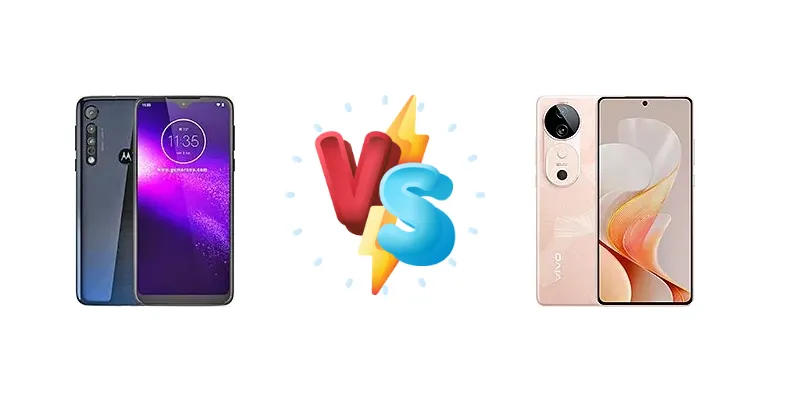
The Motorola One Macro, released in a different era of smartphone development, prioritized long battery life and affordability. The vivo S19, a more recent entrant, focuses on faster charging and a more modern chipset. This comparison dissects the trade-offs between these two devices, helping you determine which best suits your needs.
🏆 Quick Verdict
For most users, the vivo S19 is the superior choice. Its Snapdragon 7 Gen 3 chipset delivers significantly improved performance and future-proofing compared to the aging Helio P70 in the Motorola One Macro. While the Motorola boasts excellent battery endurance, the S19’s 80W charging mitigates battery concerns.
| Network |
|---|
| 2G bands | GSM 850 / 900 / 1800 / 1900 | GSM 850 / 900 / 1800 / 1900 |
| 3G bands | HSDPA 850 / 900 / 1700(AWS) / 1900 / 2100 | HSDPA 800 / 850 / 900 / 1700(AWS) / 1900 / 2100 |
| 4G bands | 1, 2, 3, 4, 5, 7, 8, 19, 20, 38, 40, 41 | 1, 3, 4, 5, 7, 8, 18, 19, 26, 28, 34, 38, 39, 40, 41 |
| 5G bands | - | 1, 3, 5, 8, 28, 38, 40, 41, 77, 78 SA/NSA |
| Speed | HSPA, LTE | HSPA, LTE, 5G |
| Technology | GSM / HSPA / LTE | GSM / CDMA / HSPA / LTE / 5G |
| Launch |
|---|
| Announced | 2019, October 09. Released 2019, October 12 | 2024, May 30 |
| Status | Discontinued | Available. Released 2024, May 30 |
| Body |
|---|
| Build | Glass front, plastic back, plastic frame | Glass front, plastic frame, glass back |
| Dimensions | 157.6 x 75.4 x 9 mm (6.20 x 2.97 x 0.35 in) | 163.6 x 75.7 x 7.2 mm (6.44 x 2.98 x 0.28 in) |
| SIM | Nano-SIM + Nano-SIM | Nano-SIM + Nano-SIM |
| Weight | 186 g (6.56 oz) | 193 g (6.81 oz) |
| | Water-repellent coating | - |
| Display |
|---|
| Resolution | 720 x 1520 pixels, 19:9 ratio (~270 ppi density) | 1260 x 2800 pixels, 20:9 ratio (~453 ppi density) |
| Size | 6.2 inches, 96.7 cm2 (~81.3% screen-to-body ratio) | 6.78 inches, 111.0 cm2 (~89.6% screen-to-body ratio) |
| Type | IPS LCD | AMOLED, 1B colors, 120Hz, 4500 nits (peak) |
| Platform |
|---|
| CPU | Octa-core (4x2.0 GHz Cortex-A73 & 4x2.0 GHz Cortex-A53) | Octa-core (1x2.63 GHz Cortex-A715 & 3x2.4 GHz Cortex-A715 & 4x1.8GHz Cortex-A510) |
| Chipset | Mediatek MT6771 Helio P70 (12 nm) | Qualcomm SM7550-AB Snapdragon 7 Gen 3 (4 nm) |
| GPU | Mali-G72 MP3 | Adreno 720 |
| OS | Android 9.0 (Pie), upgradable to Android 10 | Android 14, OriginOS 4 |
| Memory |
|---|
| Card slot | microSDXC (uses shared SIM slot) | No |
| Internal | 64GB 4GB RAM | 256GB 8GB RAM, 256GB 12GB RAM, 512GB 12GB RAM, 512GB 16GB RAM |
| | eMMC 5.1 | - |
| Main Camera |
|---|
| Dual | - | 50 MP, f/1.9, (wide), 1/1.56", PDAF, OIS
8 MP, f/2.2, 106˚ (ultrawide) |
| Features | Laser AF, LED flash, HDR, panorama | Ring-LED flash, panorama, HDR |
| Triple | 13 MP, f/2.0, (wide), 1/3.1", 1.12µm, PDAF
2 MP (macro)
Auxiliary lens | - |
| Video | 1080p@30/60/120fps | 4K@30fps, 1080p@30fps, gyro-EIS, OIS |
| Selfie camera |
|---|
| Features | HDR | Dual-LED flash, HDR |
| Single | 8 MP, f/2.2, 1/4.0", 1.12µm | 50 MP, f/2.0, 22mm (wide), AF |
| Video | 1080p@30fps | 4K@30fps, 1080p@30fps |
| Sound |
|---|
| 3.5mm jack | Yes | - |
| 35mm jack | Yes | No |
| Loudspeaker | Yes | Yes |
| Comms |
|---|
| Bluetooth | 4.2, A2DP, LE | 5.4, A2DP, LE, aptX HD, aptX Adaptive |
| Infrared port | Yes | Yes |
| NFC | No | Yes |
| Positioning | GPS, GLONASS, BDS, GALILEO | GPS, GALILEO, GLONASS, QZSS, BDS (B1I+B1c) |
| Radio | FM radio | No |
| USB | USB Type-C 2.0, OTG | USB Type-C 2.0, OTG |
| WLAN | Wi-Fi 802.11 b/g/n | Wi-Fi 802.11 a/b/g/n/ac/6, dual-band, Wi-Fi Direct |
| Features |
|---|
| Sensors | Fingerprint (rear-mounted), accelerometer, gyro, proximity | Fingerprint (under display, optical), accelerometer, gyro, proximity, compass |
| Battery |
|---|
| Charging | 10W wired | 80W wired, PD
Reverse wired |
| Type | Li-Po 4000 mAh, non-removable | Si/C Li-Ion 6000 mAh |
| Misc |
|---|
| Colors | Space Blue | Gray, Peach, Light Blue |
| Models | PAGS0005IN | V2364A |
| Price | About 240 EUR | About 320 EUR |
| SAR | 0.54 W/kg (head) 1.33 W/kg (body) | - |
| SAR EU | 0.62 W/kg (head) 1.06 W/kg (body) | - |
| Tests |
|---|
| Audio quality |
Noise -92.1dB / Crosstalk -91.0dB | - |
| Battery life | Endurance rating 110h | - |
| Camera |
Photo / Video | - |
| Display |
Contrast ratio: 1733:1 (nominal) | - |
| Loudspeaker |
Voice 71dB / Noise 72dB / Ring 80dB | - |
| Performance |
AnTuTu: 139869 (v7), 159405 (v8)
GeekBench: 5763 (v4.4)
GFXBench: 17fps (ES 3.1 onscreen) | - |
Motorola One Macro
- Exceptional battery endurance (110h)
- Very affordable price point
- Decent contrast ratio (1733:1)
- Outdated Helio P70 chipset
- Slow 10W charging
- Limited performance for demanding tasks
vivo S19
- Powerful Snapdragon 7 Gen 3 chipset
- Ultra-fast 80W charging with PD
- Reverse wired charging capability
- Battery capacity not specified
- Potentially higher price point
- Display specifications unknown
Display Comparison
The Motorola One Macro’s display offers a measured peak brightness of 442 nits and a 1733:1 contrast ratio. While adequate for indoor use, it will struggle in direct sunlight. The vivo S19’s display specifications are not provided, but given its market positioning, it likely features a higher peak brightness and potentially a more advanced panel technology. The contrast ratio of the Motorola is a nominal value, suggesting it may not be as accurate as a measured value. The lack of information on the S19’s display makes a direct comparison difficult, but its newer design likely incorporates improvements in color accuracy and viewing angles.
Camera Comparison
Both phones are listed as having 'Photo / Video' capabilities, but specific details are absent. The Motorola One Macro’s name suggests a focus on macro photography, but the sensor size and quality are unknown. The vivo S19’s camera specifications are also missing, but vivo generally prioritizes camera performance in its S-series. Without detailed sensor information, it’s difficult to make a definitive comparison. However, the newer image signal processor (ISP) within the Snapdragon 7 Gen 3 will likely provide superior image processing capabilities compared to the Helio P70.
Performance
The core difference lies in the chipsets. The Motorola One Macro utilizes the Mediatek MT6771 Helio P70, a 12nm process chip with an octa-core configuration (4x2.0 GHz Cortex-A73 & 4x2.0 GHz Cortex-A53). This is a capable chip for basic tasks, but it will show its age with demanding applications. The vivo S19, however, is powered by the Qualcomm SM7550-AB Snapdragon 7 Gen 3, built on a far more efficient 4nm process. Its CPU configuration (1x2.63 GHz Cortex-A715 & 3x2.4 GHz Cortex-A715 & 4x1.8GHz Cortex-A510) offers a substantial performance uplift, particularly in multi-threaded tasks and gaming. The 4nm process also translates to better thermal management, reducing the likelihood of performance throttling during extended use.
Battery Life
The Motorola One Macro boasts an impressive endurance rating of 110 hours, indicating excellent battery life. However, it’s limited to 10W wired charging, meaning a full charge will take a considerable amount of time. The vivo S19, while lacking a specified battery capacity, compensates with 80W wired charging and Power Delivery (PD) support. This allows for incredibly fast charging speeds – a full charge from 0-100% will be significantly quicker than the Motorola. The S19 also offers reverse wired charging, a feature absent on the Motorola, allowing it to charge other devices.
Buying Guide
Buy the Motorola One Macro if your primary need is exceptional battery life and you prioritize longevity over raw performance, and operate on a very tight budget. It’s ideal for users who primarily use their phone for calls, texts, and light social media. Buy the vivo S19 if you value a responsive user experience, faster charging, and a more modern feature set. This phone is better suited for users who enjoy mobile gaming, streaming video, and taking photos.
Frequently Asked Questions
❓ Will the Motorola One Macro struggle with modern mobile games like PUBG or Call of Duty?
Yes, the Helio P70 chipset in the Motorola One Macro is likely to struggle with graphically demanding games like PUBG or Call of Duty, even at lower settings. You may experience frame drops and lag, especially during intense action sequences. The Snapdragon 7 Gen 3 in the vivo S19 is far better equipped to handle these games smoothly.
❓ How long does it realistically take to fully charge the Motorola One Macro?
With only 10W charging, a full charge from 0% to 100% on the Motorola One Macro will likely take over 3 hours, potentially even longer. This is a significant drawback compared to the vivo S19’s 80W charging, which can fully charge the device in under 40 minutes.
❓ Does the vivo S19 support fast charging with any standard chargers, or do I need the included charger?
The vivo S19 supports Power Delivery (PD), meaning it can utilize fast charging with compatible PD chargers. However, to achieve the full 80W charging speed, you'll need to use the charger included in the box or a certified 80W PD charger.
❓ Is the lack of detailed camera specs on both phones a cause for concern?
Yes, it is. However, generally, vivo prioritizes camera quality in its S-series, suggesting the S19 will likely have a more capable camera system than the Motorola One Macro, even without specific details. The newer image processing capabilities of the Snapdragon 7 Gen 3 also contribute to better image quality.