
Motorola One Hyper vs OnePlus 7T Pro 5G McLaren: A Detailed Performance and Value Comparison
| Phones Images | |||||
|---|---|---|---|---|---|
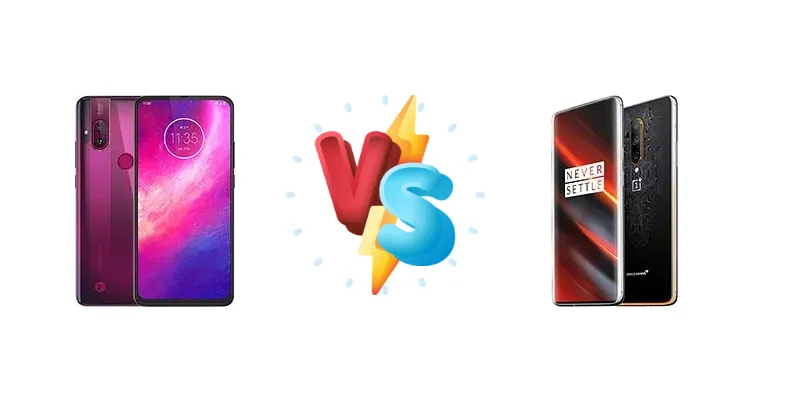
|
🏆 Quick Verdict
For the average user prioritizing raw performance and 5G connectivity, the OnePlus 7T Pro 5G McLaren is the clear winner. However, the Motorola One Hyper offers a compelling value proposition for those on a tighter budget who don't require the absolute fastest processing speeds or the latest cellular technology.
| PHONES | ||
|---|---|---|
| Phone Names | Motorola One Hyper | OnePlus 7T Pro 5G McLaren |
| Network | ||
|---|---|---|
| 2G bands | GSM 850 / 900 / 1800 / 1900 | GSM 850 / 900 / 1800 / 1900 |
| 3G bands | HSDPA 850 / 900 / 1900 / 2100 | HSDPA 850 / 900 / 1700(AWS) / 1900 / 2100 |
| 4G bands | 1, 2, 3, 4, 5, 7, 8, 12, 17, 28, 66 - USA | 1, 2, 3, 4, 5, 1, 2, 3, 4, 5, 7, 8, 12, 13, 17, 18, 19, 20, 25, 26, 28, 29, 30, 34, 38, 39, 40, 41, 46, 48, 66, 71 |
| 5G bands | - | 71 SA |
| Speed | HSPA, LTE | HSPA 42.2/5.76 Mbps, LTE (5CA) Cat18 1200/150 Mbps, 5G (2+ Gbps DL) |
| Technology | GSM / CDMA / HSPA / EVDO / LTE | GSM / CDMA / HSPA / LTE / 5G |
| CDMA2000 1xEV-DO | CDMA 800 / 1900 & TD-SCDMA | |
| Launch | ||
|---|---|---|
| Announced | 2019, December 04. Released 2020, January 22 | 2019, October 23. Released 2019, November 05 |
| Status | Discontinued | Discontinued |
| Body | ||
|---|---|---|
| Build | Glass front, plastic back, plastic frame | Glass front (Gorilla Glass 6), glass back (Gorilla Glass 5), aluminum frame |
| Dimensions | 161.8 x 76.6 x 8.9 mm (6.37 x 3.02 x 0.35 in) | 162.6 x 75.9 x 8.8 mm (6.40 x 2.99 x 0.35 in) |
| SIM | · Nano-SIM· Nano-SIM + Nano-SIM | Nano-SIM + Nano-SIM |
| Weight | 210 g (7.41 oz) | 206 g (7.27 oz) |
| Display | ||
|---|---|---|
| Protection | - | Corning Gorilla Glass 6 |
| Resolution | 1080 x 2340 pixels, 19.5:9 ratio (~396 ppi density) | 1440 x 3120 pixels, 19.5:9 ratio (~516 ppi density) |
| Size | 6.5 inches, 103.7 cm2 (~83.7% screen-to-body ratio) | 6.67 inches, 108.8 cm2 (~88.1% screen-to-body ratio) |
| Type | IPS LCD | Fluid AMOLED, 90Hz, HDR10+ |
| Platform | ||
|---|---|---|
| CPU | Octa-core (2x2.0 GHz Kryo 460 Gold & 6x1.7 GHz Kryo 460 Silver) | Octa-core (1x2.96 GHz Kryo 485 & 3x2.42 GHz Kryo 485 & 4x1.78 GHz Kryo 485) |
| Chipset | Qualcomm SDM675 Snapdragon 675 (11 nm) | Qualcomm SM8150 Snapdragon 855+ (7 nm) |
| GPU | Adreno 612 | Adreno 640 (700 MHz) |
| OS | Android 10, upgradable to Android 11 | Android 10, OxygenOS 10.0 |
| Memory | ||
|---|---|---|
| Card slot | microSDXC (uses shared SIM slot) | No |
| Internal | 128GB 4GB RAM | 256GB 12GB RAM |
| UFS 2.0 | UFS 3.0 | |
| Main Camera | ||
|---|---|---|
| Dual | 64 MP, f/1.8, (wide), 1/1.72", 0.8µm, PDAF 8 MP, f/2.2, 13mm (ultrawide), 1/4.0", 1.12µm | - |
| Features | Laser AF, LED flash, HDR, panorama | Laser AF, Dual-LED flash, HDR, panorama |
| Triple | - | 48 MP, f/1.6, (wide), 1/2.0", 0.8µm, PDAF, OIS 8 MP, f/2.4, (telephoto), 1.0µm, PDAF, OIS, 3x optical zoom 16 MP, f/2.2, 13mm (ultrawide), AF |
| Video | 4K@30fps, 1080p@30/60fps | 4K@30/60fps, 1080p@30/60/240fps, 720p@960fps, Auto HDR, gyro-EIS |
| Selfie camera | ||
|---|---|---|
| Features | HDR | HDR |
| Single | Motorized pop-up 32 MP, f/2.0, 26mm (wide), 0.8µm | Motorized pop-up 16 MP, f/2.0, 25mm (wide), 1/3.06", 1.0µm |
| Video | 1080p@30/60fps | 1080p@30fps, gyro-EIS |
| Sound | ||
|---|---|---|
| 3.5mm jack | Yes | No |
| 35mm jack | Yes | No |
| Loudspeaker | Yes | Yes, with stereo speakers |
| Comms | ||
|---|---|---|
| Bluetooth | 5.0, A2DP, LE, EDR | 5.1, A2DP, LE, aptX HD |
| NFC | Yes | Yes |
| Positioning | GPS, GLONASS, GALILEO, BDS | GPS (L1+L5), GLONASS (G1), BDS (B1), GALILEO (E1+E5a) |
| Radio | Yes | No |
| USB | USB Type-C 2.0 | USB Type-C 3.1, OTG |
| WLAN | Wi-Fi 802.11 a/b/g/n/ac, dual-band, Wi-Fi Direct | Wi-Fi 802.11 a/b/g/n/ac, dual-band, Wi-Fi Direct, DLNA |
| Features | ||
|---|---|---|
| Sensors | Fingerprint (rear-mounted), accelerometer, gyro, proximity, compass | Fingerprint (under display, optical), accelerometer, gyro, compass |
| - | Virtual proximity sensing | |
| Battery | ||
|---|---|---|
| Charging | 27W wired (Europe) 45W wired (USA) | 30W wired |
| Type | Li-Po 4000 mAh, non-removable | Li-Po 4085 mAh, non-removable |
| Misc | ||
|---|---|---|
| Colors | Fresh Orchid, Deepsea Blue, Dark Amber | Papaya Orange |
| Models | XT2027, XT2027-1 | HD1925 |
| Price | About 540 EUR | About 800 EUR |
| SAR | 1.01 W/kg (head) 1.40 W/kg (body) | - |
| SAR EU | 0.59 W/kg (head) 0.88 W/kg (body) | - |
Motorola One Hyper
- More affordable price point
- Potentially faster charging (45W in USA)
- Good value for everyday use
- Significantly slower processor
- Less capable camera system
- Limited 5G support
OnePlus 7T Pro 5G McLaren
- Flagship-level performance with Snapdragon 855+
- 5G connectivity for faster data speeds
- Superior camera capabilities
- Higher price tag
- Potentially more prone to thermal throttling under extreme load
- Slightly slower charging than Motorola One Hyper (US version)
Display Comparison
While both devices likely feature AMOLED panels (based on brand history), the specifics are not provided. The key difference lies in the processing power driving them. The OnePlus 7T Pro 5G McLaren, being a flagship, likely boasts a higher peak brightness and potentially a higher refresh rate (90Hz was standard for the 7T Pro line) for smoother visuals. The Motorola One Hyper, targeting a lower price bracket, likely prioritizes cost-effectiveness over display extravagance. The impact is a more vibrant and responsive visual experience on the OnePlus.
Camera Comparison
Without specific sensor details, a direct camera comparison is limited. However, the OnePlus 7T Pro 5G McLaren, as a flagship, likely incorporates a larger main sensor with optical image stabilization (OIS) for improved low-light performance and sharper images. The Motorola One Hyper, while potentially offering a respectable camera for its price range, likely relies on software processing to compensate for a smaller sensor and lack of OIS. The 855+’s image signal processor (ISP) in the OnePlus also provides superior image processing capabilities, resulting in more detailed and dynamic photos. The 2MP macro lenses often found in this price range on both devices are generally of limited practical use.
Performance
The performance gap is substantial. The OnePlus 7T Pro 5G McLaren’s Snapdragon 855+ (7nm) is a significant leap over the Motorola One Hyper’s Snapdragon 675 (11nm). The 855+ features a Kryo 485 core clocked at 2.96 GHz, compared to the 675’s 2.0 GHz Kryo 460 Gold core. This translates to significantly faster app loading times, smoother multitasking, and a far superior gaming experience on the OnePlus. The 7nm process node of the 855+ also contributes to better thermal efficiency, reducing the likelihood of performance throttling during sustained workloads. Users who frequently edit videos, play graphically intensive games, or run demanding applications will overwhelmingly benefit from the OnePlus.
Battery Life
The Motorola One Hyper supports 27W (Europe) or 45W (USA) wired charging, while the OnePlus 7T Pro 5G McLaren offers 30W Warp Charge. While the Motorola One Hyper’s US variant has a higher wattage, OnePlus’s Warp Charge technology is known for its efficiency and speed. The actual 0-100% charging time will depend on battery capacity (not provided), but the OnePlus is likely to achieve a full charge slightly faster due to its optimized charging system. The Snapdragon 855+ is also more power-efficient than the 675, potentially offsetting a smaller battery capacity on the OnePlus.
Buying Guide
Buy the Motorola One Hyper if you need a reliable daily driver with decent performance for everyday tasks, prioritize value for money, and don't heavily rely on demanding mobile games or 5G connectivity. Buy the OnePlus 7T Pro 5G McLaren if you prefer a flagship-level experience with significantly faster processing speeds, benefit from 5G network access, and are willing to pay a premium for top-tier performance and responsiveness.