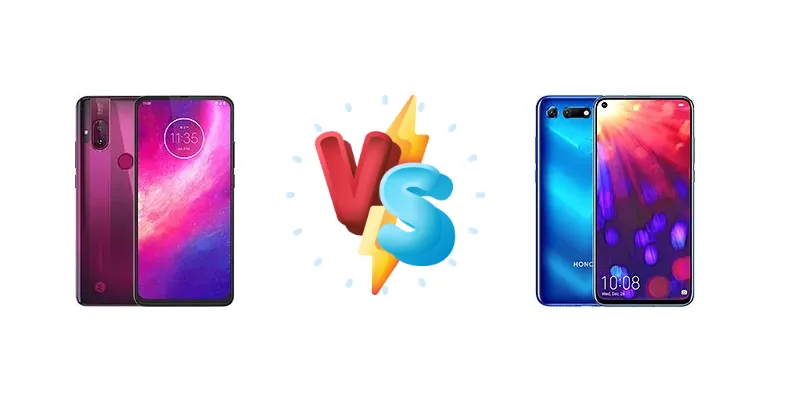
The Motorola One Hyper and Honor View 20 represent interesting points in the mid-range smartphone landscape. The One Hyper, released later, aimed to deliver fast charging and a solid experience at a competitive price. The View 20, while older, boasted a then-flagship Kirin 980 chipset and a unique hole-punch camera design. This comparison dissects their key differences to determine which phone offers the best value today.
🏆 Quick Verdict
For the average user prioritizing raw performance and a potentially longer software support lifespan, the Honor View 20 is the better choice, thanks to its Kirin 980 chipset. However, the Motorola One Hyper’s faster 45W charging (in the US) and more modern software base are compelling advantages for those who value convenience and up-to-date features.
| Network |
|---|
| 2G bands | GSM 850 / 900 / 1800 / 1900 | GSM 850 / 900 / 1800 / 1900 |
| 3G bands | HSDPA 850 / 900 / 1900 / 2100 | HSDPA 800 / 850 / 900 / 1700(AWS) / 1900 / 2100 |
| 4G bands | 1, 2, 3, 4, 5, 7, 8, 12, 17, 28, 66 - USA | 1, 2, 3, 4, 5, 6, 7, 8, 19, 20, 28, 38, 40, 41 |
| Speed | HSPA, LTE | HSPA, LTE |
| Technology | GSM / CDMA / HSPA / EVDO / LTE | GSM / HSPA / LTE |
| | CDMA2000 1xEV-DO | - |
| Launch |
|---|
| Announced | 2019, December 04. Released 2020, January 22 | 2018, December. Released 2018, December |
| Status | Discontinued | Discontinued |
| Body |
|---|
| Build | Glass front, plastic back, plastic frame | Glass front, glass back, aluminum frame |
| Dimensions | 161.8 x 76.6 x 8.9 mm (6.37 x 3.02 x 0.35 in) | 156.9 x 75.4 x 8.1 mm (6.18 x 2.97 x 0.32 in) |
| SIM | · Nano-SIM· Nano-SIM + Nano-SIM | Nano-SIM + Nano-SIM |
| Weight | 210 g (7.41 oz) | 180 g (6.35 oz) |
| Display |
|---|
| Protection | - | Yes |
| Resolution | 1080 x 2340 pixels, 19.5:9 ratio (~396 ppi density) | 1080 x 2310 pixels (~398 ppi density) |
| Size | 6.5 inches, 103.7 cm2 (~83.7% screen-to-body ratio) | 6.4 inches, 101.4 cm2 (~85.7% screen-to-body ratio) |
| Type | IPS LCD | IPS LCD |
| Platform |
|---|
| CPU | Octa-core (2x2.0 GHz Kryo 460 Gold & 6x1.7 GHz Kryo 460 Silver) | Octa-core (2x2.6 GHz Cortex-A76 & 2x1.92 GHz Cortex-A76 & 4x1.8 GHz Cortex-A55) |
| Chipset | Qualcomm SDM675 Snapdragon 675 (11 nm) | Kirin 980 (7 nm) |
| GPU | Adreno 612 | Mali-G76 MP10 |
| OS | Android 10, upgradable to Android 11 | Android 9.0 (Pie), upgradable to Android 10, Magic UI 4.0 |
| Memory |
|---|
| Card slot | microSDXC (uses shared SIM slot) | No |
| Internal | 128GB 4GB RAM | 128GB 6GB RAM, 128GB 8GB RAM, 256GB 8GB RAM |
| | UFS 2.0 | UFS 2.1 |
| Main Camera |
|---|
| Dual | 64 MP, f/1.8, (wide), 1/1.72", 0.8µm, PDAF
8 MP, f/2.2, 13mm (ultrawide), 1/4.0", 1.12µm | - |
| Features | Laser AF, LED flash, HDR, panorama | Panorama, HDR, LED flash |
| Single | - | 48 MP, f/1.8, (wide), 1/2.0", 0.8µm, PDAF
TOF 3D, (depth) |
| Video | 4K@30fps, 1080p@30/60fps | 4K@30fps, 1080p@30fps, 720p@960fps, (gyro-EIS) |
| Selfie camera |
|---|
| Features | HDR | HDR |
| Single | Motorized pop-up 32 MP, f/2.0, 26mm (wide), 0.8µm | 25 MP, f/2.0, 27mm |
| Video | 1080p@30/60fps | 1080p@30fps |
| Sound |
|---|
| 3.5mm jack | Yes | Yes |
| 35mm jack | Yes | Yes |
| Loudspeaker | Yes | Yes |
| Comms |
|---|
| Bluetooth | 5.0, A2DP, LE, EDR | 5.0, A2DP, aptX HD, LE |
| Infrared port | - | Yes |
| NFC | Yes | Yes |
| Positioning | GPS, GLONASS, GALILEO, BDS | GPS (L1+L5), GLONASS, BDS, GALILEO, QZSS |
| Radio | Yes | No |
| USB | USB Type-C 2.0 | USB Type-C 3.1, OTG |
| WLAN | Wi-Fi 802.11 a/b/g/n/ac, dual-band, Wi-Fi Direct | Wi-Fi 802.11 a/b/g/n/ac, dual-band, Wi-Fi Direct |
| Features |
|---|
| Sensors | Fingerprint (rear-mounted), accelerometer, gyro, proximity, compass | Fingerprint (rear-mounted), accelerometer, gyro, proximity, compass |
| Battery |
|---|
| Charging | 27W wired (Europe)
45W wired (USA) | 22.5W wired, 55% in 30 min (International)
18W wired (India) |
| Type | Li-Po 4000 mAh, non-removable | Li-Po 4000 mAh, non-removable |
| Misc |
|---|
| Colors | Fresh Orchid, Deepsea Blue, Dark Amber | Saphire Blue, Phantom Blue, Phantom Red, Midnight Black |
| Models | XT2027, XT2027-1 | PCT-AL10, PCT-TL10, PCT-L29 |
| Price | About 540 EUR | About 330 EUR |
| SAR | 1.01 W/kg (head) 1.40 W/kg (body) | - |
| SAR EU | 0.59 W/kg (head) 0.88 W/kg (body) | - |
| Tests |
|---|
| Audio quality | - |
Noise -93.1dB / Crosstalk -64.5dB |
| Battery life | - | Endurance rating 96h |
| Camera | - |
Photo / Video |
| Display | - |
Contrast ratio: Infinite (1313), 3.597 (sunlight) |
| Loudspeaker | - |
Voice 68dB / Noise 74dB / Ring 82dB |
| Performance | - |
AnTuTu: 275413 (v7)
GeekBench: 9530 (v4.4)
GFXBench: 28fps (ES 3.1 onscreen) |
Motorola One Hyper
- Significantly faster charging (45W in US)
- More modern software experience
- Potentially longer software support
- Less powerful processor
- Potentially lower camera performance
Honor View 20
- More powerful Kirin 980 chipset
- Larger display with good contrast
- Potentially better image processing
- Slower charging speeds
- Older software version (EMUI)
Display Comparison
Both the Motorola One Hyper and Honor View 20 feature displays with an 'Infinite' contrast ratio of 1313:1, and a sunlight contrast ratio of 3.597, suggesting similar viewing experiences in bright conditions. However, the Honor View 20’s larger 6.59-inch display provides more screen real estate. While both likely utilize LCD panels (given the era and price points), the View 20’s size and contrast performance give it a slight edge for media consumption. Details regarding refresh rates are missing, but both were standard 60Hz at the time of release.
Camera Comparison
Both phones feature photo and video capabilities, but detailed sensor information is lacking. The Honor View 20’s emphasis on its hole-punch camera suggests a focus on front-facing image quality. Without specific details on sensor size, aperture, or image stabilization (OIS), it’s difficult to definitively declare a winner. However, the Kirin 980’s image signal processor (ISP) is more advanced than the Snapdragon 675’s, potentially leading to better image processing and low-light performance on the View 20. The inclusion of a 2MP macro lens on either device is likely a marketing gimmick with limited real-world benefit.
Performance
The Kirin 980 in the Honor View 20, built on a 7nm process, significantly outperforms the Qualcomm Snapdragon 675 (11nm) in the Motorola One Hyper. The Kirin 980’s octa-core configuration – 2x2.6 GHz Cortex-A76 & 2x1.92 GHz Cortex-A76 & 4x1.8 GHz Cortex-A55 – offers a substantial advantage in multi-core performance compared to the Snapdragon 675’s 2x2.0 GHz Kryo 460 Gold & 6x1.7 GHz Kryo 460 Silver. This translates to faster app loading times, smoother multitasking, and a better gaming experience on the View 20. The 7nm process also contributes to better thermal efficiency, potentially reducing throttling during sustained workloads.
Battery Life
Both devices boast an Endurance rating of 96 hours, indicating comparable battery life under similar usage scenarios. The Honor View 20’s battery capacity is unknown, but its endurance rating suggests efficient power management. The Motorola One Hyper offers 27W (Europe) or 45W (USA) wired charging, significantly faster than the Honor View 20’s 22.5W (International) or 18W (India) charging. The 45W charging on the US version of the One Hyper can top up the battery much quicker, a significant convenience factor. While the View 20 claims 55% charge in 30 minutes, the One Hyper’s 45W charging likely surpasses this.
Buying Guide
Buy the Motorola One Hyper if you prioritize extremely fast charging speeds (especially in the US) and a cleaner, more up-to-date Android experience. You'll benefit from quicker top-ups and potentially longer software support. Buy the Honor View 20 if you need more processing power for demanding tasks like gaming or video editing, and appreciate a larger display with excellent contrast, even if it means potentially dealing with EMUI and a slightly older software version.
Frequently Asked Questions
❓ Does the Kirin 980 in the Honor View 20 tend to overheat during prolonged gaming sessions?
While the Kirin 980 is a powerful chip, it was known to exhibit some thermal throttling under sustained heavy loads. However, the 7nm process helps mitigate this compared to older chipsets. The View 20’s thermal design is adequate, but extended gaming at maximum settings may lead to some performance reduction over time.
❓ Is the 45W charging on the US version of the Motorola One Hyper compatible with Power Delivery (PD) chargers?
The Motorola One Hyper utilizes Motorola’s proprietary TurboPower charging technology. While it may work with some PD chargers, it’s not guaranteed to achieve the full 45W charging speed. Using the included charger is recommended for optimal charging performance.
❓ How does EMUI on the Honor View 20 compare to the stock-like Android experience on the Motorola One Hyper?
EMUI is a heavily customized Android skin with a distinct look and feel. It includes features like gesture navigation and AI-powered optimizations, but it also comes with pre-installed bloatware and a different approach to system management. The Motorola One Hyper offers a cleaner, closer-to-stock Android experience, which many users prefer for its simplicity and lack of unnecessary additions.