
Motorola One Hyper vs. Google Pixel 4a 5G: A Detailed Comparison
| Phones Images | |||||
|---|---|---|---|---|---|
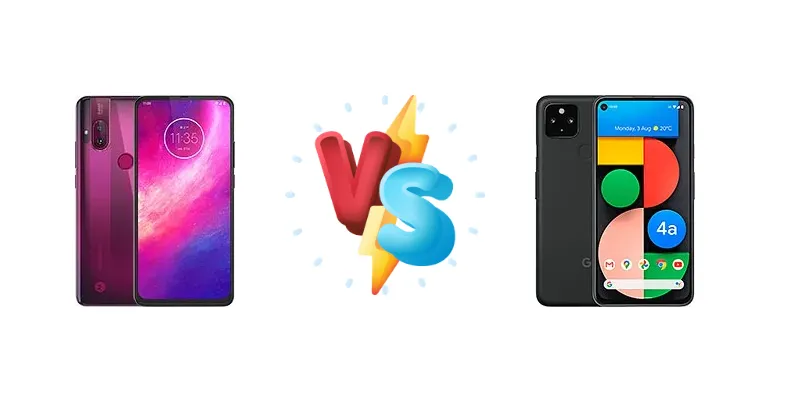
|
🏆 Quick Verdict
For most users, the Google Pixel 4a 5G is the superior choice. Its Snapdragon 765G chipset delivers noticeably better performance and 5G connectivity, coupled with Google’s excellent camera software. While the Motorola One Hyper boasts faster charging in the US, the Pixel’s overall experience is more refined.
| PHONES | ||
|---|---|---|
| Phone Names | Motorola One Hyper | Google Pixel 4a 5G |
| Network | ||
|---|---|---|
| 2G bands | GSM 850 / 900 / 1800 / 1900 | GSM 850 / 900 / 1800 / 1900 |
| 3G bands | HSDPA 850 / 900 / 1900 / 2100 | HSDPA 850 / 900 / 1700(AWS) / 1900 / 2100 |
| 4G bands | 1, 2, 3, 4, 5, 7, 8, 12, 17, 28, 66 - USA | 1, 2, 3, 4, 5, 7, 8, 12, 13, 14, 17, 18, 19, 20, 25, 26, 28, 29, 30, 32, 38, 39, 40, 41, 42, 46, 48, 66, 71 |
| 5G bands | - | 1, 2, 3, 5, 7, 8, 12, 28, 41, 66, 71, 77, 78 Sub6, mmWave (market dependant) |
| Speed | HSPA, LTE | HSPA, LTE, 5G |
| Technology | GSM / CDMA / HSPA / EVDO / LTE | GSM / HSPA / LTE / 5G |
| CDMA2000 1xEV-DO | - | |
| Launch | ||
|---|---|---|
| Announced | 2019, December 04. Released 2020, January 22 | 2020, September 30 |
| Status | Discontinued | Available. Released 2020, November 05 |
| Body | ||
|---|---|---|
| Build | Glass front, plastic back, plastic frame | Glass front (Gorilla Glass 3), plastic back, plastic frame |
| Dimensions | 161.8 x 76.6 x 8.9 mm (6.37 x 3.02 x 0.35 in) | 153.9 x 74 x 8.2 mm (Sub-6) or 8.5 mm (Sub-6 and mmWave) |
| SIM | · Nano-SIM· Nano-SIM + Nano-SIM | Nano-SIM + eSIM |
| Weight | 210 g (7.41 oz) | 168 g (5G Sub-6); 171 g ( 5G Sub-6 and mmWave) (5.93 oz) |
| Display | ||
|---|---|---|
| Protection | - | Corning Gorilla Glass 3 |
| Resolution | 1080 x 2340 pixels, 19.5:9 ratio (~396 ppi density) | 1080 x 2340 pixels, 19.5:9 ratio (~413 ppi density) |
| Size | 6.5 inches, 103.7 cm2 (~83.7% screen-to-body ratio) | 6.2 inches, 95.7 cm2 (~84.1% screen-to-body ratio) |
| Type | IPS LCD | OLED, HDR |
| - | Always-on display | |
| Platform | ||
|---|---|---|
| CPU | Octa-core (2x2.0 GHz Kryo 460 Gold & 6x1.7 GHz Kryo 460 Silver) | Octa-core (1x2.4 GHz Kryo 475 Prime & 1x2.2 GHz Kryo 475 Gold & 6x1.8 GHz Kryo 475 Silver) |
| Chipset | Qualcomm SDM675 Snapdragon 675 (11 nm) | Qualcomm SM7250 Snapdragon 765G 5G (7 nm) |
| GPU | Adreno 612 | Adreno 620 |
| OS | Android 10, upgradable to Android 11 | Android 11, upgradable to Android 14 |
| Memory | ||
|---|---|---|
| Card slot | microSDXC (uses shared SIM slot) | No |
| Internal | 128GB 4GB RAM | 128GB 6GB RAM |
| UFS 2.0 | UFS 2.1 | |
| Main Camera | ||
|---|---|---|
| Dual | 64 MP, f/1.8, (wide), 1/1.72", 0.8µm, PDAF 8 MP, f/2.2, 13mm (ultrawide), 1/4.0", 1.12µm | 12.2 MP, f/1.7, 27mm (wide), 1/2.55", 1.4µm, dual pixel PDAF, OIS 16 MP, f/2.2, 107˚ (ultrawide), 1.0µm |
| Features | Laser AF, LED flash, HDR, panorama | LED flash, Pixel Shift, Auto-HDR, panorama |
| Video | 4K@30fps, 1080p@30/60fps | 4K@30/60fps, 1080p@30/60/120/240fps; gyro-EIS |
| Selfie camera | ||
|---|---|---|
| Features | HDR | HDR |
| Single | Motorized pop-up 32 MP, f/2.0, 26mm (wide), 0.8µm | 8 MP, f/2.0, 24mm (wide), 1/4.0", 1.12µm |
| Video | 1080p@30/60fps | 1080p@30fps |
| Sound | ||
|---|---|---|
| 3.5mm jack | Yes | Yes |
| 35mm jack | Yes | Yes |
| Loudspeaker | Yes | Yes, with stereo speakers |
| Comms | ||
|---|---|---|
| Bluetooth | 5.0, A2DP, LE, EDR | 5.0, A2DP, LE, aptX HD |
| NFC | Yes | Yes |
| Positioning | GPS, GLONASS, GALILEO, BDS | GPS, GLONASS, GALILEO, QZSS, BDS |
| Radio | Yes | No |
| USB | USB Type-C 2.0 | USB Type-C 3.1 |
| WLAN | Wi-Fi 802.11 a/b/g/n/ac, dual-band, Wi-Fi Direct | Wi-Fi 802.11 a/b/g/n/ac, dual-band, Wi-Fi Direct |
| Features | ||
|---|---|---|
| Sensors | Fingerprint (rear-mounted), accelerometer, gyro, proximity, compass | Fingerprint (rear-mounted), accelerometer, gyro, proximity, compass, barometer |
| Battery | ||
|---|---|---|
| Charging | 27W wired (Europe) 45W wired (USA) | 18W wired, PD2.0 |
| Type | Li-Po 4000 mAh, non-removable | Li-Po 3885 mAh |
| Misc | ||
|---|---|---|
| Colors | Fresh Orchid, Deepsea Blue, Dark Amber | Just Black, Clearly White |
| Models | XT2027, XT2027-1 | GD1YQ, G025I, G025E, G025H, G6QU3 |
| Price | About 540 EUR | About 140 EUR |
| SAR | 1.01 W/kg (head) 1.40 W/kg (body) | - |
| SAR EU | 0.59 W/kg (head) 0.88 W/kg (body) | - |
Motorola One Hyper
- Significantly faster charging (45W in US)
- Potentially lower price point
- Decent performance for everyday tasks
- Older, less efficient Snapdragon 675 chipset
- Lacks 5G connectivity
- Inferior camera performance compared to Pixel
Google Pixel 4a 5G
- Faster and more efficient Snapdragon 765G chipset
- 5G connectivity
- Superior camera quality with Google’s software
- Slower charging speed (18W)
- Potentially higher price
- May not have the longest battery life under heavy load
Display Comparison
Neither device boasts a standout display. Both likely utilize IPS LCD panels, a common choice in this price bracket. However, the Pixel 4a 5G benefits from Google’s image processing, potentially offering more accurate colors. The Motorola One Hyper’s display specs are not provided, but given its market positioning, it likely has a lower peak brightness than the Pixel 4a 5G. Bezels are expected to be comparable, with neither phone aiming for a premium, nearly bezel-less design.
Camera Comparison
The Pixel 4a 5G leverages Google’s renowned computational photography, a major advantage. While sensor sizes aren’t specified, the Pixel’s image processing algorithms excel at dynamic range, noise reduction, and detail preservation, even in challenging lighting conditions. The Motorola One Hyper’s camera system, while potentially capable, lacks the software optimization of the Pixel. The absence of details regarding OIS on the One Hyper suggests it may struggle with low-light video recording compared to the Pixel 4a 5G. Ignoring the likely low-resolution macro lens on both devices, the Pixel’s overall camera experience is expected to be significantly better.
Performance
The core difference lies in the chipsets. The Google Pixel 4a 5G’s Snapdragon 765G, fabricated on a 7nm process, is a significant upgrade over the Motorola One Hyper’s Snapdragon 675 (11nm). The 765G’s Kryo 475 Prime core, clocked at 2.4GHz, provides a substantial performance boost in CPU-intensive tasks compared to the One Hyper’s 2.0GHz Kryo 460 Gold cores. The 7nm process also translates to better thermal efficiency, reducing the likelihood of throttling during sustained gaming. The 765G also integrates a 5G modem, a feature absent in the One Hyper. While both phones likely feature similar RAM configurations, the 765G’s superior architecture will deliver a snappier overall experience.
Battery Life
The Motorola One Hyper’s 27W (Europe) or 45W (USA) charging is its standout feature. This allows for a significantly faster 0-100% charge time compared to the Pixel 4a 5G’s 18W charging with PD2.0. However, battery capacity isn’t specified for either device. The Pixel 4a 5G’s more efficient Snapdragon 765G chipset may offset the charging speed difference with improved battery life during typical usage. The One Hyper’s faster charging is ideal for users who frequently need to top up their battery quickly, while the Pixel prioritizes efficiency and a balanced power consumption profile.
Buying Guide
Buy the Motorola One Hyper if you prioritize extremely fast charging (specifically the 45W US variant) and are on a very tight budget, willing to compromise on processing power and camera quality. Buy the Google Pixel 4a 5G if you value a smoother user experience, superior camera capabilities, guaranteed software updates, and 5G connectivity, even if it means slightly slower charging speeds.