
Motorola One Fusion+ vs. OnePlus Nord 2T: A Deep Dive into Battery, Performance, and Value
| Phones Images | |||||
|---|---|---|---|---|---|
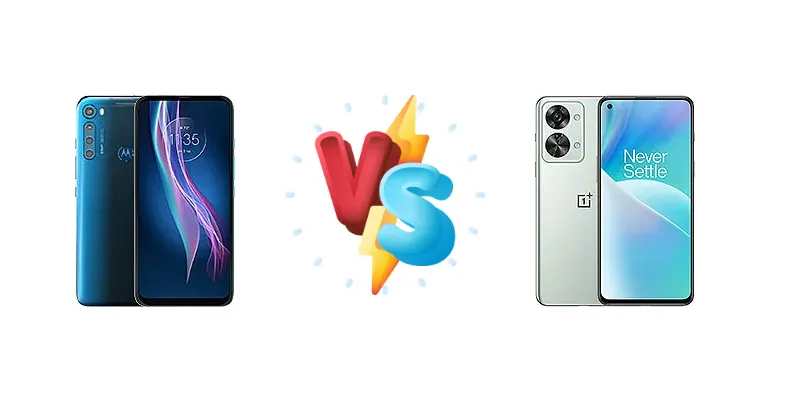
|
🏆 Quick Verdict
For the average user prioritizing speed and convenience, the OnePlus Nord 2T is the better choice. Its Dimensity 1300 chipset and 80W SuperVOOC charging significantly outperform the Fusion+'s Snapdragon 730 and 15W charging. However, users who absolutely need maximum battery life will find the Motorola One Fusion+ superior.
| PHONES | ||
|---|---|---|
| Phone Names | Motorola One Fusion+ | OnePlus Nord 2T |
| Network | ||
|---|---|---|
| 2G bands | GSM 850 / 900 / 1800 / 1900 | GSM 850 / 900 / 1800 / 1900 |
| 3G bands | HSDPA 800 / 850 / 900 / 1900 / 2100 International | HSDPA 800 / 850 / 900 / 1700(AWS) / 1800 / 1900 / 2100 |
| 4G bands | 1, 2, 3, 5, 7, 8, 19, 20, 38, 40, 41 - Europe, India | 1, 2, 3, 4, 5, 7, 8, 12, 17, 18, 19, 20, 26, 28, 32, 34, 38, 39, 40, 41, 66 |
| 5G bands | - | 1, 3, 7, 8, 20, 28, 38, 41, 78 SA/NSA |
| Speed | HSPA 42.2/5.76 Mbps, LTE Cat4 150/50 Mbps | HSPA 42.2/5.76 Mbps, LTE Cat18 1200/150 Mbps, 5G |
| Technology | GSM / HSPA / LTE | GSM / HSPA / LTE / 5G |
| 1, 2, 3, 5, 7, 8, 19, 20, 28, 38, 40, 41 - APEM | - | |
| Launch | ||
|---|---|---|
| Announced | 2020, June 08. Released 2020, June 08 | 2022, May 19 |
| Status | Discontinued | Available. Released 2022, May 21 |
| Body | ||
|---|---|---|
| Build | Glass front, plastic back, plastic frame | Glass front (Gorilla Glass 5), plastic frame |
| Dimensions | 162.9 x 76.4 x 9.6 mm (6.41 x 3.01 x 0.38 in) | 159.1 x 73.2 x 8.2 mm (6.26 x 2.88 x 0.32 in) |
| SIM | · Nano-SIM· Nano-SIM + Nano-SIM | Nano-SIM + Nano-SIM |
| Weight | 210 g (7.41 oz) | 190 g (6.70 oz) |
| Water-repellent coating | - | |
| Display | ||
|---|---|---|
| Protection | - | Corning Gorilla Glass 5 |
| Resolution | 1080 x 2340 pixels, 19.5:9 ratio (~396 ppi density) | 1080 x 2400 pixels, 20:9 ratio (~409 ppi density) |
| Size | 6.5 inches, 103.7 cm2 (~83.3% screen-to-body ratio) | 6.43 inches, 99.8 cm2 (~85.7% screen-to-body ratio) |
| Type | IPS LCD, HDR10 | AMOLED, 90Hz, HDR10+ |
| Platform | ||
|---|---|---|
| CPU | Octa-core (2x2.2 GHz Kryo 470 Gold & 6x1.8 GHz Kryo 470 Silver) | Octa-core (1x3.0 GHz Cortex-A78 & 3x2.6 GHz Cortex-A78 & 4x2.0 GHz Cortex-A55) |
| Chipset | Qualcomm SDM730 Snapdragon 730 (8 nm) - EuropeQualcomm SDM730 Snapdragon 730G (8 nm) - India | Mediatek Dimensity 1300 (6 nm) |
| GPU | Adreno 618 | Mali-G77 MC9 |
| OS | Android 10 | Android 12, upgradable to Android 14, OxygenOS 14 |
| Memory | ||
|---|---|---|
| Card slot | microSDXC (uses shared SIM slot) | No |
| Internal | 128GB 4GB RAM, 128GB 6GB RAM | 128GB 8GB RAM, 256GB 12GB RAM |
| UFS 2.1 | UFS 3.1 | |
| Main Camera | ||
|---|---|---|
| Features | LED flash, panorama, HDR | Dual-LED flash, HDR, panorama |
| Quad | 64 MP, f/1.8, (wide), 1/1.72", 0.8µm, PDAF 8 MP, f/2.2, 118˚ (ultrawide), 1/4.0", 1.12µm 5 MP (macro) Auxiliary lens | - |
| Single | - | 32 MP, f/2.4, (wide), 1/2.8", 0.8µm |
| Triple | - | 50 MP, f/1.9, 24mm (wide), 1/1.56", 1.0µm, PDAF, OIS 8 MP, f/2.2, 120˚ (ultrawide) Auxiliary lens |
| Video | 4K@30fps, 1080p@30/60fps | 4K@30fps, 1080p@30/60/120/480fps, gyro-EIS |
| Selfie camera | ||
|---|---|---|
| Features | - | Auto HDR |
| Single | Motorized pop-up 16 MP, f/2.0, (wide), 1/3.06", 1.0µm | 32 MP, f/2.4, (wide), 1/2.8", 0.8µm |
| Video | 1080p@30fps | 1080p@30fps, gyro-EIS |
| Sound | ||
|---|---|---|
| 3.5mm jack | Yes | No |
| 35mm jack | Yes | No |
| Loudspeaker | Yes | Yes, with stereo speakers |
| Comms | ||
|---|---|---|
| Bluetooth | 5.0, A2DP, LE | 5.2, A2DP, LE, aptX HD |
| NFC | No | Yes |
| Positioning | GPS, GLONASS, GALILEO, BDS | GPS, GLONASS, GALILEO, BDS, NavIC |
| Radio | FM radio (market/region dependent) | No |
| USB | USB Type-C 2.0, OTG | USB Type-C 2.0, OTG |
| WLAN | Wi-Fi 802.11 a/b/g/n/ac, dual-band, Wi-Fi Direct | Wi-Fi 802.11 a/b/g/n/ac/6, dual-band, Wi-Fi Direct |
| Features | ||
|---|---|---|
| Sensors | Fingerprint (rear-mounted), accelerometer, gyro, proximity | Fingerprint (under display, optical), accelerometer, gyro, proximity, compass |
| Battery | ||
|---|---|---|
| Charging | 15W wired | 80W wired, PD |
| Type | Li-Po 5000 mAh | Li-Po 4500 mAh |
| Misc | ||
|---|---|---|
| Colors | Moonlight White, Twilight Blue | Gray Shadow, Jade Fog |
| Models | PAKF0002IN | CPH2399, CPH2401 |
| Price | About 300 EUR | € 144.39 / $ 169.99 / ₹ 31,490 |
| SAR | 0.52 W/kg (head) 1.43 W/kg (body) | - |
| Tests | ||
|---|---|---|
| Battery life | Endurance rating 136h | Endurance rating 100h |
| Camera | Photo / Video | Photo / Video |
| Display | Contrast ratio: 1423:1 (nominal) | Contrast ratio: Infinite (nominal) |
| Loudspeaker | -27.9 LUFS (Good) | -25.6 LUFS (Very good) |
| Performance | AnTuTu: 267980 (v8) GeekBench: 1705 (v5.1) GFXBench: 14fps (ES 3.1 onscreen) | AnTuTu: 490545 (v8) | 604467 (v9) GeekBench: 2790 (v5.1) GFXBench: 40fps (ES 3.1 onscreen) |
Motorola One Fusion+
- Exceptional battery life (136h endurance)
- More affordable price point (likely)
- Decent display quality for the price
- Slow 15W charging
- Older Snapdragon 730 chipset
- Less powerful CPU and GPU
OnePlus Nord 2T
- Fast 80W SuperVOOC charging
- Powerful Mediatek Dimensity 1300 chipset
- Brighter and more vibrant display
- Shorter battery life (100h endurance)
- Potentially higher price
- No expandable storage (likely)
Display Comparison
The OnePlus Nord 2T boasts a higher peak brightness of 636 nits compared to the Motorola One Fusion+'s 562 nits, resulting in better visibility outdoors. While the Fusion+ claims a 1423:1 contrast ratio, the Nord 2T’s ‘Infinite’ contrast ratio (typical of AMOLED panels) likely delivers deeper blacks and a more vibrant image. Both phones lack high refresh rate displays, a notable omission in this price bracket. The Fusion+'s display is adequate, but the Nord 2T offers a more visually appealing experience.
Camera Comparison
Both phones feature capable camera systems, but detailed sensor information is limited. The focus should be on image processing. While both are listed as having Photo/Video capabilities, the Nord 2T’s more powerful ISP (Image Signal Processor) within the Dimensity 1300 chipset likely provides superior image processing, especially in low-light conditions. The Fusion+’s Snapdragon 730 is capable, but the Nord 2T has a clear advantage in computational photography. We can assume the Nord 2T will offer more refined HDR and noise reduction.
Performance
The Mediatek Dimensity 1300 in the Nord 2T, built on a 6nm process, represents a significant leap in performance over the Qualcomm Snapdragon 730 (8nm) found in the Fusion+. The Nord 2T’s CPU configuration – a 1x3.0 GHz Cortex-A78 and 3x2.6 GHz Cortex-A78 – provides substantially more processing power than the Fusion+'s 2x2.2 GHz Kryo 470 Gold & 6x1.8 GHz Kryo 470 Silver. This translates to faster app launches, smoother multitasking, and improved gaming performance. The 6nm node also contributes to better thermal efficiency, potentially reducing throttling during sustained workloads.
Battery Life
The Motorola One Fusion+ shines in battery endurance, achieving a measured 136 hours, significantly outlasting the Nord 2T’s 100 hours. However, this advantage is offset by the Nord 2T’s blazing-fast 80W SuperVOOC charging. The Fusion+ is limited to a slow 15W wired charge, taking considerably longer to reach a full charge. The Nord 2T can go from 0-100% in under 30 minutes, while the Fusion+ will take well over two hours. This difference in charging speed dramatically alters the user experience, making the Nord 2T more convenient despite its smaller battery capacity.
Buying Guide
Buy the Motorola One Fusion+ if you need a phone that can reliably last through two full days of moderate use and aren't concerned with the latest processing speeds. Buy the OnePlus Nord 2T if you prioritize a smoother user experience, faster app loading times, and the ability to quickly top up your battery with its incredibly fast 80W charging – even if it means sacrificing some endurance.