
Motorola One Fusion+ vs Nokia X20: A Detailed Comparison of Mid-Range Challengers
| Phones Images | |||||
|---|---|---|---|---|---|
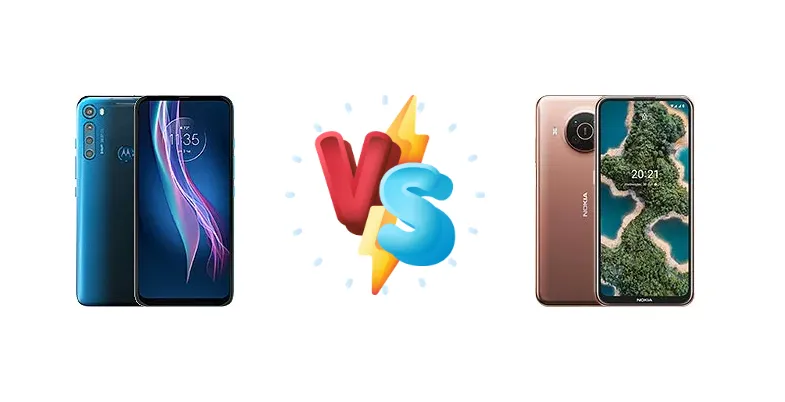
|
🏆 Quick Verdict
For users prioritizing performance and display quality, the Motorola One Fusion+ is the stronger choice. Its Snapdragon 730G offers a noticeable advantage in processing power, and its brighter, higher-contrast display enhances media consumption. However, the Nokia X20’s 5G connectivity and potentially longer software support are compelling for future-proofing.
| PHONES | ||
|---|---|---|
| Phone Names | Motorola One Fusion+ | Nokia X20 |
| Network | ||
|---|---|---|
| 2G bands | GSM 850 / 900 / 1800 / 1900 | GSM 850 / 900 / 1800 / 1900 |
| 3G bands | HSDPA 800 / 850 / 900 / 1900 / 2100 International | HSDPA 850 / 900 / 1700(AWS) / 1900 / 2100 |
| 4G bands | 1, 2, 3, 5, 7, 8, 19, 20, 38, 40, 41 - Europe, India | 1, 2, 3, 4, 5, 7, 8, 12, 20, 28, 66, 38, 39, 40, 41 |
| 5G bands | - | 1, 2, 3, 5, 7, 28, 38, 41, 66, 78 SA/NSA/Sub6 |
| Speed | HSPA 42.2/5.76 Mbps, LTE Cat4 150/50 Mbps | HSPA, LTE, 5G |
| Technology | GSM / HSPA / LTE | GSM / HSPA / LTE / 5G |
| 1, 2, 3, 5, 7, 8, 19, 20, 28, 38, 40, 41 - APEM | - | |
| Launch | ||
|---|---|---|
| Announced | 2020, June 08. Released 2020, June 08 | 2021, April 08 |
| Status | Discontinued | Available. Released 2021, May 12 |
| Body | ||
|---|---|---|
| Build | Glass front, plastic back, plastic frame | - |
| Dimensions | 162.9 x 76.4 x 9.6 mm (6.41 x 3.01 x 0.38 in) | 168.9 x 79.7 x 9.1 mm (6.65 x 3.14 x 0.36 in) |
| SIM | · Nano-SIM· Nano-SIM + Nano-SIM | · Nano-SIM· Nano-SIM + Nano-SIM |
| Weight | 210 g (7.41 oz) | 220 g (7.76 oz) |
| Water-repellent coating | - | |
| Display | ||
|---|---|---|
| Protection | - | Corning Gorilla Glass 5 |
| Resolution | 1080 x 2340 pixels, 19.5:9 ratio (~396 ppi density) | 1080 x 2400 pixels, 20:9 ratio (~395 ppi density) |
| Size | 6.5 inches, 103.7 cm2 (~83.3% screen-to-body ratio) | 6.67 inches, 107.4 cm2 (~79.8% screen-to-body ratio) |
| Type | IPS LCD, HDR10 | IPS LCD, 450 nits (typ) |
| Platform | ||
|---|---|---|
| CPU | Octa-core (2x2.2 GHz Kryo 470 Gold & 6x1.8 GHz Kryo 470 Silver) | Octa-core (2x2.0 GHz Kryo 460 & 6x1.8 GHz Kryo 460) |
| Chipset | Qualcomm SDM730 Snapdragon 730 (8 nm) - EuropeQualcomm SDM730 Snapdragon 730G (8 nm) - India | Qualcomm SM4350 Snapdragon 480 5G (8 nm) |
| GPU | Adreno 618 | Adreno 619 |
| OS | Android 10 | Android 11, upgradable to Android 14 |
| Memory | ||
|---|---|---|
| Card slot | microSDXC (uses shared SIM slot) | microSDXC (uses shared SIM slot) |
| Internal | 128GB 4GB RAM, 128GB 6GB RAM | 128GB 6GB RAM, 128GB 8GB RAM |
| UFS 2.1 | - | |
| Main Camera | ||
|---|---|---|
| Features | LED flash, panorama, HDR | Zeiss optics, LED flash, HDR, panorama |
| Quad | 64 MP, f/1.8, (wide), 1/1.72", 0.8µm, PDAF 8 MP, f/2.2, 118˚ (ultrawide), 1/4.0", 1.12µm 5 MP (macro) Auxiliary lens | 64 MP, (wide), PDAF 5 MP, (ultrawide) 2 MP (macro) Auxiliary lens |
| Single | - | 32 MP, (wide) |
| Video | 4K@30fps, 1080p@30/60fps | 1080p@30/60fps |
| Selfie camera | ||
|---|---|---|
| Single | Motorized pop-up 16 MP, f/2.0, (wide), 1/3.06", 1.0µm | 32 MP, (wide) |
| Video | 1080p@30fps | 1080p@30fps |
| Sound | ||
|---|---|---|
| 3.5mm jack | Yes | Yes |
| 35mm jack | Yes | Yes |
| Loudspeaker | Yes | Yes |
| Comms | ||
|---|---|---|
| Bluetooth | 5.0, A2DP, LE | 5.0, A2DP, LE, aptX HD |
| NFC | No | Yes |
| Positioning | GPS, GLONASS, GALILEO, BDS | GPS, GLONASS, GALILEO |
| Radio | FM radio (market/region dependent) | FM radio |
| USB | USB Type-C 2.0, OTG | USB Type-C 2.0, OTG |
| WLAN | Wi-Fi 802.11 a/b/g/n/ac, dual-band, Wi-Fi Direct | Wi-Fi 802.11 a/b/g/n/ac, dual-band, Wi-Fi Direct |
| Features | ||
|---|---|---|
| Sensors | Fingerprint (rear-mounted), accelerometer, gyro, proximity | Fingerprint (side-mounted), accelerometer, gyro, proximity |
| Battery | ||
|---|---|---|
| Charging | 15W wired | 18W wired |
| Type | Li-Po 5000 mAh | Li-Po 4470 mAh |
| Misc | ||
|---|---|---|
| Colors | Moonlight White, Twilight Blue | Midnight Sun, Nordic Blue |
| Models | PAKF0002IN | TA-1341, TA-1344 |
| Price | About 300 EUR | About 130 EUR |
| SAR | 0.52 W/kg (head) 1.43 W/kg (body) | 1.04 W/kg (head) 0.62 W/kg (body) |
| SAR EU | - | 0.51 W/kg (head) 1.29 W/kg (body) |
| Tests | ||
|---|---|---|
| Battery life | Endurance rating 136h | - |
| Camera | Photo / Video | - |
| Display | Contrast ratio: 1423:1 (nominal) | - |
| Loudspeaker | -27.9 LUFS (Good) | - |
| Performance | AnTuTu: 267980 (v8) GeekBench: 1705 (v5.1) GFXBench: 14fps (ES 3.1 onscreen) | - |
Motorola One Fusion+
- Superior processor performance with Snapdragon 730G
- Brighter and higher contrast display for better viewing
- Excellent battery endurance (136h rating)
- Slower 15W charging
- No 5G connectivity
Nokia X20
- 5G connectivity for future-proof networking
- Faster 18W charging
- Clean Android experience with guaranteed updates
- Less powerful Snapdragon 480 processor
- Likely lower display quality (brightness and contrast)
Display Comparison
The Motorola One Fusion+ boasts a display capable of reaching 562 nits of peak brightness, coupled with a 1423:1 contrast ratio. This translates to a more vivid and readable experience, particularly outdoors. While the Nokia X20’s display specifications are not provided, Nokia typically focuses on color accuracy rather than peak brightness in this segment. The Fusion+'s higher contrast ratio will deliver deeper blacks and a more dynamic image, benefiting video watchers and gamers. The lack of detailed display specs for the X20 suggests a more standard LCD experience.
Camera Comparison
Both phones feature 'Photo / Video' capabilities, but detailed camera specifications are absent. Given the market positioning, it’s likely the Motorola One Fusion+ has a more refined camera system. Motorola often prioritizes image processing and sensor quality in this price range. The Nokia X20 likely focuses on simplicity and reliability. Without sensor size or aperture information, it’s difficult to make a definitive judgment, but the Fusion+'s processor advantage suggests better image processing capabilities, potentially leading to superior low-light performance and dynamic range.
Performance
The core difference lies in the chipsets. The Motorola One Fusion+ utilizes the Qualcomm Snapdragon 730 (or 730G in India), built on an 8nm process, featuring an octa-core CPU with Kryo 470 cores clocked up to 2.2 GHz. This is a significant step up from the Nokia X20’s Snapdragon 480 5G, also 8nm, but with Kryo 460 cores peaking at 2.0 GHz. The 730G’s superior CPU and GPU architecture will result in smoother multitasking, faster app loading times, and better gaming performance. While the X20 offers 5G, the 480 is an entry-level 5G chip, prioritizing connectivity over raw power. The Fusion+ will handle demanding applications with greater ease.
Battery Life
The Motorola One Fusion+ achieves an impressive endurance rating of 136 hours, indicating excellent battery life. It supports 15W wired charging. The Nokia X20 offers 18W wired charging, which is faster, but without knowing its battery capacity, it’s hard to assess its overall endurance. The Fusion+'s higher endurance rating suggests a more efficient combination of battery size and power consumption. While the X20’s faster charging is convenient, the Fusion+’s longer runtime between charges may be more valuable for many users.
Buying Guide
Buy the Motorola One Fusion+ if you need a phone that excels at everyday tasks, streaming video, and light gaming, and value a vibrant display. Buy the Nokia X20 if you prioritize 5G connectivity, a clean Android experience with guaranteed updates, and are willing to trade some processing power for future network compatibility.