
Motorola Fusion+ vs. Motorola Edge 40: A Head-to-Head Showdown
| Phones Images | |||||
|---|---|---|---|---|---|
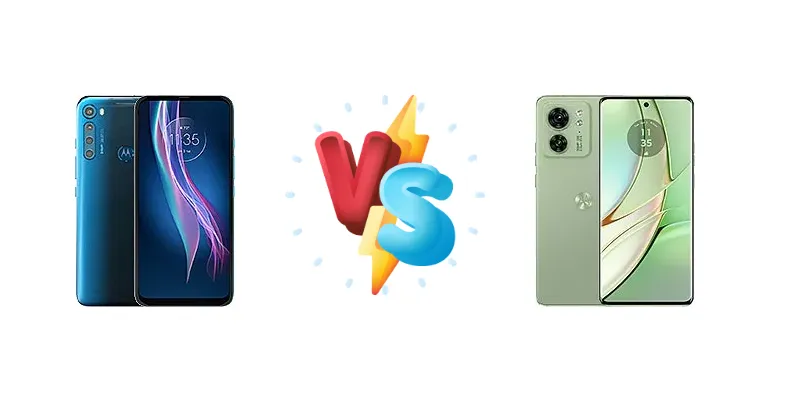
|
🏆 Quick Verdict
The Motorola Edge 40 is the clear winner, offering significantly faster performance, a brighter display, and much quicker charging. While the Fusion+ boasts exceptional battery life, the Edge 40's overall package makes it the more compelling choice for most users.
| PHONES | ||
|---|---|---|
| Phone Names | Motorola One Fusion+ | Motorola Edge 40 |
| Network | ||
|---|---|---|
| 2G bands | GSM 850 / 900 / 1800 / 1900 | GSM 850 / 900 / 1800 / 1900 |
| 3G bands | HSDPA 800 / 850 / 900 / 1900 / 2100 International | HSDPA 850 / 900 / 1700(AWS) / 1900 / 2100 |
| 4G bands | 1, 2, 3, 5, 7, 8, 19, 20, 38, 40, 41 - Europe, India | 1, 2, 3, 4, 5, 7, 8, 12, 13, 17, 20, 26, 28, 32, 38, 39, 40, 41, 42, 43, 66 |
| 5G bands | - | 1, 2, 3, 5, 7, 8, 20, 28, 38, 40, 41, 66, 77, 78 SA/NSA/Sub6 |
| Speed | HSPA 42.2/5.76 Mbps, LTE Cat4 150/50 Mbps | HSPA, LTE, 5G |
| Technology | GSM / HSPA / LTE | GSM / HSPA / LTE / 5G |
| 1, 2, 3, 5, 7, 8, 19, 20, 28, 38, 40, 41 - APEM | - | |
| Launch | ||
|---|---|---|
| Announced | 2020, June 08. Released 2020, June 08 | 2023, May 04 |
| Status | Discontinued | Available. Released 2023, May 04 |
| Body | ||
|---|---|---|
| Build | Glass front, plastic back, plastic frame | Glass front, aluminum frame, plastic back or eco leather back |
| Dimensions | 162.9 x 76.4 x 9.6 mm (6.41 x 3.01 x 0.38 in) | 158.4 x 72 x 7.6 mm (6.24 x 2.83 x 0.30 in) |
| SIM | · Nano-SIM· Nano-SIM + Nano-SIM | · Nano-SIM· Nano-SIM + eSIM· Nano-SIM + Nano-SIM |
| Weight | 210 g (7.41 oz) | 167 g or 171 g (5.89 oz) |
| Water-repellent coating | IP68 dust/water resistant (up to 1.5m for 30 min) | |
| Display | ||
|---|---|---|
| Resolution | 1080 x 2340 pixels, 19.5:9 ratio (~396 ppi density) | 1080 x 2400 pixels, 20:9 ratio (~402 ppi density) |
| Size | 6.5 inches, 103.7 cm2 (~83.3% screen-to-body ratio) | 6.55 inches, 103.6 cm2 (~90.8% screen-to-body ratio) |
| Type | IPS LCD, HDR10 | P-OLED, 144Hz, HDR10+, 1200 nits (peak) |
| Platform | ||
|---|---|---|
| CPU | Octa-core (2x2.2 GHz Kryo 470 Gold & 6x1.8 GHz Kryo 470 Silver) | Octa-core (4x2.6 GHz Cortex-A78 & 4x2.0 GHz Cortex-A55) |
| Chipset | Qualcomm SDM730 Snapdragon 730 (8 nm) - EuropeQualcomm SDM730 Snapdragon 730G (8 nm) - India | Mediatek Dimensity 8020 (6 nm) |
| GPU | Adreno 618 | Mali-G77 MC9 |
| OS | Android 10 | Android 13, up to 2 major Android upgrades |
| Memory | ||
|---|---|---|
| Card slot | microSDXC (uses shared SIM slot) | No |
| Internal | 128GB 4GB RAM, 128GB 6GB RAM | 128GB 8GB RAM, 256GB 8GB RAM |
| UFS 2.1 | UFS 3.1 | |
| Main Camera | ||
|---|---|---|
| Dual | - | 50 MP, f/1.4, (wide), 1/1.55", 1.0µm, multi-directional PDAF, OIS 13 MP, f/2.2, 120˚ (ultrawide), 1/3.0", 1.12µm, AF |
| Features | LED flash, panorama, HDR | Dual-LED flash, HDR, panorama |
| Quad | 64 MP, f/1.8, (wide), 1/1.72", 0.8µm, PDAF 8 MP, f/2.2, 118˚ (ultrawide), 1/4.0", 1.12µm 5 MP (macro) Auxiliary lens | - |
| Video | 4K@30fps, 1080p@30/60fps | 4K@30fps, 1080p@30/60/120fps, 720p@960fps, HDR10, gyro-EIS |
| Selfie camera | ||
|---|---|---|
| Features | - | HDR |
| Single | Motorized pop-up 16 MP, f/2.0, (wide), 1/3.06", 1.0µm | 32 MP, f/2.4, (wide), 1/3.0", 0.7µm |
| Video | 1080p@30fps | 4K@30fps, 1080p@30/120fps |
| Sound | ||
|---|---|---|
| 3.5mm jack | Yes | No |
| 35mm jack | Yes | No |
| Loudspeaker | Yes | Yes, with stereo speakers |
| Comms | ||
|---|---|---|
| Bluetooth | 5.0, A2DP, LE | 5.2, A2DP, LE |
| NFC | No | Yes |
| Positioning | GPS, GLONASS, GALILEO, BDS | GPS, GLONASS, GALILEO, BDS |
| Radio | FM radio (market/region dependent) | No |
| USB | USB Type-C 2.0, OTG | USB Type-C 2.0, OTG |
| WLAN | Wi-Fi 802.11 a/b/g/n/ac, dual-band, Wi-Fi Direct | Wi-Fi 802.11 a/b/g/n/ac/6e, tri-band, Wi-Fi Direct |
| Features | ||
|---|---|---|
| Sensors | Fingerprint (rear-mounted), accelerometer, gyro, proximity | Fingerprint (under display, optical), accelerometer, gyro, proximity, compass |
| - | Moto Ready For support | |
| Battery | ||
|---|---|---|
| Charging | 15W wired | 68W wired 15W wireless |
| Type | Li-Po 5000 mAh | Li-Po 4400 mAh |
| Misc | ||
|---|---|---|
| Colors | Moonlight White, Twilight Blue | Nebula Green, Lunar Blue, Eclipse Black, Viva Magenta |
| Models | PAKF0002IN | XT2303-2 |
| Price | About 300 EUR | € 202.03 / $ 419.99 / £ 199.00 / ₹ 29,999 |
| SAR | 0.52 W/kg (head) 1.43 W/kg (body) | - |
| Tests | ||
|---|---|---|
| Battery life | Endurance rating 136h | Endurance rating 98h |
| Camera | Photo / Video | Photo / Video |
| Display | Contrast ratio: 1423:1 (nominal) | Contrast ratio: Infinite (nominal) |
| Loudspeaker | -27.9 LUFS (Good) | -24.2 LUFS (Very good) |
| Performance | AnTuTu: 267980 (v8) GeekBench: 1705 (v5.1) GFXBench: 14fps (ES 3.1 onscreen) | AnTuTu: 688347 (v9) GeekBench: 3320 (v5.1), 3603 (v6) GFXBench: 33fps (ES 3.1 onscreen) |
Motorola One Fusion+
- Exceptional battery life (136h Endurance)
- Affordable price point
- Decent display contrast
- Slower performance
- Lower brightness display
- Slower charging (15W)
- Older chipset
Motorola Edge 40
- Fast performance (Dimensity 8020)
- Bright and vibrant display (1043 nits)
- Rapid charging (68W wired, 15W wireless)
- Sleek design
- Shorter battery life (98h Endurance)
- Potentially higher price
Display Comparison
The Motorola Edge 40 takes a commanding lead in the display department. Its 1043 nits max brightness blows the Fusion+'s 562 nits out of the water, making it far more usable outdoors. The Edge 40 also boasts an 'infinite' contrast ratio (though nominal), suggesting excellent blacks and vibrant colors, while the Fusion+ has a respectable 1423:1 ratio. Both phones likely use OLED panels, but the Edge 40's superior brightness and potentially better color accuracy give it the edge.
Camera Comparison
While both phones offer 'Photo / Video' capabilities (details are lacking in the provided specs), the Edge 40's newer chipset and likely improved image processing algorithms suggest a better camera experience. Expect better low-light performance, more accurate colors, and potentially more advanced features like improved stabilization. The Fusion+'s camera is likely decent, but not a standout.
Performance
The Edge 40's Mediatek Dimensity 8020 chipset is a significant upgrade over the Fusion+'s Snapdragon 730 (or 730G). The Dimensity 8020 offers noticeably faster processing speeds and better graphics performance, resulting in smoother multitasking, quicker app loading times, and a more responsive overall experience. The Fusion+ is adequate for everyday tasks, but struggles with demanding games or heavy workloads.
Battery Life
The Motorola One Fusion+ shines in this category. Its endurance rating of 136h is exceptional, significantly outperforming the Edge 40's 98h. This translates to significantly longer battery life on a single charge, potentially lasting multiple days for moderate users. However, the Edge 40's 68W wired charging more than compensates for the shorter battery life, allowing for incredibly fast top-ups.
Buying Guide
Who should buy the Motorola One Fusion+? Budget-conscious users prioritizing battery life above all else. Who should buy the Motorola Edge 40? Users seeking a premium experience with a fast processor, vibrant display, and rapid charging capabilities.