
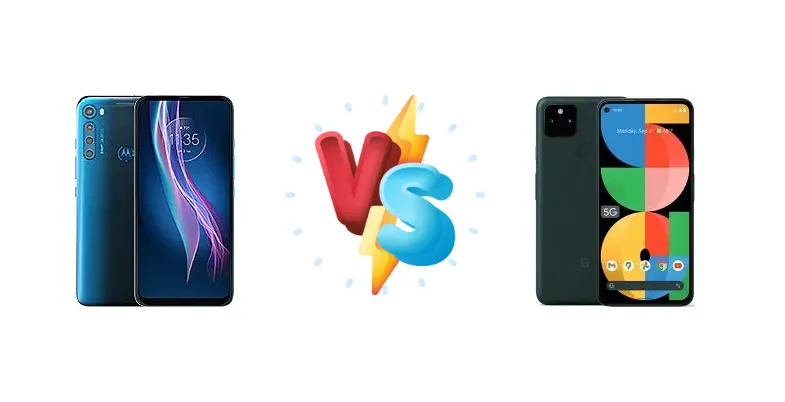
Motorola One Fusion+ vs. Google Pixel 5a 5G: A Deep Dive into Mid-Range 5G Contenders
| Phones Images | |||||
|---|---|---|---|---|---|
|
🏆 Quick Verdict
For the average user prioritizing all-day battery life and a vibrant display, the Motorola One Fusion+ emerges as the winner. Its significantly longer endurance rating (136h vs 122h) and higher contrast ratio (1423:1) provide a tangible advantage. However, the Pixel 5a 5G’s superior chipset and camera software make it a strong contender for photography enthusiasts.
| PHONES | ||
|---|---|---|
| Phone Names | Motorola One Fusion+ | Google Pixel 5a 5G |
| Network | ||
|---|---|---|
| 2G bands | GSM 850 / 900 / 1800 / 1900 | GSM 850 / 900 / 1800 / 1900 |
| 3G bands | HSDPA 800 / 850 / 900 / 1900 / 2100 International | HSDPA 850 / 900 / 1700(AWS) / 1900 / 2100 |
| 4G bands | 1, 2, 3, 5, 7, 8, 19, 20, 38, 40, 41 - Europe, India | 1, 2, 3, 4, 5, 7, 8, 12, 13, 14, 17, 18, 19, 20, 25, 26, 28, 29, 30, 32, 38, 39, 40, 41, 42, 46, 48, 66, 71 |
| 5G bands | - | 1, 2, 5, 12, 25, 28, 41, 66, 71, 77, 78 SA/NSA/Sub6 |
| Speed | HSPA 42.2/5.76 Mbps, LTE Cat4 150/50 Mbps | HSPA, LTE, 5G |
| Technology | GSM / HSPA / LTE | GSM / HSPA / EVDO / LTE / 5G |
| 1, 2, 3, 5, 7, 8, 19, 20, 28, 38, 40, 41 - APEM | CDMA2000 1xEV-DO | |
| Launch | ||
|---|---|---|
| Announced | 2020, June 08. Released 2020, June 08 | 2021, August 17 |
| Status | Discontinued | Available. Released 2021, August 26 |
| Body | ||
|---|---|---|
| Build | Glass front, plastic back, plastic frame | Glass front (Gorilla Glass 3), aluminum frame, aluminum back |
| Dimensions | 162.9 x 76.4 x 9.6 mm (6.41 x 3.01 x 0.38 in) | 156.2 x 73.2 x 8.8 mm (6.15 x 2.88 x 0.35 in) |
| SIM | · Nano-SIM· Nano-SIM + Nano-SIM | Nano-SIM + eSIM |
| Weight | 210 g (7.41 oz) | 183 g (6.46 oz) |
| Water-repellent coating | IP67 dust/water resistant (up to 1m for 30 min) | |
| Display | ||
|---|---|---|
| Protection | - | Corning Gorilla Glass 3 |
| Resolution | 1080 x 2340 pixels, 19.5:9 ratio (~396 ppi density) | 1080 x 2400 pixels, 20:9 ratio (~415 ppi density) |
| Size | 6.5 inches, 103.7 cm2 (~83.3% screen-to-body ratio) | 6.34 inches, 97.0 cm2 (~84.9% screen-to-body ratio) |
| Type | IPS LCD, HDR10 | OLED, HDR |
| - | Always-on display | |
| Platform | ||
|---|---|---|
| CPU | Octa-core (2x2.2 GHz Kryo 470 Gold & 6x1.8 GHz Kryo 470 Silver) | Octa-core (1x2.4 GHz Kryo 475 Prime & 1x2.2 GHz Kryo 475 Gold & 6x1.8 GHz Kryo 475 Silver) |
| Chipset | Qualcomm SDM730 Snapdragon 730 (8 nm) - EuropeQualcomm SDM730 Snapdragon 730G (8 nm) - India | Qualcomm SM7250 Snapdragon 765G 5G (7 nm) |
| GPU | Adreno 618 | Adreno 620 |
| OS | Android 10 | Android 11, upgradable to Android 14 |
| Memory | ||
|---|---|---|
| Card slot | microSDXC (uses shared SIM slot) | No |
| Internal | 128GB 4GB RAM, 128GB 6GB RAM | 128GB 6GB RAM |
| UFS 2.1 | - | |
| Main Camera | ||
|---|---|---|
| Dual | - | 12.2 MP, f/1.7, 27mm, (wide), 1/2.55", 1.4µm, dual pixel PDAF, OIS 16 MP, f/2.2, 119˚ (ultrawide), 1.0µm |
| Features | LED flash, panorama, HDR | LED flash, Pixel Shift, Auto-HDR, panorama |
| Quad | 64 MP, f/1.8, (wide), 1/1.72", 0.8µm, PDAF 8 MP, f/2.2, 118˚ (ultrawide), 1/4.0", 1.12µm 5 MP (macro) Auxiliary lens | - |
| Single | - | 8 MP, f/2.0, 24mm (wide), 1.12µm |
| Video | 4K@30fps, 1080p@30/60fps | 4K@30/60fps, 1080p@30/60/120/240fps; gyro-EIS |
| Selfie camera | ||
|---|---|---|
| Features | - | HDR |
| Single | Motorized pop-up 16 MP, f/2.0, (wide), 1/3.06", 1.0µm | 8 MP, f/2.0, 24mm (wide), 1.12µm |
| Video | 1080p@30fps | 1080p@30fps |
| Sound | ||
|---|---|---|
| 3.5mm jack | Yes | Yes |
| 35mm jack | Yes | Yes |
| Loudspeaker | Yes | Yes, with stereo speakers |
| Comms | ||
|---|---|---|
| Bluetooth | 5.0, A2DP, LE | 5.0, A2DP, LE, aptX HD |
| NFC | No | Yes |
| Positioning | GPS, GLONASS, GALILEO, BDS | GPS, GLONASS, GALILEO, QZSS, BDS |
| Radio | FM radio (market/region dependent) | No |
| USB | USB Type-C 2.0, OTG | USB Type-C 3.1 |
| WLAN | Wi-Fi 802.11 a/b/g/n/ac, dual-band, Wi-Fi Direct | Wi-Fi 802.11 a/b/g/n/ac, dual-band, Wi-Fi Direct |
| Features | ||
|---|---|---|
| Sensors | Fingerprint (rear-mounted), accelerometer, gyro, proximity | Fingerprint (rear-mounted), accelerometer, gyro, proximity, compass, barometer |
| Battery | ||
|---|---|---|
| Charging | 15W wired | 18W wired, PD2.0 |
| Type | Li-Po 5000 mAh | Li-Po 4680 mAh |
| Misc | ||
|---|---|---|
| Colors | Moonlight White, Twilight Blue | Mostly Black |
| Models | PAKF0002IN | G1F8F, G4S1M |
| Price | About 300 EUR | $ 189.00 / C$ 249.99 |
| SAR | 0.52 W/kg (head) 1.43 W/kg (body) | - |
| Tests | ||
|---|---|---|
| Battery life | Endurance rating 136h | Endurance rating 122h |
| Camera | Photo / Video | - |
| Display | Contrast ratio: 1423:1 (nominal) | Contrast ratio: Infinite (nominal) |
| Loudspeaker | -27.9 LUFS (Good) | - |
| Performance | AnTuTu: 267980 (v8) GeekBench: 1705 (v5.1) GFXBench: 14fps (ES 3.1 onscreen) | AnTuTu: 291303 (v8) GeekBench: 1337 (v5.1) GFXBench: 19fps (ES 3.1 onscreen) |
Motorola One Fusion+
- Exceptional battery life (136h endurance)
- High contrast display (1423:1 ratio)
- Generally more affordable price point
- Less powerful chipset compared to the Pixel 5a 5G
- Camera performance lags behind the Pixel 5a 5G
Google Pixel 5a 5G
- Superior chipset (Snapdragon 765G)
- Excellent camera software and image processing
- Brighter display for outdoor visibility
- Shorter battery life (122h endurance)
- Higher price compared to the Motorola One Fusion+
Display Comparison
The Pixel 5a 5G boasts a significantly brighter display, reaching 861 nits compared to the Fusion+'s 562 nits. This translates to superior visibility in direct sunlight. However, the Fusion+ counters with a 1423:1 contrast ratio, offering deeper blacks and a more immersive viewing experience, especially for video content. While the Pixel 5a 5G is listed with an 'Infinite' contrast ratio, this is typical marketing language and doesn't necessarily indicate superior black levels. Both displays lack high refresh rates, focusing instead on power efficiency.
Camera Comparison
While both phones offer capable camera systems, the Pixel 5a 5G leverages Google’s renowned computational photography algorithms. Although sensor sizes aren't specified, the Pixel’s image processing excels in dynamic range and low-light performance. The Fusion+ offers a standard photo/video experience, but lacks the Pixel’s software optimizations. The absence of detailed camera specs for both devices makes a direct comparison difficult, but the Pixel’s reputation for camera quality gives it a significant advantage. We can assume both phones will have similar quality 2MP macro/depth sensors, which are often of limited practical use.
Performance
The Google Pixel 5a 5G’s Snapdragon 765G (7nm) holds a clear architectural advantage over the Motorola One Fusion+’s Snapdragon 730 (8nm). The 7nm process allows for greater transistor density and improved power efficiency. The Pixel 5a 5G’s CPU configuration, featuring a Kryo 475 Prime core, further enhances single-core performance, crucial for responsive app launching and general navigation. While both phones utilize 6x1.8 GHz Kryo cores, the 765G’s overall architecture provides a noticeable performance edge, particularly in graphically demanding tasks. The Fusion+ has a variant with the 730G, which offers a slight performance boost over the standard 730.
Battery Life
The Motorola One Fusion+’s endurance rating of 136 hours significantly surpasses the Pixel 5a 5G’s 122 hours. This difference is primarily attributable to the Fusion+'s more efficient chipset and display. While the Pixel 5a 5G supports 18W charging with PD2.0, offering faster charging speeds, the Fusion+’s 15W charging is adequate given its larger battery life buffer. The Pixel’s faster charging is beneficial for quick top-ups, but the Fusion+ will likely last longer between charges in real-world usage.
Buying Guide
Buy the Motorola One Fusion+ if you need exceptional battery life for extended use, value a high-contrast display for media consumption, and are comfortable with a more generalized camera experience. Buy the Google Pixel 5a 5G if you prioritize camera quality and Google’s computational photography prowess, demand a brighter screen for outdoor visibility, and appreciate faster charging speeds with PD2.0 support.