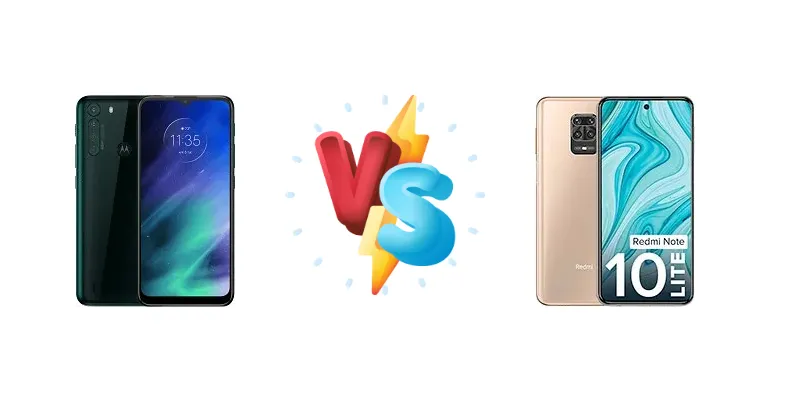
Both the Motorola One Fusion and the Xiaomi Redmi Note 10 Lite target the competitive mid-range smartphone market, but they approach it with different chipsets and charging solutions. This comparison dissects the key differences between the Snapdragon 710-powered Motorola and the Snapdragon 720G-equipped Xiaomi, helping you determine which device delivers the best value for your needs.
🏆 Quick Verdict
For the average user, the Xiaomi Redmi Note 10 Lite is the stronger choice. Its Snapdragon 720G offers a noticeable performance uplift over the Motorola One Fusion’s Snapdragon 710, and the 18W charging significantly reduces downtime. While the Motorola offers a respectable experience, the Xiaomi provides a more future-proof and responsive user experience.
| Network |
|---|
| 2G bands | GSM 850 / 900 / 1800 / 1900 | GSM 850 / 900 / 1800 / 1900 |
| 3G bands | HSDPA 850 / 900 / 1700(AWS) / 1900 / 2100 | HSDPA 850 / 900 / 1700(AWS) / 1900 / 2100 |
| 4G bands | 1, 2, 3, 4, 5, 7, 8, 19, 28, 66 | 1, 2, 3, 4, 5, 7, 8, 20, 28, 38, 40, 41 |
| Speed | HSPA 42.2/5.76 Mbps, LTE Cat4 150/50 Mbps | HSPA, LTE |
| Technology | GSM / HSPA / LTE | GSM / HSPA / LTE |
| Launch |
|---|
| Announced | 2020, July 02. Released 2020, July 02 | 2021, October 01 |
| Status | Discontinued | Available. Released 2021, October 02 |
| Body |
|---|
| Build | Glass front, plastic back, plastic frame | Glass front (Gorilla Glass 5), glass back (Gorilla Glass 5), plastic frame |
| Dimensions | 165 x 75.9 x 9.4 mm (6.50 x 2.99 x 0.37 in) | 165.8 x 76.7 x 8.8 mm (6.53 x 3.02 x 0.35 in) |
| SIM | · Nano-SIM· Nano-SIM + Nano-SIM | Nano-SIM + Nano-SIM |
| Weight | 202 g (7.13 oz) | 209 g (7.37 oz) |
| | Water-repellent coating | Water-repellent coating |
| Display |
|---|
| Protection | - | Corning Gorilla Glass 5 |
| Resolution | 720 x 1600 pixels, 20:9 ratio (~270 ppi density) | 1080 x 2400 pixels, 20:9 ratio (~395 ppi density) |
| Size | 6.5 inches, 102.0 cm2 (~81.5% screen-to-body ratio) | 6.67 inches, 107.4 cm2 (~84.5% screen-to-body ratio) |
| Type | IPS LCD | IPS LCD |
| Platform |
|---|
| CPU | Octa-core (2x2.2 GHz 360 Gold & 6x1.7 GHz Kryo 360 Silver) | Octa-core (2x2.3 GHz Kryo 465 Gold & 6x1.8 GHz Kryo 465 Silver) |
| Chipset | Qualcomm SDM710 Snapdragon 710 (10 nm) | Qualcomm SM7125 Snapdragon 720G (8 nm) |
| GPU | Adreno 616 | Adreno 618 |
| OS | Android 10 | Android 10, MIUI 11 |
| Memory |
|---|
| Card slot | microSDXC (uses shared SIM slot) | microSDXC (dedicated slot) |
| Internal | 64GB 4GB RAM, 128GB 4GB RAM | 64GB 4GB RAM, 64GB 6GB RAM, 128GB 4GB RAM, 128GB 6GB RAM |
| Main Camera |
|---|
| Features | LED flash, panorama, HDR | LED flash, HDR, panorama |
| Quad | 48 MP, f/1.7, (wide), 1/2.0", 0.8µm, PDAF
8 MP, f/2.2, 118˚ (ultrawide), 1/4.0", 1.12µm
5 MP (macro)
Auxiliary lens | 48 MP, f/1.9, 26mm (wide), 0.8µm, PDAF
8 MP, f/2.2, 119˚ (ultrawide), 1/4.0", 1.12µm
5 MP (macro), AF
Auxiliary lens |
| Single | - | 16 MP, f/2.5, (wide), 1/3.06", 1.0µm |
| Video | 4K@30fps, 1080p@30fps | 4K@30fps, 1080p@30/60/120fps, 720p@960fps, gyro-EIS |
| Selfie camera |
|---|
| Features | - | HDR, panorama |
| Single | 8 MP, f/2.0 | 16 MP, f/2.5, (wide), 1/3.06", 1.0µm |
| Video | 1080p@30fps | 1080p@30fps |
| Sound |
|---|
| 3.5mm jack | Yes | Yes |
| 35mm jack | Yes | Yes |
| Loudspeaker | Yes | Yes |
| Comms |
|---|
| Bluetooth | 5.0, A2DP, LE | 5.0, A2DP, LE |
| Infrared port | - | Yes |
| NFC | No | Yes |
| Positioning | GPS, GLONASS, GALILEO, BDS | GPS, GLONASS, GALILEO, BDS, NavIC |
| Radio | FM radio (market/region dependent) | FM radio, recording |
| USB | USB Type-C 2.0, OTG | USB Type-C 2.0 |
| WLAN | Wi-Fi 802.11 b/g/n | Wi-Fi 802.11 a/b/g/n/ac, dual-band, Wi-Fi Direct |
| Features |
|---|
| Sensors | Fingerprint (rear-mounted), accelerometer, gyro, proximity | Fingerprint (side-mounted), accelerometer, gyro, proximity, compass |
| Battery |
|---|
| Charging | 10W wired | 18W wired |
| Type | Li-Po 5000 mAh | Li-Po 5020 mAh |
| Misc |
|---|
| Colors | Emerald Green, Deep Sapphire Blue | Aurora Blue, Glacier White, Interstellar Black, Champagne Gold |
| Models | XT2073-2 | M2002F4LG |
| Price | About 100 EUR | About 200 EUR |
| SAR | - | 1.17 W/kg (head) 0.86 W/kg (body) |
| SAR EU | - | 1.01 W/kg (head) 1.39 W/kg (body) |
Motorola One Fusion
- Potentially cleaner software experience (Motorola's near-stock Android)
- May be available at a lower price point
- Reliable Snapdragon 710 performance for basic tasks
- Slower Snapdragon 710 chipset
- Significantly slower 10W charging
- Older processor architecture
Xiaomi Redmi Note 10 Lite
- Faster Snapdragon 720G chipset for improved performance
- Faster 18W wired charging
- More efficient 8nm process
- MIUI software can be resource-intensive and include bloatware
- May be slightly more expensive than the Motorola
Display Comparison
Neither device boasts a particularly standout display. While specific panel details (like peak brightness or color gamut coverage) are unavailable, the focus here is on the underlying processing power impacting UI smoothness. The difference in display quality is likely minimal, making the chipset the more significant factor for overall user experience.
Camera Comparison
Without detailed camera sensor information, a direct comparison is limited. However, the Snapdragon 720G’s image signal processor (ISP) is more advanced than the 710’s, offering improved image processing capabilities. This could result in better dynamic range, noise reduction, and overall image quality on the Redmi Note 10 Lite, even with similar sensor hardware. The presence of a more modern ISP is a key advantage, even if the megapixel counts are identical.
Performance
The Xiaomi Redmi Note 10 Lite’s Snapdragon 720G (8nm) represents a clear generational improvement over the Motorola One Fusion’s Snapdragon 710 (10nm). The 720G’s newer Kryo 465 cores, clocked at 2.3 GHz, offer a performance advantage over the 710’s 2.2 GHz Kryo 360 Gold cores. The 8nm process also contributes to better thermal efficiency, potentially reducing throttling during sustained workloads like gaming. This translates to smoother multitasking and a more responsive experience on the Redmi Note 10 Lite, particularly for users who frequently engage in demanding applications.
Battery Life
While battery capacity isn't specified, the Redmi Note 10 Lite’s 18W wired charging is a significant advantage over the Motorola One Fusion’s 10W charging. This faster charging speed drastically reduces the time required to replenish the battery, making the Redmi Note 10 Lite more convenient for users who are frequently on the go. Even if the Motorola has a slightly larger battery, the Redmi’s faster charging will likely result in less perceived downtime.
Buying Guide
Buy the Motorola One Fusion if you prioritize a clean software experience and are on a very tight budget, accepting a slightly slower processor and slower charging. Buy the Xiaomi Redmi Note 10 Lite if you value performance for gaming and multitasking, and appreciate faster charging speeds, even if it means dealing with Xiaomi’s MIUI software.
Frequently Asked Questions
❓ Will the Snapdragon 720G in the Redmi Note 10 Lite handle demanding games like PUBG Mobile smoothly?
Yes, the Snapdragon 720G is capable of running PUBG Mobile at medium to high settings with stable frame rates. The improved GPU and thermal efficiency compared to the Snapdragon 710 in the Motorola One Fusion contribute to a smoother gaming experience.
❓ How much faster is the 18W charging on the Redmi Note 10 Lite compared to the 10W charging on the Motorola One Fusion?
The 18W charging on the Redmi Note 10 Lite will significantly reduce charging times. While exact 0-100% times depend on battery capacity, expect the Redmi Note 10 Lite to charge considerably faster – potentially cutting charging time by 40-60% compared to the Motorola One Fusion.
❓ Does the Xiaomi Redmi Note 10 Lite's MIUI software significantly impact performance?
MIUI can be more resource-intensive than Motorola's near-stock Android. While the Snapdragon 720G has enough power to handle MIUI, users may notice slightly slower animations or more background app activity compared to the Motorola One Fusion. However, MIUI also offers extensive customization options.